Every September, thousands of Year 6 pupils across England sit the 11+ entrance exam for grammar schools. For the tutors preparing them, the real work compresses into one high-pressure window: roughly 90 days from June mock season to exam day. A clear 11+ preparation timeline is what separates tutors who finish that window energised, with score improvements to show, from tutors who spend it firefighting reschedules and anxious late-night messages.
This playbook gives you both halves of the job: a week-by-week plan you can hand to families, and five concrete workflows that keep lessons, mocks and parent updates organised while you teach.
Why the final 90 days decide the 11+
Families often ask when 11+ revision should start, and the honest answer has two parts. Foundations in vocabulary, arithmetic and reading stamina are built over 9 to 12 months. But the score a child posts in September is disproportionately shaped by the final three months, because that is when exam-specific skills mature: working at pace, decoding unfamiliar question types, and managing nerves in timed conditions.
That is also why the biggest score jumps tutors see tend to happen between the first mock and the real exam. A child who knows the content but has never practised under time pressure routinely gains meaningful marks simply from technique and familiarity.
Two practical anchors for your planning:
- Know which test your target schools use. GL Assessment sets the papers in most grammar school areas, while some regions and independent schools use their own or CEM-style tests. The question formats differ enough that practice materials must match, so confirm the board for each child's target schools before you build their plan, and check when that board's familiarisation materials are released.
- Set realistic targets now, not in August. Use the first mock as a baseline, compare it against what the target schools typically require, and agree the goal with parents in June. A target set early is a shared plan; a target set in August is a panic.
The 90-day timeline you can copy
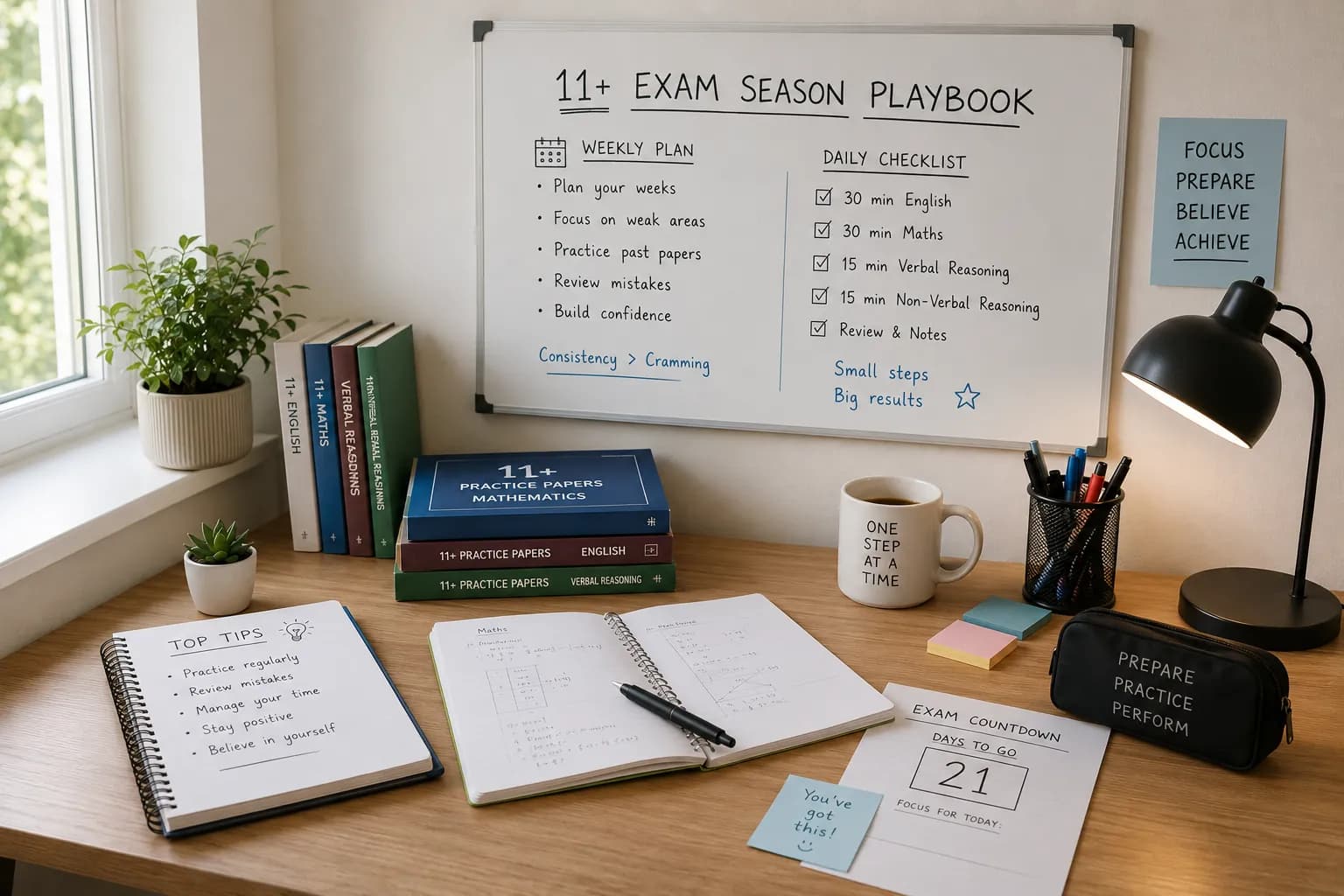
Here is a week-by-week 11+ study schedule you can adapt per student. It assumes an early September exam; shift the weeks to match your region's date. Copy it into a spreadsheet, or set it up once as recurring sessions so the whole revision timetable runs itself. For the student's own day-by-day plan at home, our free revision timetable maker spreads verbal reasoning, non-verbal reasoning, maths and English over the evenings up to the exam date.
| Weeks | Focus | Milestone |
|---|---|---|
| 1-2 (mid-June) | Baseline diagnostics across VR, NVR, Maths, English | Mock 1 plus a target-setting call with parents |
| 3-4 (late June) | Verbal reasoning technique and a daily vocabulary routine | Weekly timed sections begin |
| 5-6 (July) | Maths accuracy and speed; English comprehension method | Homework packs for between sessions |
| 7 (late July) | Buffer week: consolidation, lighter load, family holidays | Catch-up slots for missed lessons |
| 8 (mid-August) | Full mock under exam conditions, then detailed review | Mock 2 plus updated targets |
| 9-10 (late August) | Attack the weakest areas from Mock 2; NVR patterns; writing where required | Second parent progress call |
| 11 (early September) | Final rehearsal, then taper: shorter sessions, familiar material | Mock 3 |
| 12 (exam week) | Confidence and logistics only, no new content | Exam day |
Notice what the timeline protects: a buffer week for illness and holidays, three mocks spaced to produce useful data, and a taper at the end. A child who walks in rested outperforms a child who crammed until the night before.
To turn this into a per-student plan you can hand to parents, our free entrance exam lesson planner builds the final intensive block for you: pick the exam, the session rhythm and the papers it tests, and download a dated week-by-week plan as a PDF or Word file.
The next five workflows are how you run this plan for ten or twenty students at once without the admin swallowing your summer.
Workflow 1: fill your mock exam calendar without a message thread
Running 11+ mock exams is the highest-value group activity of the season, and the booking admin is usually the worst part. The fix is to stop being the booking system. Use Teamlilit's public booking page to list your mock exam sessions: open three Saturday slots, cap each at 12 students, and attach your cancellation policy, then let parents claim seats themselves. Our guide on how to let students self-book lessons walks through the setup.
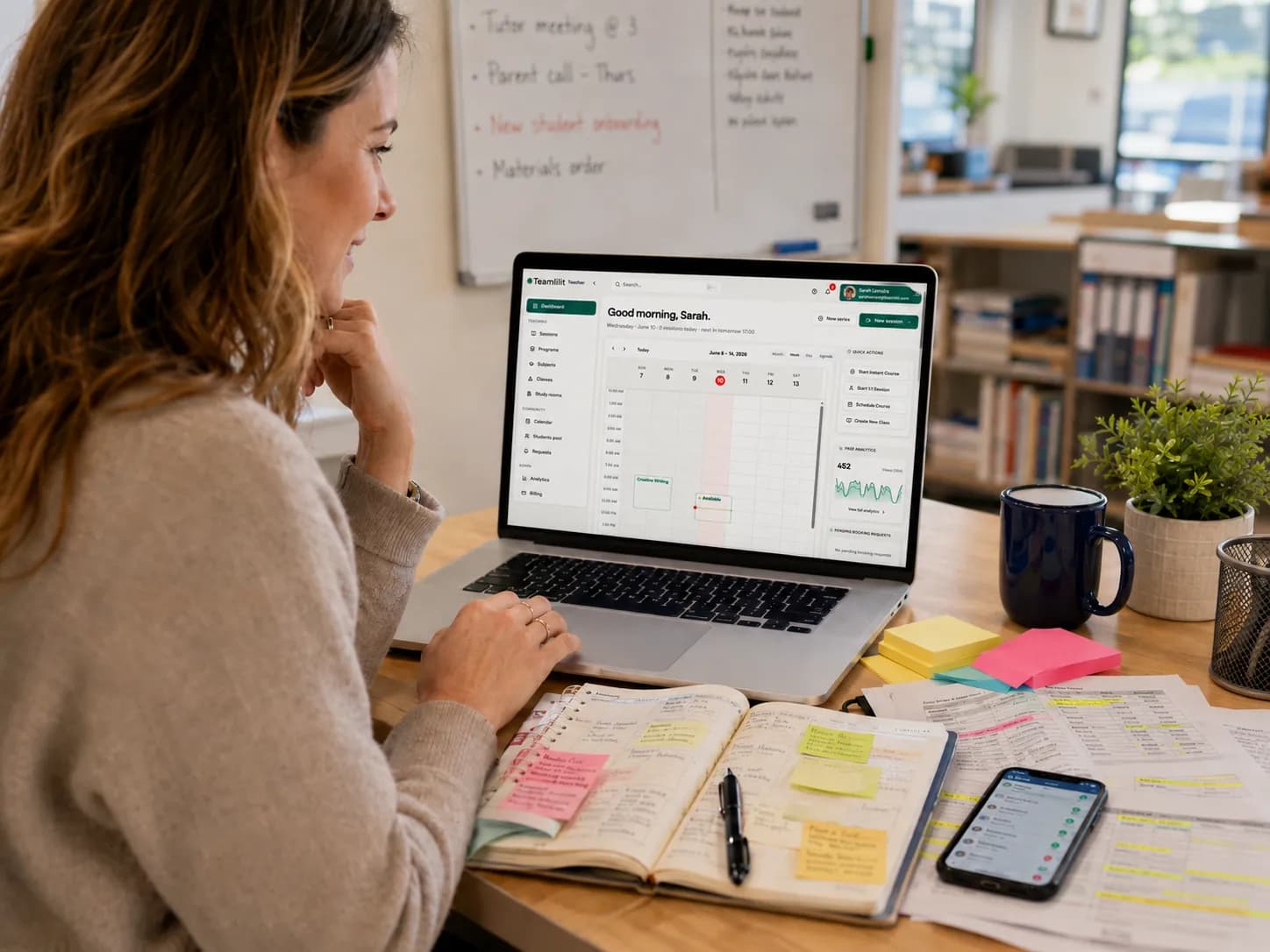
Link your Google Calendar once, and any new booking appears on it instantly, so the availability parents see is always real. Mock Saturdays fill themselves while you plan the papers.
Workflow 2: turn lesson notes into parent updates in two minutes
During 11+ season, parent communication is half the job. The parents paying for a compressed, high-stakes push want to know what happened in every session, and writing each family a thoughtful email by hand is unsustainable at fifteen students.
Keep brief bullet notes during the lesson, using a structure like our free lesson notes template so nothing gets forgotten. Then turn the raw bullets into a polished, parent-ready summary with the built-in AI summariser: Teamlilit's AI lesson summaries draft the recap from your notes, you edit for tone, and the update goes out while the lesson is still fresh. Tag any student who needs follow-up homework so the next session starts from the right place.
Workflow 3: track topic mastery, not just hours
"Ten lessons completed" tells a parent nothing. "Verbal reasoning speed up, non-verbal accuracy still shaky" tells them exactly what next week is for. That level of 11+ progress tracking needs per-topic records, not a lesson counter.
Create student tags for the skills that decide this exam: VR speed, NVR accuracy, Maths word problems, comprehension stamina. Record mock and homework scores in each student's notes, and review the tags across your roster when planning the week, so the students who share a weakness can share a targeted session. Teamlilit's student management features keep tags, records and lesson history on one profile per child, which also gives you something concrete to open the parent meeting with. The same skill-tag habit carries over to any deadline-driven exam; if you also teach older students, our guide on systemising IELTS and Cambridge exam prep applies it to language and IGCSE candidates.
Workflow 4: run a summer intensive without burning out
The six-week holiday is where 11+ tutors earn most and burn out fastest. Two scheduling decisions protect you. First, block your own holiday weeks in your availability before families book the summer solid; you can create a tutoring timetable for the intensive period once and let recurring sessions carry it. Second, keep the money side automatic: attendance is recorded per session, so you can draft invoices from recorded attendance in two clicks, review them, and send. If an invoice goes unpaid during the busy weeks, late-fee rules add the surcharge the moment it crosses its due date, so cashflow stays healthy without you chasing anyone mid-season.
Workflow 5: calm anxious parents with a pre-written FAQ
Most panic messages ask the same five questions, so answer them once. Send every 11+ family a short welcome pack when the summer block starts: the timeline above, your mock dates, how updates work, what happens if a lesson is missed, and how to book a call. Offer fortnightly progress calls through booking requests rather than "whenever", and point to your cancellation policy so last-minute panic reschedules have a clear, fair cost. Parents are calmer when the process is visible, and calm parents make better decisions in September.
Talking to parents about realistic school choices
Some of the most valuable minutes you spend this season are not about verbal reasoning. Qualifying scores differ by school and by year: most 11+ results are standardised around a mean of 100, and the score that secures a place at one grammar school may miss at a heavily oversubscribed one. Rather than quoting a number from memory, sign-post parents to the official sources: each school's admissions page and the local authority's admissions guidance publish how places were allocated in previous years.
The reframe that helps most families: the 11+ is not a pass-fail verdict on their child, it is a fit question. A child who would scrape into a hyper-selective school may thrive at a school where they arrive confident. Saying this in July, backed by mock data, spares everyone a much harder conversation in October.
How Teamlilit keeps your 11+ season organised
Everything in this playbook runs on one system rather than five apps. In Teamlilit, the same calendar holds lessons, mock Saturdays and parent calls; tutor scheduling software with recurring sessions carries the 90-day plan, and the public booking page fills the gaps. AI lesson summaries are included on paid plans at no extra cost, attendance feeds your invoices, and credit notes make mid-season schedule tweaks painless on the billing side. You set the season up once, in June, and spend September teaching.
Final checklist: 7 things to complete before exam day
- Final mock reviewed with the student: last errors understood, not just marked.
- Technique cheat-sheet written in the child's own words: timing per section, what to do when stuck.
- Stationery pack ready two days early: pencils, eraser, sharpener, water bottle, watch if permitted.
- Sleep schedule shifted the week before, so exam-day wake-up time is already normal.
- Transport dry-run done: the family has travelled the route and knows the entrance.
- Parent pep-talk script sent: what to say the night before, and what not to ask on the way home.
- Post-exam plan agreed: something fun booked for the afternoon, whatever happens.
Frequently asked questions
When should I start 11+ preparation?
Most tutors start formal preparation 9 to 12 months before the exam, but the final 90 days matter most: that is when exam-specific technique, timed practice and well-placed mock exams produce the biggest score movements.
How many mock exams should a student sit?
Three well-timed mocks give enough data without causing burnout: one in early summer to set a baseline, one in mid-August to measure progress, and one in early September as a final rehearsal under full exam conditions.
How do I deal with parents who want daily lessons?
Explain diminishing returns, show them your structured 90-day timeline, and offer self-study packs for the days between sessions. A written cancellation policy protects your calendar from panic-driven changes in the final weeks.
Can I use Teamlilit for 11+ group sessions?
Yes. Set the session up as a group class, define its capacity, and parents book the remaining seats themselves through your public booking page.
The short version
The 11+ season rewards tutors who treat it as a project: a 90-day timeline set in June, three well-placed mocks, per-topic tracking, and parent communication that runs on rails. Put the structure in place before the rush, and the most stressful window in the tutoring year becomes your most profitable and most repeatable one.
Ready before results day? Start your free Teamlilit trial and have your 11+ calendar, notes and invoices set up this week. No credit card required.