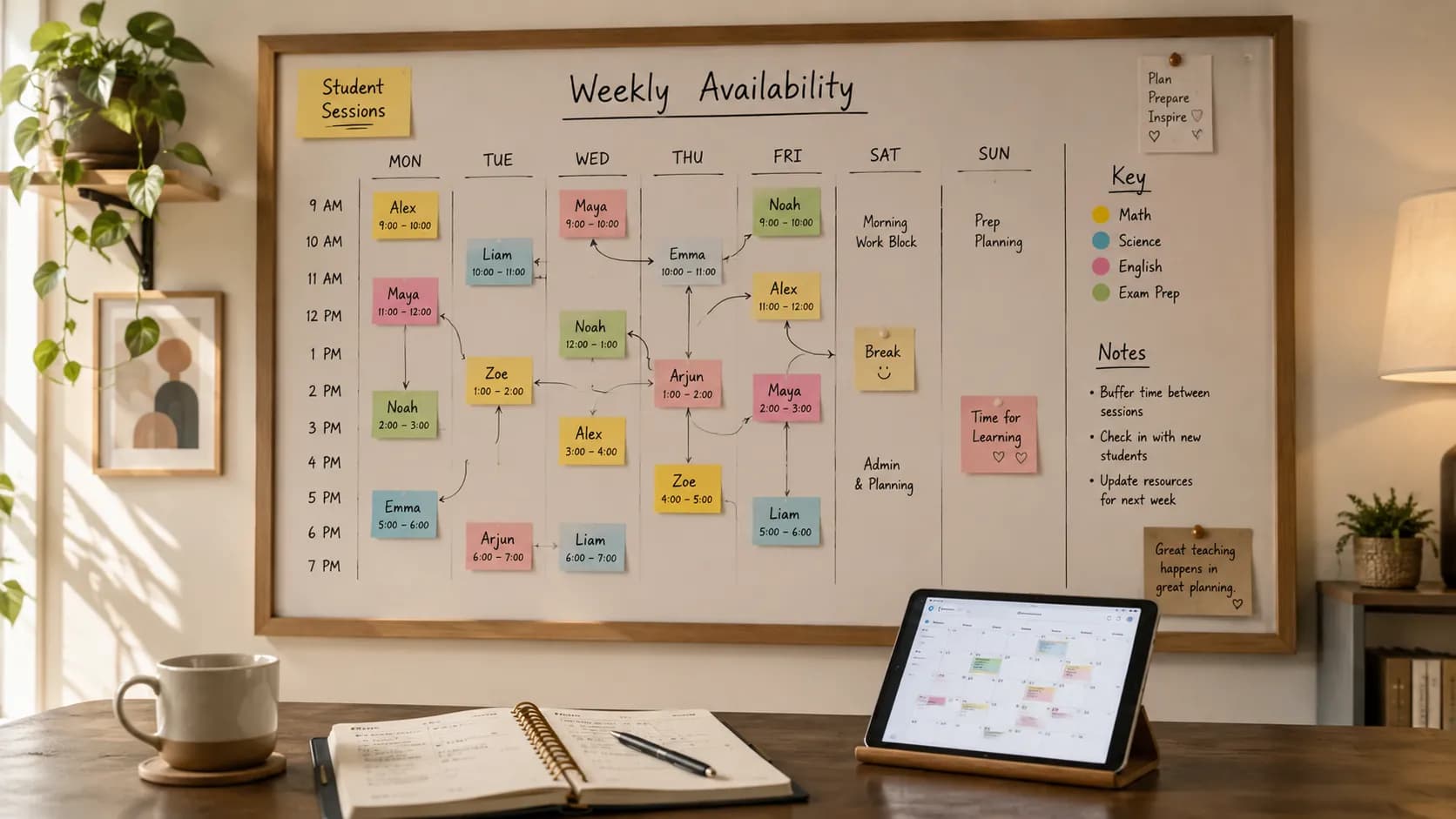
In early July 2026, a reading interventionist in northern New Jersey posted on Reddit advertising K-8 tutoring and urged parents to book before the new school year. The thread turned into a debate about timing: how quickly the good slots fill once the calendar is out, and how much a tutor can shape demand by moving first. That is the real lesson. Families make their tutoring decisions in step with the school year, so the tutor who aligns their offer to the school calendar is not chasing students; they are already in position when parents come looking.
This is not a guide to building a weekly grid, comparing scheduling apps, or writing invoices; each of those has its own home, linked below. This is about the rhythm of the year: when demand rises and falls, and how to shape your enrolment, packages, and time off around the terms so your calendar fills early and stays full.
Why the school calendar is your best planning asset
Three things happen when you plan around term dates instead of drifting week to week.
Shorter sales cycles. Parents feel urgency at predictable moments: the week the calendar is published, the run-up to report cards, the start of exam season. Meet that urgency with an offer that is already live, and the decision is easy.
More predictable revenue. A block sold at the start of a term, rather than a lesson negotiated each week, turns a maybe into a commitment. You know roughly what the term is worth before it begins.
Lower drop-off. Lessons that fit the student's existing school rhythm, and pause cleanly for the holidays, survive better than ad-hoc sessions that compete with every other thing in a family's week.
One honest caveat up front: aligning to the calendar is a discipline you impose, not something software does for you. Tutoring tools can hold your recurring availability and block the days you take off, but you are the one who reads the term dates and shapes the year around them. Everything below is that discipline, made concrete.
A calendar blueprint (a worked example)
There is no single New Jersey school calendar; dates are set district by district and vary, so the pattern below is illustrative. Pull your own district's published calendar and map your year to its real dates.
Most US districts run the same shape: a fall semester from around September to January, a spring semester from roughly February to June, and a summer gap. Layer on the usual pause points, a week around Thanksgiving, a couple of weeks over winter, a spring break, and you have the skeleton to plan against. Here is how the tutoring offer changes across that skeleton:
| Phase | What the student needs | What to offer | The hook for parents |
|---|---|---|---|
| Late summer, before the first day | A confident start | A diagnostic or catch-up session | "Start the year ahead, not behind" |
| Early fall term | A steady routine | A term-length lesson block | "Lock in the same weekly slot before it goes" |
| Before report cards / mid-terms | To lift a specific grade | Targeted skills sessions | "Turn this term's weak spot around" |
| Winter into spring, pre-testing | Exam readiness | A focused bootcamp | "Get ahead of state tests" |
| Late spring | To hold gains over summer | A lighter maintenance plan | "Avoid the summer slide" |
The point is not these exact rows; it is that each phase of the school year has a different parent worry, and your offer should answer the one that is live right now. Sell the diagnostic in August, not in November.
Publish your slots the week the calendar drops
Timing your availability is the highest-leverage move in this whole plan. The moment a district publishes its dates, parents start mentally arranging the year, and the tutors whose slots are already visible get chosen first.
Set your weekly availability once as recurring time blocks, and let families book into it. If you want students to self-book into those slots rather than message you, the mechanics of setting up a booking page live in let students book lessons online; for building the underlying weekly structure, see how to build a weekly tutoring timetable. What matters for seasonality is simply this: be live before the rush, not after it. It also helps to have something specific in those first slots: a named back-to-school prep session converts far better than an open invitation to get in touch.
One important note on how the tool actually works, so you plan correctly. Availability in Teamlilit repeats weekly with no built-in end date; it does not bound bookings to a term or open and close a window by date range. So "term alignment" is something you manage, by deciding when to publish and promote your slots, not a switch the software flips. What the software does give you is the ability to protect specific days, which is the next piece.
Protect the weeks you want to keep
Holidays are where good calendar planning quietly pays off. Decide early which breaks you are taking off and which you are working (a quiet holiday week can be prime bootcamp time), then make your calendar reflect it.
In Teamlilit you can block off individual dates as days off, so students can't book you on those days, whether they come through their student portal or your public booking page. Blocked dates simply disappear from your available slots, and any direct booking attempt is refused automatically. Add the days you are away, with an optional reason like "Holiday," and remove them just as easily when you are back. It is worth knowing that you block dates one at a time by hand rather than importing a whole calendar, so protecting a two-week break means adding those specific days; make it part of the same sitting where you map the term.
Time your packages to the marking period
A term-shaped package is easier to sell than an open-ended weekly commitment, because it matches how parents already think: in report cards and semesters, not in individual hours.
Sell a prepaid lesson package, say twelve sessions to cover a marking period, and every session you mark attended draws down the student's remaining balance. When you invoice, package-covered sessions come through at zero charge, so no one is billed twice for lessons they have already paid for, and you can keep a per-payer credit wallet for top-ups and deposits. Two honest limits to plan around: the system does not auto-issue an invoice the moment a package runs out (invoices are always drafts you review and send), and how you price and tier the packages themselves belongs to how to price online tutoring sessions, not here. Your job on the calendar is deciding that the package starts and ends with the term; the pricing is a separate craft.
Bill at the point in the term that suits you
Going term-based changes when the money moves, and you have room to choose. Some tutors bill at the start of a term for the whole block; others bill monthly to smooth cash flow; others invoice at term end from what was actually attended. A monthly recurring schedule can automatically generate a draft invoice per student for you to review and send, and if you run families with more than one child, a consolidated family invoice can apply a sibling discount and tax automatically.
That is as far as this article goes on billing, because the mechanics, what an invoice must include, attendance-based billing, VAT, live in the invoicing guide. The calendar decision is only when in the term you bill; make it deliberately rather than by default.
Run seasonal bootcamps in the peak weeks
The pre-testing stretch and the quiet holiday weeks are natural moments for a short, intensive group offer. AI lesson summaries work for group classes as well as one-to-one: during a live session the teacher starts an AI wrap-up that captures the teacher's audio and drafts a summary, session notes, and practice exercises to review and publish to the attending students. It is a fast way to keep every family in a bootcamp updated without writing each recap from scratch; see AI lesson summaries for how it works. For the exam-season timeline itself, the exam-season playbook runs the full run-up in detail; treat testing season as one peak in your year, not the whole story.
Pitch parents a plan shaped like their child's year
The pitch that lands is the one framed in the parent's own calendar. In May, it is "let's avoid the summer slide." In January, it is "let's get ahead of spring testing." At term start, it is "here is the whole autumn-term plan for your child," a roadmap, not a booking. An early-bird offer that expires a couple of weeks before term begins gives families a concrete reason to commit now rather than later.
You already have the strongest proof for that pitch: the progress your current students have made. Keep those results attached to each student so a parent update writes itself, and lean on the broader acquisition playbook in how to get more tutoring students for filling the seats. The seasonal angle is simply to make the ask when the calendar makes it obvious.
From reactive sessions to a year-round plan
Aligning to the school calendar turns tutoring from a weekly scramble into a planned year: publish your slots when the term dates drop, protect the weeks you want off, sell packages that match the marking periods, bill at the point that suits you, and pitch parents a plan in the shape of their child's year. None of it requires the software to know your district's calendar; it requires you to, and then to reflect it in your availability and your offers.
If you want the booking, packages, attendance, and invoicing to live in one place instead of five, tutor booking software lets families claim the recurring year you have just planned. Start there, map it to your district's real dates, and be the tutor whose slots are already waiting when the calendar drops. And if the weekly grid itself is what you are building, our tutoring timetable management software page covers the timetable side in depth, while our comparison of tutor timetable software vs a spreadsheet helps you decide whether this is the year the grid moves off the spreadsheet.