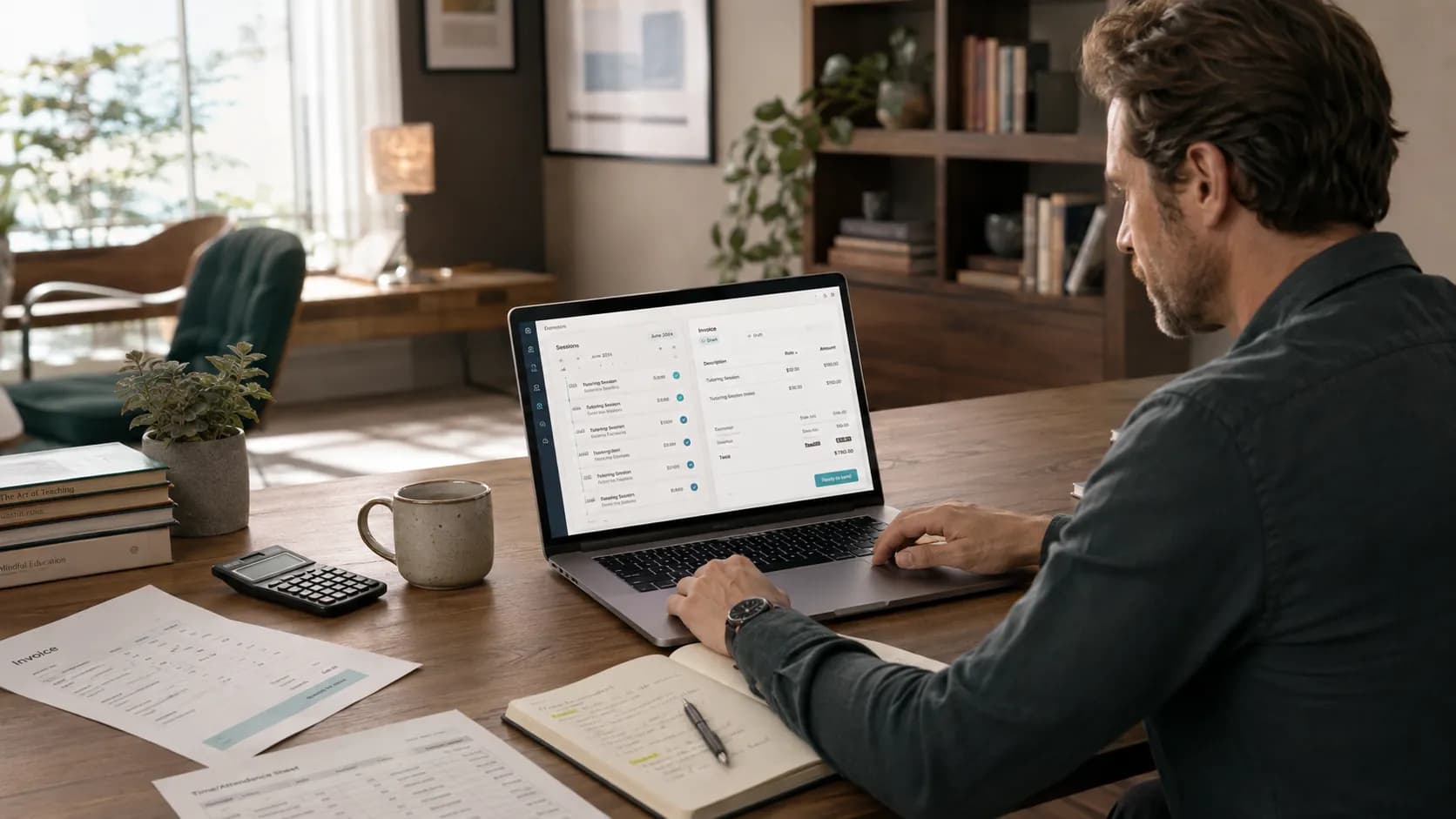
Online tutors in 2026 typically charge £15-£70+ per hour in the UK, $20-$150 per hour in the US, and €15-€40+ per hour in Europe, depending on subject, student level, and experience. Homework support sits at the bottom of each range and exam or university-level tutoring at the top. If you would rather work out your own number than pick one off a table, our free tutor pricing calculator starts from the income you need and returns a sustainable rate plus a suggested range for your subject, level and experience. Already have a rate in mind? Drop it into the Tutor Earnings Calculator to see what it pays per week, month and year. The detailed 2026 tables by region and subject are below, and the rest of this guide shows how to find your own sustainable rate rather than just copying a benchmark.
One of the hardest decisions for new and experienced tutors alike is setting the right price for their services. Charge too much, and you worry that students will choose someone else. Charge too little, and you may find yourself overworked, underpaid, and questioning whether tutoring is worth the effort.
The truth is that many tutors undervalue themselves. They base their prices on what others charge without considering their experience, preparation time, subject expertise, or the value they bring to their students.
Most UK online tutors charge between £15 and £70+ per hour, depending on subject, level, and experience. To price an online tutoring session, multiply your target hourly rate by the lesson length, then add any platform or payment fees.
Average online tutoring rates 2026
| Region | Typical hourly rate | Benchmark sources |
|---|---|---|
| United Kingdom | £15-£70+ | Superprof, MyTutor, Tutorful, First Tutors |
| United States | $20-$150 | Wyzant, Preply, Tutors.com |
| Europe | €15-€40+ | Superprof, Preply |
Ranges are rounded benchmarks compiled in June 2026 from rates publicly listed on major tutoring marketplaces; your subject, level, and experience decide where you sit inside each one. The regional tables further down break these figures out by level.
If you've ever wondered, "How much should I charge for online tutoring?", this guide will help you find an answer that is both fair to your students and sustainable for you.
Why Tutors Often Undervalue Themselves
Many tutors set their rates based on fear rather than strategy.
They think:
- "I'm not experienced enough."
- "There are tutors charging less than me."
- "Students won't pay that much."
- "I should keep my prices low to attract more clients."
While keeping your services affordable can be important, consistently undercharging creates a different problem: burnout.
Tutoring involves much more than the hour you spend with a student. There is often time spent preparing lessons, creating exercises, reviewing assignments, communicating with parents, scheduling sessions, and tracking student progress.
If your pricing only reflects the time you spend on camera, you're likely working far more hours than you're being paid for.
What Do Online Tutors Typically Charge?
Online tutoring rates vary depending on several factors, including location, subject, qualifications, and target audience.
Generally speaking:
| Type of Tutoring | Typical Hourly Range |
|---|---|
| General homework support | $15-$30 |
| School subject tutoring | $25-$50 |
| High school exam preparation | $40-$80 |
| Specialized subjects | $50-$100+ |
| University-level tutoring | $60-$120+ |
Remember that these numbers are benchmarks, not rules.
The right price is not necessarily the average market price. The right price is the one that allows you to deliver high-quality support while building a sustainable tutoring business.
Tutoring Rates by Region in 2026
Location still moves prices more than almost any other factor, even for online lessons, because families anchor on what local tutors charge. The ranges below are rounded benchmarks compiled in June 2026 from rates publicly listed on major tutoring marketplaces (Superprof, MyTutor, Tutorful and First Tutors in the UK; Wyzant, Preply and Tutors.com in the US; Superprof and Preply across Europe). Your subject, level and experience decide where you sit inside each range.
Tutoring rates in the UK
| Level | Typical hourly range |
|---|---|
| Primary and homework support | £15-£25 |
| GCSE subjects | £25-£40 |
| A-Level | £30-£50 |
| University, admissions and specialist | £40-£70+ |
London and the South East usually sit at the top of each range, and experienced 11+, Oxbridge and medicine-admissions specialists regularly charge beyond it. UK tutors should also remember that most private tutors do not charge VAT until they pass the registration threshold; our free tutor invoice maker handles both cases when it is time to bill.
Tutoring rates in the US
| Level | Typical hourly range |
|---|---|
| Elementary and homework help | $20-$40 |
| Middle and high school subjects | $30-$60 |
| AP, SAT and ACT preparation | $50-$100 |
| College-level and specialist subjects | $60-$150 |
Test preparation is the clearest premium niche in the US market: families pay for measurable score improvements, and tutors with a track record price accordingly.
Tutoring rates in Europe
| Level | Typical hourly range |
|---|---|
| School subjects and homework support | €15-€30 |
| Exam preparation (bac, Abitur, maturita) | €25-€50 |
| University-level and specialist | €40-€80 |
Rates vary widely across the continent: Switzerland, Germany and the Nordics sit well above the averages, while Southern and Eastern Europe trend lower. Online tutoring lets you price against your students' market rather than your own, which matters if you teach internationally.
Rates by subject
Across all three regions, the subject premium follows a consistent pattern. In rough USD-equivalent terms for one-to-one online lessons:
| Subject | Typical hourly range |
|---|---|
| Foreign languages and conversation | $20-$50 |
| English, literacy and essay coaching | $25-$55 |
| Maths (school level) | $30-$70 |
| Sciences (physics, chemistry, biology) | $30-$70 |
| Music and instruments | $30-$60 |
| Coding and computer science | $40-$90 |
| Test prep (SAT, IELTS, 11+, admissions) | $50-$120 |
| University STEM and specialist subjects | $60-$150 |
Scarcity drives the premium: the harder it is to find a qualified tutor in a subject, the more the qualified tutor earns.
The Hidden Work Behind Every Tutoring Session
Imagine you charge $30 for a one-hour lesson.
Sounds reasonable, right?
But let's look closer:
- 20 minutes preparing materials
- 60 minutes teaching
- 15 minutes reviewing homework
- 10 minutes answering messages
- 5 minutes updating student notes
That's nearly two hours of work.
Suddenly, your "$30 per hour" tutoring rate becomes closer to $15 per hour.
This is why successful tutors price based on their entire service, not just the live session itself. It's also why reducing the hidden work matters as much as the rate: when attendance and time per student record themselves and session notes take minutes instead of an evening, more of your working time is paid time.
Calculate Your Minimum Sustainable Rate
Instead of guessing your rates, start with your financial goals.
Ask yourself:
- How much do I want to earn each month?
- What are my monthly business expenses?
- How many paid tutoring hours can I realistically teach?
Use this formula:
Minimum Hourly Rate = (Desired Monthly Income + Monthly Expenses) ÷ Monthly Teaching Hours
For example:
- Desired monthly income: $2,000
- Expenses: $300
- Teaching hours per month: 50
Calculation:
($2,000 + $300) ÷ 50 = $46 per hour
In this scenario, charging $25 per hour would mean you are significantly underpricing your services.
Try it with your own numbers:
This quick version covers the core formula. For the full picture, our free tutor pricing calculator adds the things that quietly move the number: unpaid prep and admin, hours lost to no-shows, platform commission, package discounts, group classes, and a tax set-aside. It also positions the result against your subject, level and experience, and tells you when a target income simply does not fit the hours you teach.
Knowing your minimum sustainable rate gives you confidence when discussing prices with potential students.
One caveat: the "monthly teaching hours" number is only trustworthy if your week is actually structured. Pricing built on a stable tutoring timetable survives contact with reality; pricing built on a guessed schedule quietly collapses when reschedules eat the hours you counted on.
Factors That Should Influence Your Pricing
Two situations sit outside the ranges above because the job itself is different. Full-time homeschool instruction carries curriculum planning and progress reporting, covered in what to charge as a homeschool tutor, and application work is priced as a package rather than by the hour, covered in how to price personal statement tutoring.
1. Your Subject Expertise
Not all tutoring services are valued equally in the market.
Subjects such as advanced mathematics, physics, programming, university admissions preparation, and standardized test preparation often command higher rates due to their complexity and demand.
2. Student Level
Teaching elementary students is different from preparing someone for university entrance exams.
As the stakes become higher, families are generally more willing to invest in expert support.
3. Experience and Qualifications
Years of experience matter.
So do:
- Teaching certifications
- Degrees in your field
- Exam specialization
- Success stories and testimonials
If you've helped dozens of students achieve their goals, your pricing should reflect that expertise.
4. Preparation Requirements
Do you provide:
- Personalized lesson plans?
- Homework assignments?
- Progress reports?
- Additional support outside sessions?
The more comprehensive your service becomes, the more valuable it is.
Stop Competing on Price Alone
Many tutors believe they need to be the cheapest option available.
This is rarely true.
Parents and students are not always looking for the lowest price.
They're looking for someone they trust to help them succeed.
A tutor who is organized, prepared, responsive, and invested in their students' progress often provides significantly more value than someone charging less but offering little structure. Keeping complete student records, attendance history, and session notes is exactly the kind of structure parents notice.
Instead of asking:
"How can I be cheaper?"
Ask:
"How can I provide a better learning experience?"
Consider Offering Tutoring Packages
Charging only by the hour can make your income unpredictable.
Packages encourage commitment and provide greater stability.
For example:
Starter Package
- 4 sessions per month
- Email support between lessons
Progress Package
- 8 sessions per month
- Personalized exercises
- Monthly progress updates
Intensive Package
- Multiple sessions per week
- Exam preparation strategy
- Priority support
Packages shift the conversation from buying hours to investing in outcomes. If you sell packages, per-student time tracking is what tells you, and the parents, exactly how much of the package has been used.
Make the Price Survive Contact With Your Admin
A rate you decided on in a spreadsheet has to survive the rest of the month. This is where good pricing quietly falls apart: you set three tiers, then bill everyone the same because your invoice template only has one rate in it, or you carry a £5 uplift in your head and forget it on the one invoice that mattered.
Four places where the decision either holds or leaks:
- The rate lives on the student, not in your memory. If you charge differently by level, the rate belongs on each student's record so it applies itself. Student management software supports per-student billing rates and student tags, so a KS3 rate and an A-Level rate can coexist without you checking a sheet every time you invoice.
- The published rate is the one people see first. Most pricing conversations are won or lost before you speak, on whatever page a parent lands on. A tutor booking software page that shows your tiers up front does the awkward part for you, and the enquiries that arrive have already accepted the number.
- Families get one bill, not three. Two siblings across three subjects should not produce three separate invoices to the same parent. Consolidated family invoices keep it to one document and one payment to chase; tutor billing software covers how that is put together.
- Late payment has a rule, not a mood. Deciding your terms is part of pricing. Payment tracking records what has actually been settled against each invoice, and a late fee can be applied automatically once one goes overdue, so the policy runs without you having to be the person who brings it up.
One honest limitation worth knowing before you plan around it: invoices are not logo-branded inside Teamlilit today. The invoice profile carries your payment instructions rather than your visual identity. If a branded PDF matters to you now, the free tutor invoice maker is the route to one, and our guide on how to invoice tutoring students covers numbering, terms and chasing. Still assembling your setup? Our roundup of the best tools for online tutors compares the billing and booking options honestly, ours included.
The evidence for your next rate rise accumulates here too. Lesson notes written after each session are what turn "I would like to charge more" into a specific account of what a student can now do that they could not in September. That is a much easier conversation than a percentage.
Group Sessions Can Increase Revenue
Online tutoring also creates opportunities for small group learning.
A common rule of thumb is to price each group seat at roughly 40-60% of your one-to-one rate. Each student pays less than they would for individual tutoring, while your revenue for the hour grows with the group.
Using a $40 individual rate as the baseline:
| Format | Price per student | Your hourly revenue |
|---|---|---|
| One-to-one | $40 | $40 |
| Pair (2 students) | $25 | $50 |
| Small group (4) | $18 | $72 |
| Workshop (8) | $12 | $96 |
The same logic works in pounds or euros: a £35 one-to-one rate supports a £20 per-seat pair and a £15 per-seat group of four, earning £60 for the hour.
Group tutoring works especially well for:
- Language practice
- Exam preparation workshops
- Revision sessions
- Skill-building courses
Signs You Might Be Undercharging
Ask yourself the following questions:
- Are you fully booked but still struggling financially?
- Do students rarely question your pricing?
- Are you spending unpaid hours preparing lessons?
- Do you frequently work evenings and weekends just to keep up?
- Have you kept the same prices for years despite gaining experience?
If you answered "yes" to several of these questions, it may be time to review your rates.
How to Raise Your Prices Professionally
Increasing your rates can feel uncomfortable, especially with long-term students.
However, price increases are a normal part of running a professional service.
If you decide to raise your rates:
- Give advance notice.
- Explain the effective date clearly.
- Highlight the value students receive.
- Thank them for their continued trust.
For example:
"Starting September 1st, my tutoring rates will increase to reflect the additional resources, preparation, and support included in my services. Existing students will continue at their current rate until the end of the current term."
Most families understand that expertise and quality evolve over time.
Professional billing reinforces the message: a clean, itemized invoice signals that your rate reflects a real service, not an informal favor. If you don't have invoicing set up yet, our free tutor invoice maker generates professional PDF invoices in minutes, with no signup. And when you are ready to go beyond one-off invoices, our guide to billing and CRM for your tutoring business covers packages, payment tracking, and client records, and our automated tutor billing page shows the whole cycle from tracked lesson to paid invoice.
Remember: You're Not Selling an Hour
One of the biggest mindset shifts tutors can make is understanding that they are not simply selling sixty minutes of their time.
They are providing:
- Knowledge
- Guidance
- Encouragement
- Accountability
- Structure
- Experience
- Results
Students aren't paying for the hour.
They're investing in the progress that hour helps them achieve.
Frequently Asked Questions
How much should I charge for online tutoring?
Most online tutors charge between $15 and $120 per hour depending on subject, student level, and experience: roughly $15-$30 for homework support, $25-$50 for school subjects, $40-$80 for exam preparation, and $50-$120+ for specialized or university-level tutoring. Treat these as benchmarks and price against your own minimum sustainable rate.
How do I calculate my tutoring rate?
Add your desired monthly income to your monthly business expenses, then divide by the number of paid teaching hours you can realistically deliver each month. The result is your minimum sustainable hourly rate; charging below it means the business slowly burns you out.
Should I charge less when I am just starting out?
A modest introductory rate can help you win your first students and testimonials, but it should still sit above your minimum sustainable rate, and it should come with a plan to raise prices as your results and experience grow.
How do I raise my tutoring rates without losing students?
Give advance notice, state the effective date clearly, highlight the value students receive, and thank them for their trust. Many tutors let existing students finish the current term at the old rate; most families accept that expertise and quality evolve over time.
How much do private tutors charge in the UK?
Listed UK rates in 2026 typically run around £15-£25 per hour for primary and homework support, £25-£40 for GCSE subjects, £30-£50 for A-Level, and £40-£70 or more for university-level, admissions and specialist test preparation, with London and experienced exam specialists at the top of each range.
How much should I charge for group tutoring?
A common approach is to price each seat at roughly 40-60% of your one-to-one rate. Each student pays less than for private tutoring while your revenue for the hour grows with group size; for example, five students at $15 each earns more than one student at $40.
A Note on These Benchmarks
The ranges in this guide are rounded figures compiled in June 2026 from rates publicly listed on major tutoring marketplaces, including Superprof, MyTutor, Tutorful and First Tutors in the UK, Wyzant, Preply and Tutors.com in the US, and Superprof and Preply across Europe. Marketplace listings skew toward advertised rather than negotiated rates, and platforms take commissions that independent tutors keep, so treat them as orientation points rather than targets. Your minimum sustainable rate, calculated above, remains the only number that is truly yours. To pin it down properly, including prep time, lost hours and any commission, run your figures through the tutor pricing calculator.
Final Thoughts
Pricing your tutoring sessions isn't about finding the lowest number students are willing to accept.
It's about finding a rate that allows you to provide exceptional support while maintaining a healthy, sustainable business.
When tutors undervalue themselves, everyone loses. The tutor becomes exhausted, the quality of support may decline, and students miss out on the consistency they need to succeed.
Know your worth.
Consider the full scope of your work.
Price with confidence.
Because the right students aren't looking for the cheapest tutor; they're looking for the tutor who can help them reach their goals.
And that expertise deserves to be valued.
Sources
- VAT on education and vocational training (Notice 701/30) - GOV.UK (HMRC). Confirms private tuition can be exempt from VAT.
- Register for VAT - GOV.UK. Sets out the VAT registration threshold tutors must pass before charging VAT.