Invoicing is the part of tutoring nobody trains you for. You are confident explaining quadratic equations or the subjunctive, and then a parent asks "can you send me an invoice?" and you find yourself formatting a Word document at 11pm.
This guide covers what a tutoring invoice needs to contain, when to send it, and how to handle the awkward parts like late payers, so billing takes minutes instead of evenings.
Quick answer: To invoice tutoring students, record the lessons for the billing period, total them at your rate, and send a numbered, professional PDF invoice with clear payment terms. In Teamlilit, where lessons and attendance are already tracked, that record becomes a draft invoice you review and send in a couple of clicks.
What a tutoring invoice must include
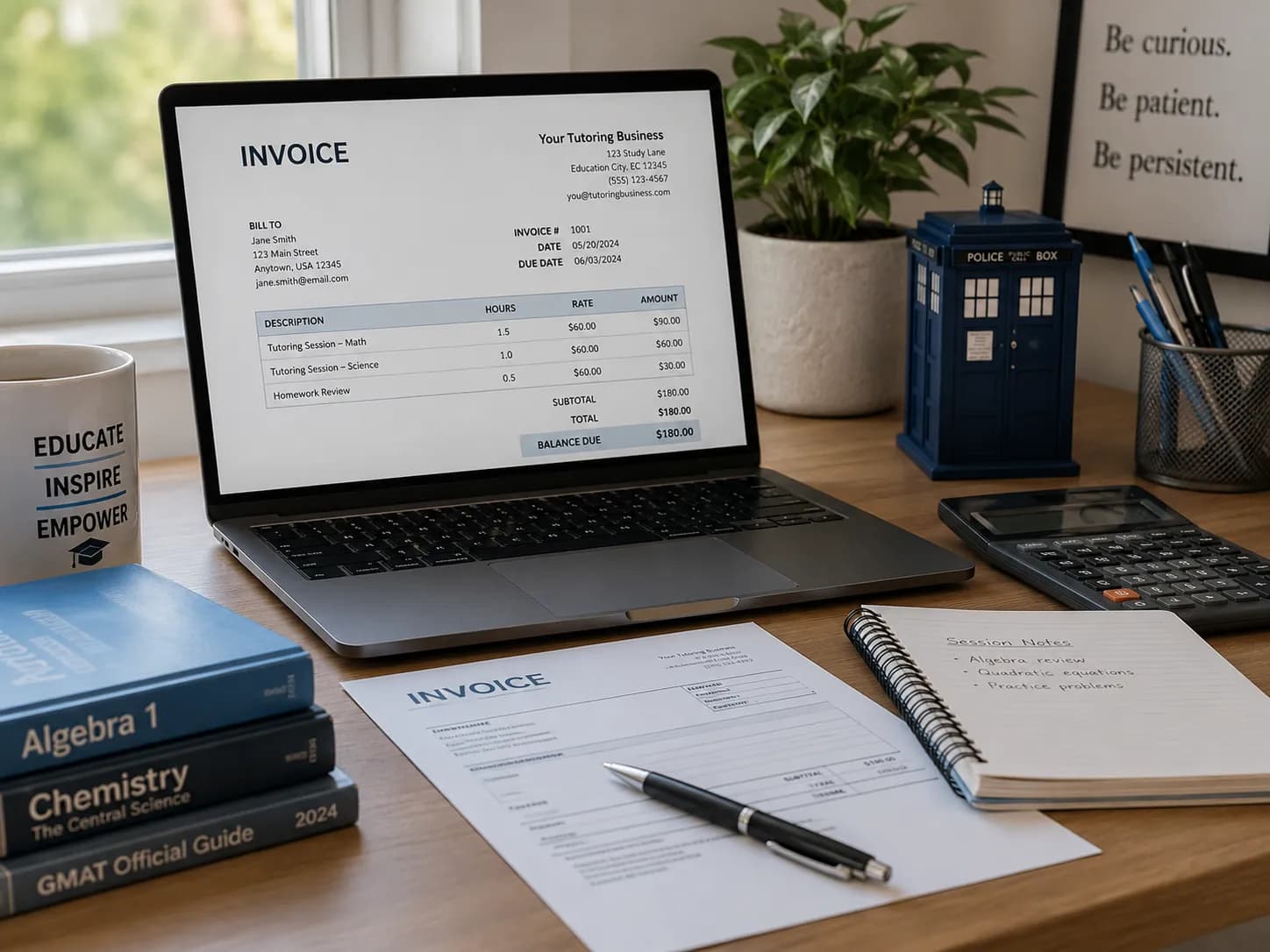
A professional invoice answers every question the payer might have, in one document:
- Who is billing: your name (and business name if you trade under one), email, and address.
- Who is paying: the parent, student or school, with their billing address. Invoice the person who actually pays, which for younger students is usually a parent.
- Invoice details: a unique invoice number, the invoice date, and a due date.
- What was delivered: an itemized list of lessons with dates, subject, duration, rate and line totals. For monthly invoices, a service period ("1 to 30 June 2026") makes the scope unambiguous.
- The money: subtotal, any discount, and the total due. UK tutors who are not VAT registered should simply note that no VAT has been charged.
- How to pay: bank details or a payment link, plus a payment reference, ideally the invoice number, so you can match transfers to invoices without detective work.
If you would rather not build this from scratch, our free tutor invoice maker is effectively this checklist turned into a tool: it itemizes lessons, handles VAT and discounts, numbers invoices sequentially, and downloads a clean PDF. No signup, nothing stored.
A simple tutor invoice template
For tutors who prefer to start from text, this structure covers everything above:
INVOICE INV-2026-0014
From: Jane Smith, jane@brightmaths.co.uk, 12 High Street, London SW1A 1AA To: Sarah Williams (parent of Emma Williams), 5 Park Road, London N1 2AB
Invoice date: 30 June 2026 · Due: 14 July 2026 · Service period: 1 to 30 June 2026
Date Lesson Hours Rate Total 4 June GCSE Maths 1 £35 £35 11 June GCSE Maths 1 £35 £35 18 June GCSE Maths 1.5 £35 £52.50 25 June GCSE Maths 1 £35 £35 Total due: £157.50 · No VAT has been charged.
Payment by bank transfer to Jane Smith, sort code 20-54-36, account 12345678. Please use INV-2026-0014 as the payment reference.
Copy it, adjust it, or generate it as a PDF with your own details filled in. If you bill weekly, per seat in a group, or in prepaid blocks, our dedicated tutoring invoice template page has a copy-paste version for each billing style.
When to invoice: per lesson, monthly, or upfront
There are three workable rhythms, and the right one depends on the relationship:
- Monthly, in arrears is the default for regular students: one invoice at the end of the month listing every lesson. Lowest admin for you, one predictable payment for the family.
- Per lesson suits trial lessons and occasional students, where waiting a month makes no sense.
- Upfront, for packages flips the dynamic entirely: families buy 4, 8 or 12 lessons in advance, which stabilises your income and, as a side effect, nearly eliminates no-shows.
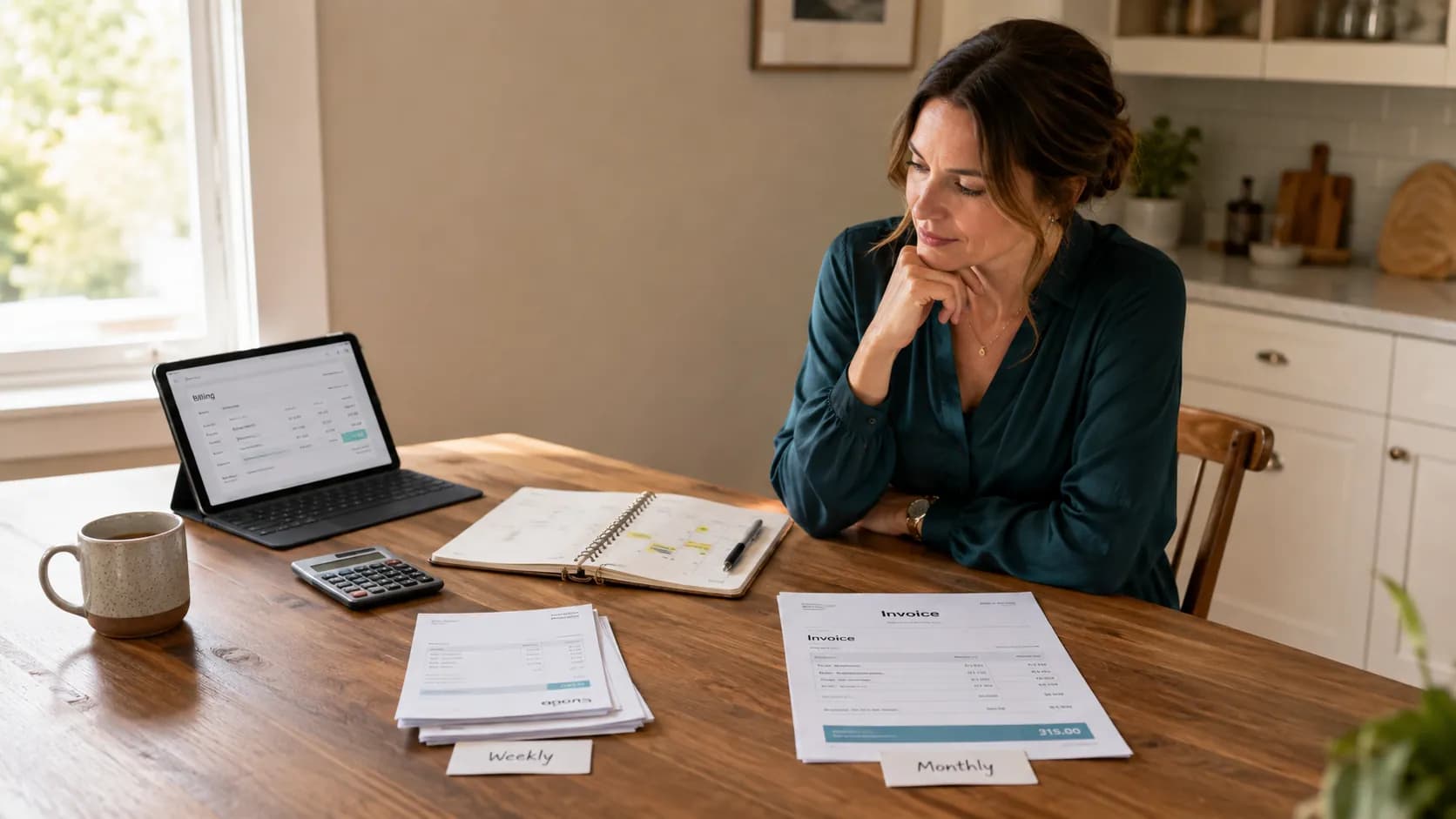
Whichever rhythm you choose, keep it consistent per client. Mixed rhythms are where lessons fall through the billing cracks. For the full comparison, including admin volume, cancellations and how to move a family from one to the other, see weekly vs monthly tutoring invoices. A rhythm is also easiest to keep when the schedule underneath it is stable: start from a clear tutoring timetable so every invoice reads off the same weekly structure. And if most of your billing goes to parents for repeating weekly lessons, our guide on simple ways to invoice parents for weekly classes compares the manual, generator, and attendance-based workflows side by side.
If you charge for late cancellations or no-shows, the invoice is where that fee belongs: add it as a clear line ("Late cancellation, 18 June, 50%") so it is transparent rather than a surprise. This only works if you have agreed the rule in advance, which is what our free private tutor cancellation policy generator is for: it writes a fair policy, plus a message to send parents, in a couple of minutes.
Number your invoices properly
Use one sequential series, like INV-2026-0001, INV-2026-0002, and never reuse or skip numbers. Sequential numbering matters more than it looks: it is what lets you, or an accountant, or the tax office, confirm that no income is missing. It also makes payment references trivially matchable.
Set payment terms, and put them on the invoice
14 days is the sweet spot for tutoring: short enough to keep cash flowing, long enough to feel reasonable. For small amounts, 7 days or due-on-receipt is fine. Whatever you choose, the due date goes on the invoice, not in a separate conversation.
Your rate itself should already account for the admin time invoicing takes; if you have never done that calculation, the calculator in our pricing guide takes two minutes.
Handling late payers without burning the relationship
Most late payments are forgetfulness, not refusal. An escalation that stays friendly:
- Day after due date: a one-line reminder with the invoice attached again. Most payments arrive here.
- A week later: a slightly firmer note proposing a payment date, still warm in tone.
- Two weeks later: pause scheduling new lessons until the account is settled, stated matter-of-factly. A tutor who keeps teaching unpaid lessons is funding the delay.
Families respect a tutor who treats their own business seriously. The tutors who struggle with late payment are usually the ones who apologise for invoicing at all.
Keep records like it is a business, because it is
Keep every invoice, note what has been paid, and review the unpaid list monthly. A folder of PDFs plus a simple ledger is enough when you start. As your student count grows, copying lesson dates, checking rates and matching payments takes more time each month.
If you are rebuilding that ledger by hand, Teamlilit's tutor billing software connects the lesson record to the invoice and payment status. Tracked lessons become draft invoice lines with each student's rate applied; you review the draft, send it, and record payments against it as they arrive.
Invoicing students based on attendance
Basing each bill on what actually happened, the lessons attended, the late arrivals, the sessions a student missed, is far more accurate than reconstructing a month from memory. When your attendance record feeds the invoice, the numbers line up with reality and disputes mostly disappear. See how attendance-based tutoring invoices work in practice.
The step before that one is worth getting right first: if the hours themselves are guesswork, an accurate invoice built on them is still wrong. Software that records lesson time as you teach closes that gap, so the figure on the invoice is the figure from the room rather than a rounded estimate.
Frequently asked questions
Do private tutors need to send invoices?
In most cases, yes. Invoices give you a clean record of income for tax purposes, make payment expectations explicit, and signal that you run a professional service. In the UK, sole-trader tutors can invoice under their own name without forming a company.
What should a tutoring invoice include?
Your name and contact details, the client's name and billing address, a unique invoice number, the invoice and due dates, an itemized list of lessons with dates and rates, the total due, your payment details with a payment reference, and a VAT note if applicable.
Should tutors invoice per lesson or monthly?
Monthly invoicing works best for regular students: one invoice listing the month's lessons keeps admin low and gives parents one predictable payment. Per-lesson billing suits trials and occasional students, and packages are billed upfront.
What payment terms should a tutor use?
14 days is the most common term for tutoring invoices, with 7 days or due-on-receipt for small amounts. State the due date on the invoice and ask clients to use the invoice number as the payment reference so transfers are easy to match.
The short version
A good tutoring invoice is a complete answer: who, what, how much, by when, and how to pay, under one sequential number. Bill monthly for regulars, upfront for packages, chase kindly but promptly, and let a template or generator do the formatting so your evenings go back to teaching, or to not working at all. For recurring weekly lessons, our free weekly class invoice generator fills in every lesson date from the day, rate, and number of weeks.
The generator still asks you to supply the hours. The version of this that takes no evening at all is when the lessons themselves produce the invoice: hours tracked from the lesson itself become invoice lines with each student's rate already applied, and you review a draft instead of building one. Setting that up is a one-off job, and our guide to automating tutoring invoices walks through the order to connect things in.
Want the whole chain rather than just the invoice? Start a free 14-day trial and let next month's billing build itself.
Sources
- Register for VAT - GOV.UK. When UK sole traders must register for VAT, supporting the not-VAT-registered invoice note.
- Business records if you're self-employed: what records to keep - GOV.UK. Self-employed record-keeping duties, supporting keeping every invoice.