Most private tutoring starts the same way. A parent asks if you can help with maths, you say yes, and you turn up each week and do your best. It works, but it is reactive. There is no plan, no clear path, and no simple way to show a parent what their child has actually gained.
A tutoring program changes that. Instead of a series of loosely connected lessons, you give the student a structured path: a starting point, a set of goals, a sequence of topics, and regular checkpoints that prove progress. It is what turns "I help with maths" into a professional service that families stay with and recommend.
This guide walks through building one, step by step, with templates you can copy. It is written for UK private tutors, so it also covers the pricing, safeguarding, and record-keeping that come with running tutoring as a small business.
Why a structured program is worth the effort
Structure is not just tidier, it works better. The Education Endowment Foundation, which reviews education evidence for schools, rates one-to-one tuition as having moderate evidence and, on average, delivering around five months of additional progress when it is well implemented. Crucially, its guidance points to the same habits a good program builds in: identifying the specific learning gaps, linking tuition to the student's normal lessons, giving well-planned feedback, and monitoring progress and adjusting as you go.
The difference between a program and ad-hoc tutoring shows up across the whole relationship:
| Aspect | Structured program | Ad-hoc tutoring |
|---|---|---|
| Planning | Curriculum mapped in advance, goals set | Topics picked lesson by lesson |
| Progress tracking | Profiles and notes record each step | Little formal record beyond memory |
| Parent involvement | Regular feedback and clear policies | Occasional, informal updates |
| Professionalism | Written agreement, DBS, quality focus | Often informal, few policies |
| Outcomes | Evidence-led, progress you can show | Harder to demonstrate, more variable |
In other words, the thing that makes tutoring effective is not just contact hours, it is the structure around them. A program is how you put that structure in place.
Step 1: Assess the student before you plan anything
The first session is not a lesson, it is an assessment. Before you can build a path, you need to know where the student is starting from and where they want to get to.
Gather:
- Level and context: year group, school, the subjects and exams involved.
- Current standing: recent grades or scores, and a quick baseline task or discussion to reveal the real gaps rather than the assumed ones.
- Goals: the concrete outcome the family wants, for example "a grade 7 in GCSE Maths by summer 2027".
- Strengths and weaknesses: what comes easily and what does not.
- Learning preferences and any additional needs: how the student engages best, and any support requirements to plan around.
- Availability: when they can realistically have lessons and do homework.
Capture all of this in one place so you are not reconstructing it later. A simple student profile template gives you a structured form to fill in at that first meeting, and it becomes the reference the whole program is built on.
Student profile template
| Field | Example |
|---|---|
| Student name | Jane, Year 10 |
| Subjects and levels | Maths (GCSE), Physics (GCSE) |
| Current standing | Maths grade 5, Physics grade 4 (latest school reports) |
| Goal | Grade 7 in both by summer 2027 |
| Strengths | Confident with algebra, well motivated |
| Weaknesses | Graphs, exam timing |
| Learning preferences | Responds well to worked examples and practice |
| Additional needs | Prefers shorter tasks with frequent checks |
| Availability | Weds 5 to 6pm, Sat mornings |
Step 2: Turn the assessment into a curriculum
Now translate what you learned into a plan of what to cover and in what order.
For exam students, anchor the curriculum to the exam board specification so nothing is missed. For everything else, lead with the weakest areas that unlock the most, then build outward. You do not need a rigid term-by-term syllabus on day one, you need a clear sequence and a set of milestones you can revisit.
Decide the rhythm too. Most students start with one weekly hour. Stepping up to two or three sessions a week can make a real difference in the run-up to mocks or final exams, or when there is a lot of ground to cover in a short time. Match the frequency to the goal and the timeline, not to a default.
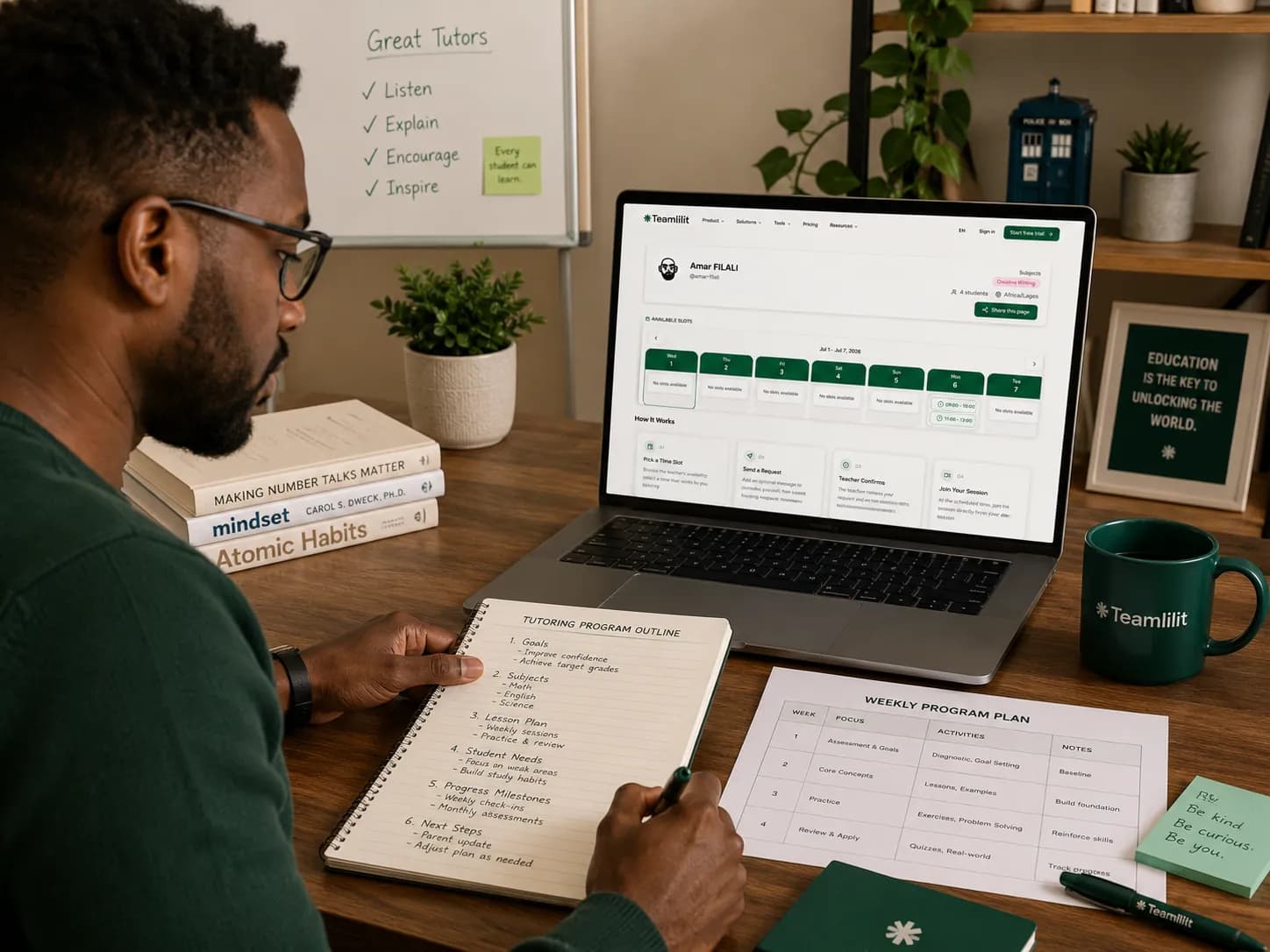
This is exactly the shift a tutoring program builder is designed for: moving from ad-hoc lessons to a structured, multi-session curriculum with ordered materials and a visible path, so both you and the student always know what comes next.
The plan should stay a living thing. After every few sessions, look at progress and adjust: if a topic is taking longer than expected, give it more time; if something clicked quickly, move on. The loop is assess, plan, teach, review, and back to plan.
Step 3: Plan lessons from a reusable template
The fastest way to burn out is to design every lesson from scratch. The fix is a template you fill in rather than a blank page you face.
A good session plan has a predictable shape: a quick review of last time, a clear objective, a main activity with practice, a check that it landed, and homework that carries into next time. Keeping the same structure every week also helps the student, because they know what to expect.
Lesson plan template
| Section | What goes here |
|---|---|
| Date and session number | e.g. Session 6, 12 Sep 2026 |
| Objective | The one thing this lesson should achieve |
| Materials | Worksheets, past-paper questions, anything to prepare |
| Warm-up (5 min) | Review of last session, connect to today |
| Main activity (30 min) | Teach the concept with worked examples, then practice |
| Check for understanding | A short task or question that proves it landed |
| Homework | Set work plus what to bring or prepare next time |
| Notes for next time | What to revisit, where the student struggled |
Alongside the plan, build a simple resource bank: save your worksheets and past-paper questions by topic so you can reach for the right one instead of remaking it. The hour you spend organising this early pays for itself many times over. Keeping consistent lesson notes also feeds the next step, because your record of what happened in each session is what makes progress visible to parents. For the wider habit, see our guide on keeping lesson notes for tutoring students.
Step 4: Track progress and keep parents in the loop
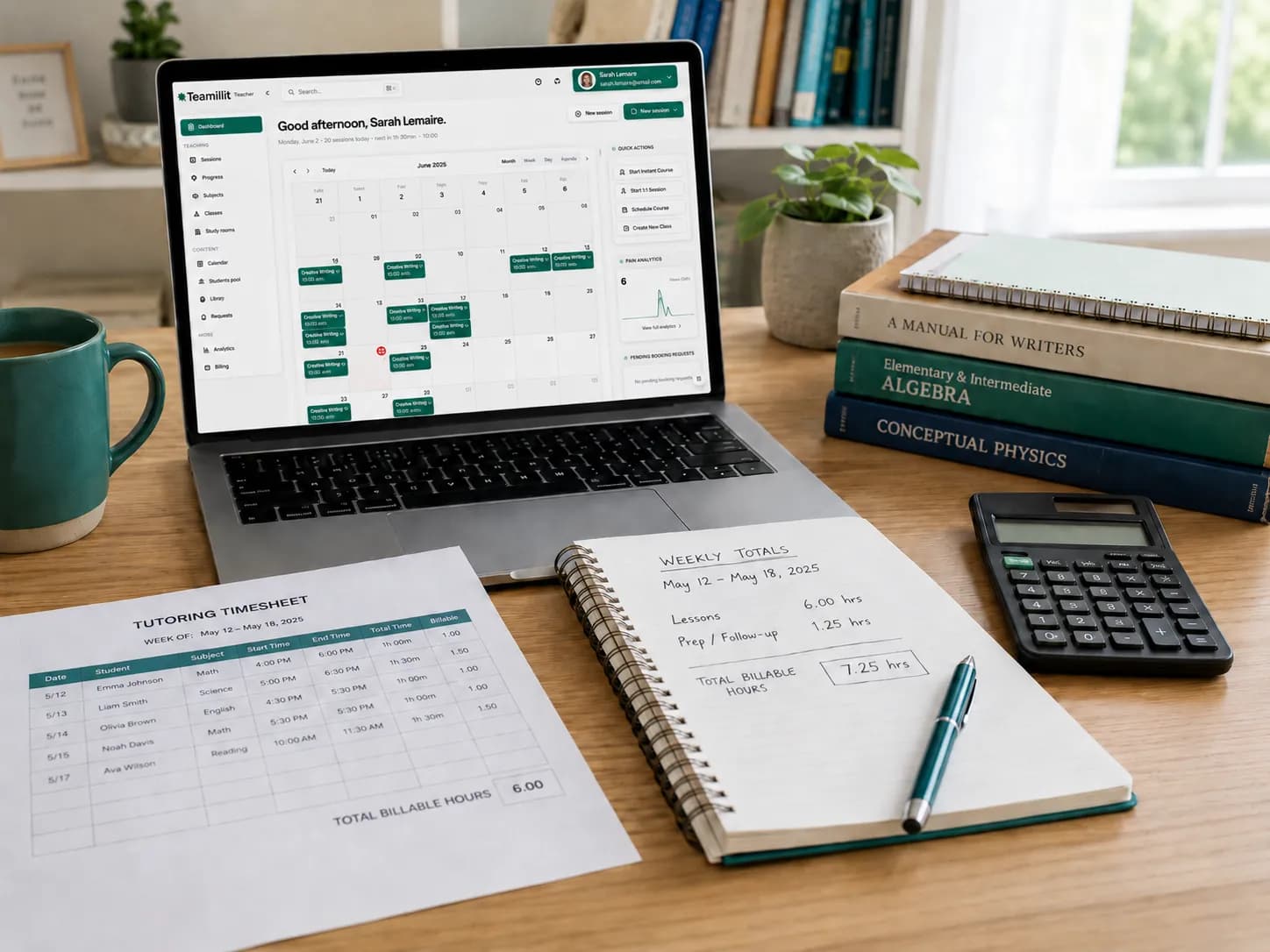
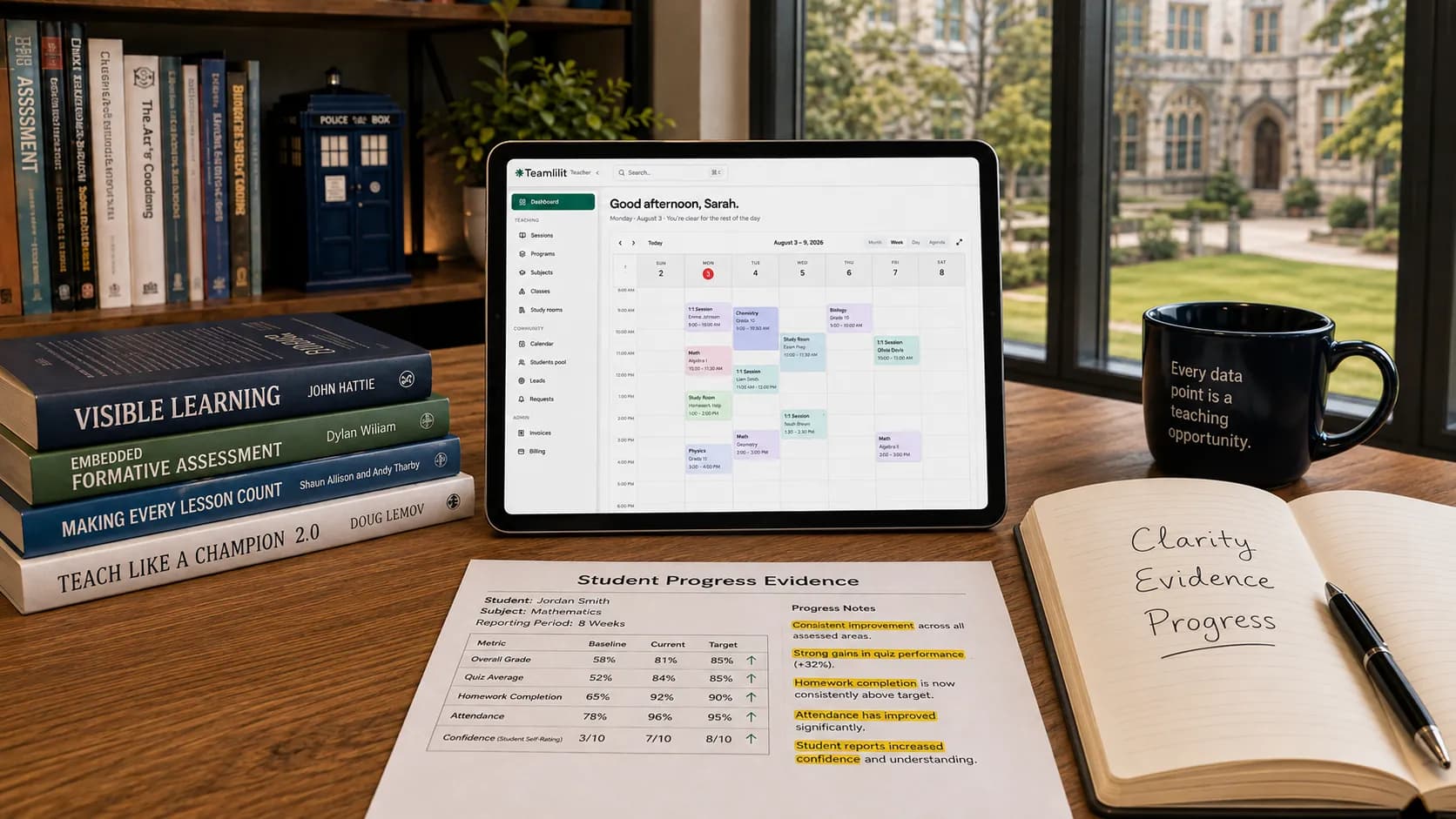
A program is only persuasive if you can show it working. Every few sessions, check what has actually been learned: a short quiz, a past-paper question, or asking the student to explain a concept back to you. This gives them feedback and gives you evidence.
Then share it. Families usually only see school grades, so the gains made in tutoring are invisible unless you surface them. A short update after each session, or a summary every few weeks, does the job: what you worked on, how it went, and what comes next. When a parent can see that a mock score moved from 55% to 70%, the value of your program is obvious and the relationship gets stronger.
Keeping this history attached to the student rather than scattered across notebooks is where student management software earns its place: profiles, session history, notes, and progress live together, so a progress update is a two-minute job rather than an evening of reconstruction.
Step 5: Set up scheduling that supports the program
A program needs a reliable rhythm, and that means recurring lessons rather than a booking negotiated from scratch each week. A student who owns "Tuesday 5pm" builds their week around it, which is far more reliable than agreeing each session one at a time.
Set the standing slots, confirm them with reminders, and make rescheduling easy but bounded by a clear notice policy. Prepaid packages help here too: selling a block of lessons up front locks in commitment and smooths your income. If you have not set a cancellation rule yet, our free cancellation policy generator writes a fair, parent-friendly one. For the full picture on protecting your schedule, see our guide on reducing student no-shows, and for the underlying setup, recurring lesson timetables.
Pricing your tutoring program
Pricing is where many UK tutors undersell themselves. Market rates commonly sit around £30 to £50 an hour, higher in London and affluent areas, and higher again for specialist subjects and exam preparation. Experience and qualifications justify the upper end. The practical advice: start at a rate you are comfortable with rather than the floor, and raise it as your results and demand grow.
A program lends itself naturally to packages, which reward commitment and stabilise your cash flow:
| Package | What it includes | Example |
|---|---|---|
| Single lesson | One 60-minute session, pay as you go | £40 |
| 5-lesson block | Five sessions paid up front, small discount | £190 |
| 10-lesson block | Ten sessions paid up front, larger discount | £360 |
| Program with reporting | Lessons plus regular written progress updates | Priced above the standard block |
Adjust the numbers to your market. The point is to present the options clearly, with the saving visible, so a family can choose the level of commitment that suits them.
To work out the rate you actually need to charge to make tutoring sustainable, once your own income target and costs are factored in, use the calculator below.
Treat tutoring as the small business it is. In the UK, HMRC provides a trading allowance of up to £1,000 a year: if your gross self-employed income is below that, you generally do not need to tell HMRC or register for Self Assessment, but above it you must register and file a return. Either way, keep proper records, invoices, income, and bank statements, because HMRC expects self-employed people to be able to show them.
Retention: keep students by keeping them engaged
Winning a new student is harder than keeping an existing one, and a well-run program is itself a retention tool. A few habits make the difference:
- Consistent feedback. A short note after each session reminds parents of the value you provide and keeps everyone aligned.
- Variety within structure. Keep the shape of lessons predictable but the activities fresh, so students stay engaged rather than bored.
- Flexibility when life happens. Reschedule promptly around illness and family events. Parents cite flexibility as a top reason they stay.
- Visible progress. Nothing retains like results. Mark milestones and show the growth, from a completed unit to an improved mock score.
UK safeguarding and legal steps
Running tutoring professionally means handling a few responsibilities that come with working with children and with being self-employed.
DBS checks. Private tutors are not legally required to hold a DBS check, which is a well-known gap. Many parents will still expect one, and it is a genuine trust signal. Since January 2026, self-employed tutors can apply for their own Enhanced DBS check, including a children's barred-list check, but only through a registered umbrella body, and because tutors are paid they do not qualify for the free volunteer rate. Parents can also verify your ID, qualifications, and references.
Safeguarding basics. Even as a sole tutor, keep sensible practices: teach in a visible space rather than behind a closed door, maintain clear professional boundaries, hold emergency contact details, and keep good per-session records. The Department for Education's guidance for out-of-school settings explicitly covers private tuition and recommends adopting school-style standards such as safer recruitment.
Agreements and records. Have a simple written agreement covering your rate, billing, and cancellation policy. Keep attendance and payment records, both for the family and for your own accounts.
Data protection. Under UK GDPR you must handle student data securely: collect only what you need, store it safely, and do not share it without consent. The Information Commissioner's Office is the UK authority on your obligations.
Once these are in place, they become a selling point. "Enhanced DBS checked" on your profile reassures parents before they even ask.
Ten habits that make a program run itself
The tutors who run the smoothest programs tend to share the same small habits. None of them take long, and together they save hours and keep families loyal:
- Ask before you plan. Before the first lesson, get the subject, exam board, current grades, and weak areas from the family. It turns your first session from guesswork into targeted work.
- Open with a diagnostic. A short quiz or task at the start reveals the real gaps, not the assumed ones, and gives you a baseline to measure against later.
- Vary the format, keep the structure. Alternate worked examples, practice, and short review activities so lessons stay fresh while the shape stays predictable.
- Set expectations early. Explain up front how your sessions work, how homework runs, and what your cancellation policy is, so nothing is a surprise later.
- Build in easy wins. Start new topics with something the student can get right, so confidence comes before difficulty.
- Always leave homework. A short, relevant task after each lesson reinforces the work and shows the family the learning continues between sessions.
- Give a quick parent debrief. A couple of minutes with the parent after a lesson, or a short written note, keeps them informed and secures the next booking.
- Book the next session before this one ends. A prompt "shall we keep Tuesday at five?" protects the recurring slot and your income.
- Take payment on or before the day. Prepayment, or payment at the lesson, is the simplest way to cut no-shows.
- Keep one record per student. Notes, grades, and history in one place, rather than scattered notebooks, is what makes progress updates quick and your program look professional.
Useful resources for building your program
Beyond your own materials, a few trustworthy places to draw on:
- The Education Endowment Foundation for evidence on what makes tuition effective.
- GOV.UK and the Department for Education for safeguarding, DBS, and out-of-school-settings guidance.
- HMRC for the trading allowance and record-keeping basics.
- BBC Bitesize and Oak National Academy for free, curriculum-aligned revision resources you can build lessons around.
Bringing it together
A tutoring program is not extra admin on top of teaching, it is what makes the teaching add up to something. Assess the student, turn that into a structured curriculum, plan lessons from a template, track progress, and keep parents informed. Wrap it in reliable scheduling, clear pricing, and the basic safeguarding and record-keeping that any UK tutoring business needs.
Do that, and you stop being someone who "helps with maths" and become a tutor running a professional program that students stay with, parents trust, and other families hear about.
FAQ
How do I start a tutoring program for a private student?
Start with an assessment: gather the student's level, recent grades, goals, and any specific needs. Turn that into a short curriculum of topics and milestones, decide the frequency, then plan lessons from a reusable template and review progress every few sessions. The program is the structure that turns ad-hoc help into a clear path.
What should a student profile or lesson plan include?
A student profile should capture level, subjects, current grades, goals, strengths and weaknesses, learning preferences, any additional needs, and availability. A lesson plan should include the objective, materials, a warm-up, the main activity, a check for understanding, homework, and notes for next time.
How often should a private student have tutoring sessions?
Most students start with one weekly one-hour session. Increasing to two or three sessions a week can help in the run-up to exams or when there is a lot of ground to cover. The right frequency depends on the goal, the timeline, and what the family can sustain.
How do I keep parents informed about progress?
Send a short update after each session or a summary every few weeks, covering what was worked on and what comes next. Because families often only see school grades, sharing the gains made in tutoring, backed by the occasional short assessment, is what keeps them confident and engaged.
What legal and safeguarding steps do UK private tutors need?
Private tutors are not legally required to hold a DBS check, but many parents expect one, and since January 2026 self-employed tutors can apply for their own Enhanced DBS via a registered umbrella body. Keep a simple written agreement, handle student data in line with UK GDPR, and follow basic safeguarding practices such as visible teaching spaces and clear records.
Sources
- One to one tuition - Education Endowment Foundation. Moderate evidence; on average around +5 months' additional progress when well implemented.
- Tax-free allowances on property and trading income - GOV.UK. The £1,000 trading allowance for self-employed income.
- Business records if you're self-employed - GOV.UK.
- DBS checks for self-employed people - GOV.UK. Since Jan 2026, self-employed tutors can apply for an Enhanced DBS via an umbrella body.
- Out-of-school settings: safeguarding guidance for providers - GOV.UK (Department for Education). Covers private tuition: safer recruitment, safeguarding, and health and safety.
- Guide to the UK GDPR - Information Commissioner's Office.