A parent messages you after the mock results come out: "Thank you so much, she was over the moon, best decision we made this year." You reply with a warm thank you, maybe an emoji, and move on to your next lesson.
You just let your single best marketing moment slip past.
That parent is, right now, more willing to recommend you than they will ever be again. They are talking about you to other mums and dads at the school gate this week whether you ask them to or not. The only question is whether you gave them the words and the nudge to do it, or left it to chance.
Referrals and reviews feel like two different jobs, but they are the same move: let happy families sell for you. A referral is a parent telling another parent. A review is that same parent writing it down so strangers can read it. Both start with a good result and a small, well-timed ask. This is quietly the highest-return part of getting more tutoring students, and it costs you nothing but a moment of mild awkwardness.
Let us make that awkwardness go away.
Why word of mouth beats everything else
When a parent is choosing a tutor for their child, they are nervous. It is their kid, their money, and their exam year. An advert reassures nobody. A slick website helps a little. But another parent they trust saying "we used her, she was brilliant, book her before she is full" ends the decision instantly.
That is why referred families behave differently once they arrive. They tend to trust you faster, haggle less on price, show up more reliably, and stay longer, because they came in already sold. You are not starting from scepticism, you are starting from a warm handshake. A referral does not just fill a slot, it fills it with your easiest kind of client.
Every other channel is you shouting to convince strangers. Referrals are your best families whispering to their friends. You cannot buy that trust, but you can absolutely encourage it.
The exact moment to ask
Timing is everything, and most tutors get it wrong by defaulting to never.
The window opens the instant a family feels the value, out loud. Watch for these moments:
- A grade jumps: a mock goes from a 4 to a 6, a report improves, a target gets hit.
- The parent thanks you unprompted, especially in writing.
- The child's teacher or school praises the progress.
- Term ends on a high, with results to point at.
In any of these moments the family is not just satisfied, they are grateful and a little relieved. That is the emotional peak, and it is short. Ask a week later and the feeling has cooled into "yes, it was fine". Ask in the moment and you are simply agreeing with how they already feel.
So the rule is: when a parent hands you a thank you, do not just say "you're welcome". Say thank you, then ask.
Light framing that never feels like a pitch
The reason asking feels awkward is that it sounds like begging for business. The fix is to change what you are asking for. You are not asking them to do you a favour out of nowhere. You are giving a delighted parent an easy way to act on a feeling they already have.
A few scripts that stay warm and low pressure:
For a referral, tie it to genuine scarcity:
"I am really glad this term went so well. Just so you know, I have room for one or two more students at the moment, so if any of the parents you know are looking, feel free to pass me on."
That line works because it is true (keep it true), it is casual, and it puts them in control. No hard sell, no guilt.
For a review, tie it to the result they just named:
"That means a lot, thank you. If you ever have two minutes, a short note about how the year went would genuinely help other families decide, no pressure at all."
Notice what these have in common. They are short. They give an easy exit ("if any of the parents you know", "if you ever have two minutes"). And they attach to a specific, recent win. You are never asking a lukewarm client to vouch for you, which is exactly why it does not feel pushy.
Ask for the written testimonial, not just praise
Verbal praise is lovely and it vanishes. A written testimonial works for you for years. So when a parent says something kind, gently ask if you can turn it into words on a page.
Keep it painless. Most parents want to help but freeze at a blank message, so give them a starting point:
"Thank you, that is so kind. Would you be happy for me to use that as a short quote for other parents? If it helps, you could just mention the subject, where he started, and how it went. A couple of lines is plenty."
That small prompt does two things. It removes the "what do I even write" friction, and it steers them toward the details that actually persuade the next family. Left to themselves, parents write "she was amazing, highly recommend". Nice, but forgettable. With a nudge, you get something far more useful.
What makes a testimonial actually convince someone
Specifics sell. Adjectives do not.
Compare these two. "Fantastic tutor, my son loved the lessons." Warm, but it could describe anyone. Now: "My son went into Year 11 predicted a grade 3 in maths and came out with a 6. He actually stopped dreading the subject." A hesitant parent reads the second one and thinks that is my child, that is exactly what I want.
A strong testimonial usually contains three things:
- The subject and level (GCSE maths, A level chemistry, KS2 English).
- The starting point (struggling, predicted a 4, lacking confidence).
- The outcome (jumped to a 7, passed the entrance exam, actually enjoys it now).
If a parent gives you a vague quote, it is completely fair to reply: "Thank you so much. Would you mind if I mentioned the grade she went up to? It really helps other parents picture it." Nearly everyone says yes, because they are proud of the result too.
The same specificity helps in your own words when you write your tutor profile: concrete outcomes reassure far more than a list of qualifications.
Where to put the reviews so they do their job
A great testimonial hidden in your inbox helps nobody. Put your reviews exactly where a nervous parent is deciding whether to book.
The highest-value spot is right next to the action: your booking page, near your availability and your prices. When a parent is one click from booking and hesitating, a specific quote from a family like theirs is often what tips them over. Rotate two or three of your strongest, most specific reviews there.
Also use them on any website, local listing, or social profile you keep. And do not underestimate the direct approach: when a new parent enquires and asks "how do I know you are any good", you can simply forward a couple of relevant quotes. A GCSE physics parent is reassured by a GCSE physics result, so match the review to the enquiry where you can.
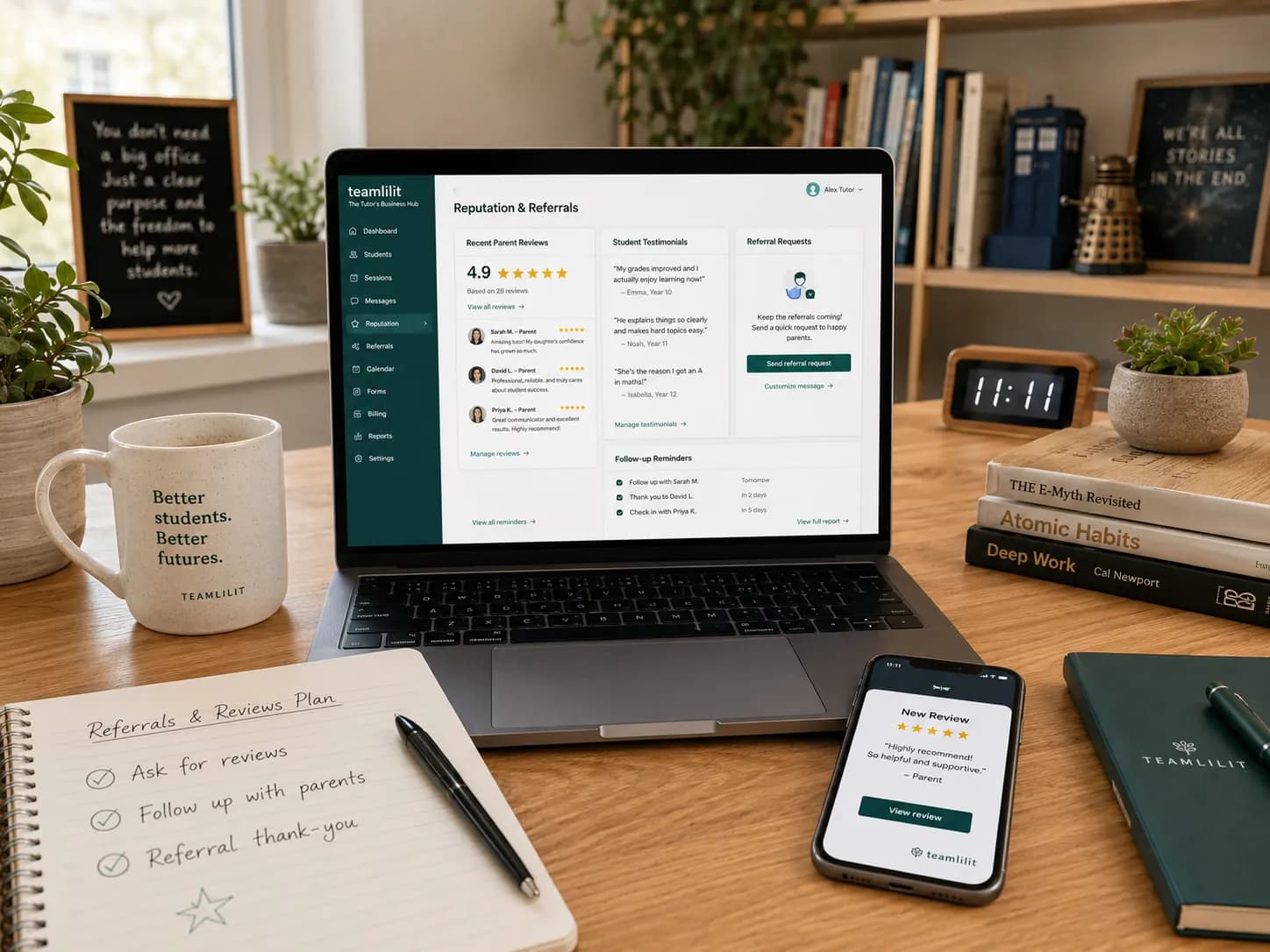
One honest note: Teamlilit does not collect reviews for you or run a referral scheme, and neither does any tool worth trusting on autopilot. Gathering these is a human job, done by you, in the moment. What software does is give you the place to show them off and the link to pass around. The asking is yours.
Turning one happy family into several
Here is the multiplier most tutors miss. One delighted parent is not one referral, they are a doorway into a whole network.
Think about where your best families already are. They stand at the school gate with other Year 10 parents. They sit in the class group chat. They chat at football on Saturday, at the dance studio, at church, at the childminder's. Tutoring recommendations travel along exactly these lines, parent to parent, because everyone is quietly worried about the same exams.
Your job is to make passing you on frictionless. That means:
- Have one shareable link (your booking page) so recommending you is a paste, not a paragraph of explaining.
- Mention your open spots so the recommendation feels timely: "she is taking one or two more before September".
- Always circle back and thank a parent who sends someone your way. It costs a sentence and it makes them do it again.
Do this consistently and something nice happens. You stop chasing students one at a time and start receiving them in small clusters: a sibling, then their friend, then the friend's cousin. That is how a fully booked tutoring practice actually gets built, not through clever ads, but through happy families who keep sending you more.
And the families you already have are the seed of all of it, which is why keeping your students happy and staying is not separate from growth. It is the engine of it.
FAQ
When is the best time to ask for a tutoring referral?
Ask just after a visible win: a jumped grade, a passed mock, a piece of praise from school, or a parent thanking you unprompted. In that moment the family already feels the value, so a light ask lands naturally rather than feeling like a sales pitch.
How do I ask parents for a review without feeling pushy?
Frame it as a favour tied to the result they just saw. Try: "I am so pleased with how the mock went. If you have two minutes, a short note about your experience would really help other families find me." Make it optional, specific, and easy to say no to.
What makes a good tutoring testimonial?
Specifics beat praise. A strong testimonial names the subject, the starting point, and the outcome: "My daughter went from a grade 4 to a grade 7 in GCSE maths over two terms." Concrete numbers and situations reassure new parents far more than words like "brilliant" or "lovely".
Where should I use the reviews I collect?
Put them where prospective families decide: your booking page, your website, and any local listing or social profile you use. Rotate a couple of specific quotes near your prices or your "book a session" button, where a bit of reassurance tips a hesitant parent into booking.
How do I turn one happy family into several new students?
Happy families already talk to other parents at the school gate, in class group chats, and at clubs. Make it effortless to pass you on: mention you have room for one or two more students, give them a simple link to your booking page, and thank anyone who sends someone your way.