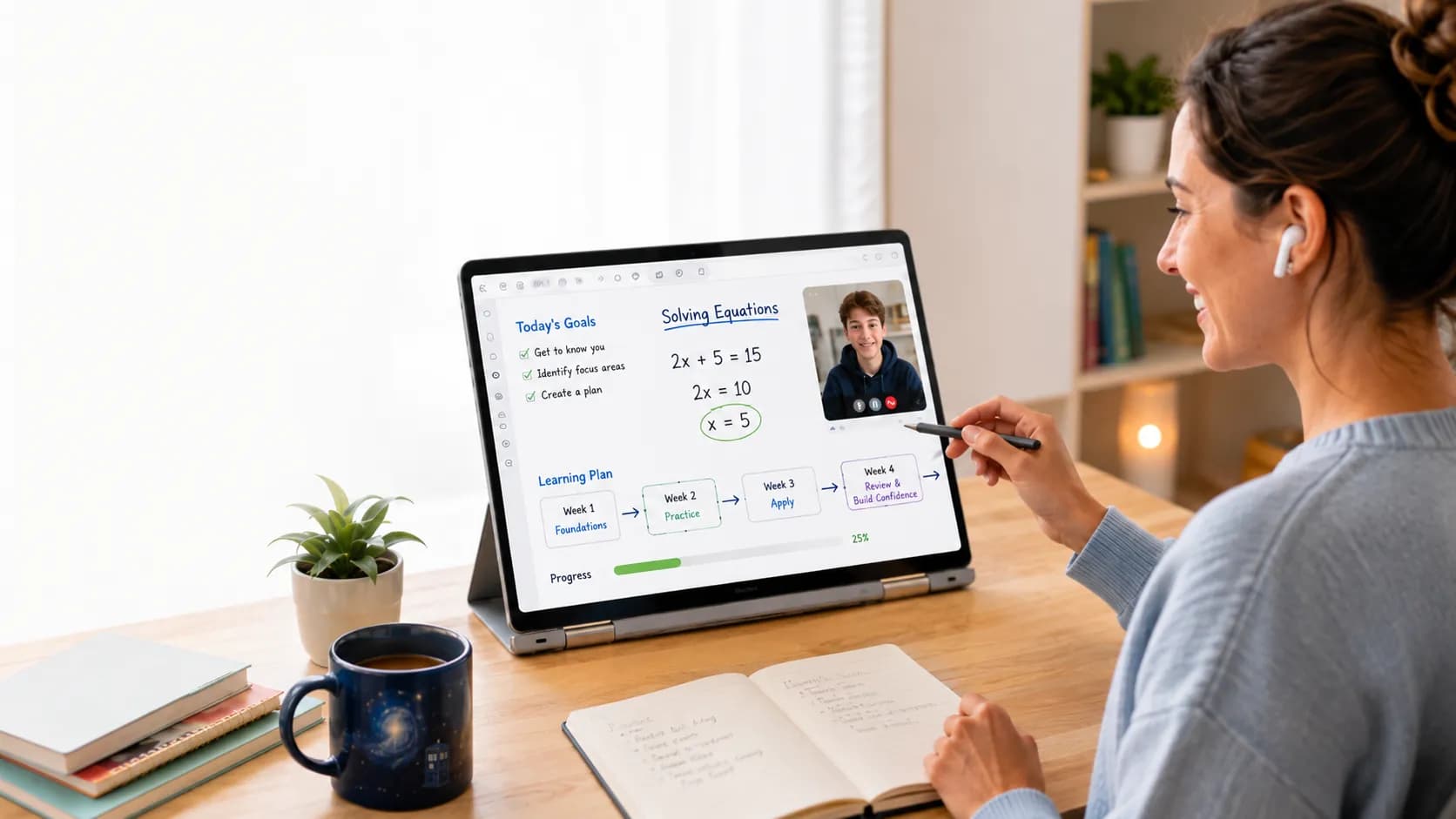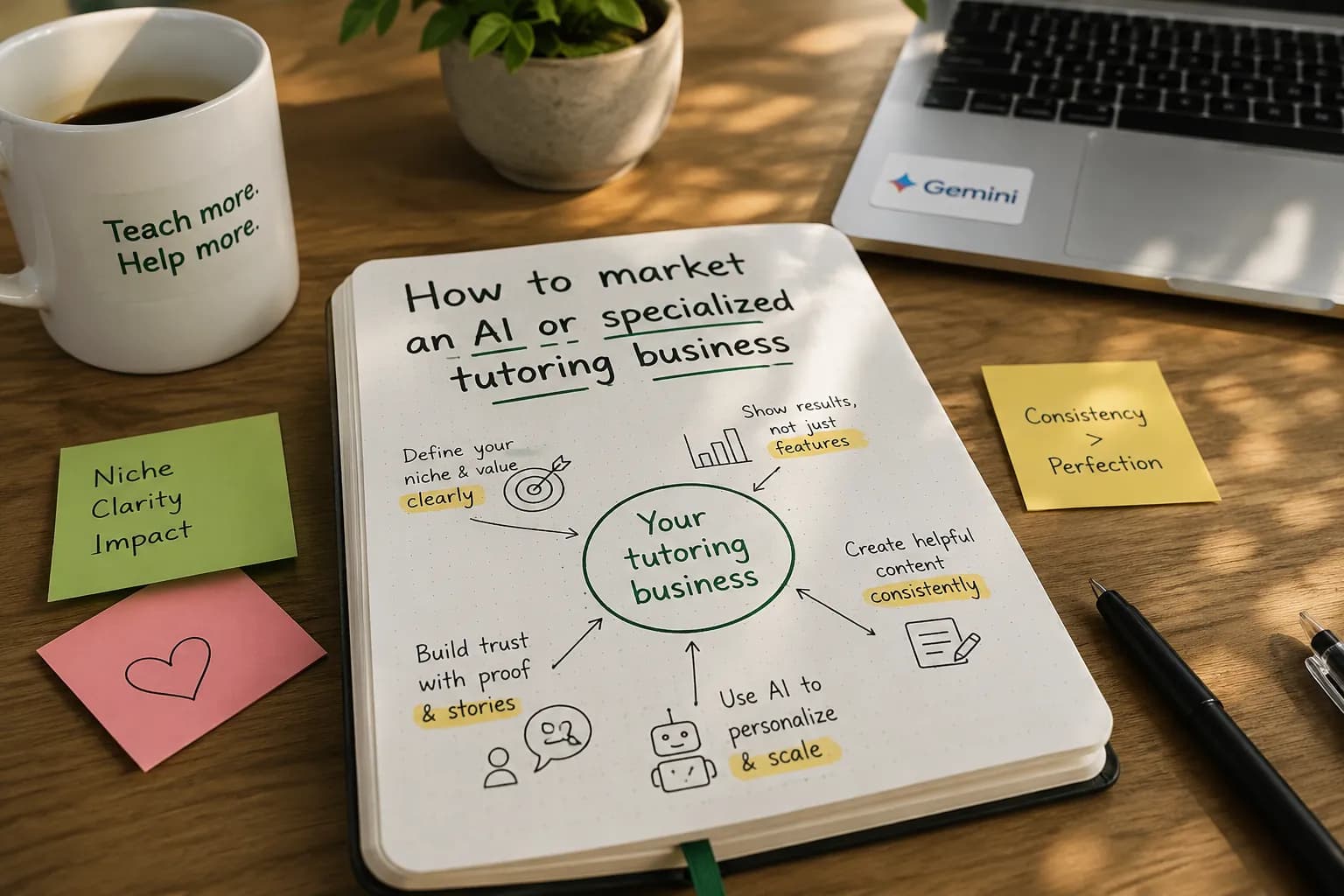
A tutor with a PhD in Nuclear Engineering and a background in AI and machine learning recently posted in Reddit's r/tutor community. They offered a $40 trial session for online tutoring in advanced subjects, listed their credentials, and waited.
If you tutor a niche, advanced subject, you probably recognize the situation. The expertise is real. The demand for AI and machine learning skills has never been higher. And yet the calendar stays emptier than it should, because deep credentials do not sell themselves.
This guide covers how to market an AI tutoring business, or any specialized tutoring practice, with four practical workflows and the systems that keep them running while you teach.
Beyond the Reddit post: translating your expertise into clients
A PhD does not fill a schedule, because clients do not buy credentials. They buy confidence that you can get them, or their child, from where they are to where they need to be.
Here is the uncomfortable part: the people paying for an AI tutor or ML tutor usually cannot evaluate the subject itself. A parent choosing support for a computer science undergraduate, or a career-changer picking a machine learning mentor, judges proxies instead: how clearly you explain things, whether other students got results, and how professional the whole experience feels from first click to first invoice.
That is actually good news. Marketing for specialized tutors is mostly a translation exercise. You are not competing with thousands of GCSE maths profiles; you are one of a handful of people who can teach what you teach. The tutors who win in a niche are rarely the most credentialed. They are the ones who translate their expertise into proof a non-expert can evaluate.
The rest of this guide is that translation, turned into repeatable workflows.
Four marketing workflows for the specialist tutor
Workflow 1: build a showcase, not just a profile
A profile lists what you have done. A showcase demonstrates what it means for the student.
Create a short "Projects & Research" page: three to five items, each explained for a lay audience in three parts. What the problem was, what you did, and what it means for your teaching. "I built a model that predicts equipment failure from sensor data" becomes "I taught machines to spot problems before they happen, and I can show your student how the same ideas power everything from Netflix recommendations to medical imaging."
The point is not to impress other PhDs. It is to let a parent or an undergraduate feel the gap between "has qualifications" and "can make this make sense."
Keep a master copy somewhere stable that you control. The lesson notes area of your tutoring software works well for this: the showcase lives alongside your teaching materials as evergreen content, and you paste it into community profiles, marketplace bios, and emails whenever you need it, without rewriting it from scratch each time.
Workflow 2: turn every session into a case study
Specialized tutors have a social proof problem. Nobody's neighbor recommends an ML tutor over the fence, so you have to manufacture the word of mouth that generalist tutors get for free.
The raw material already exists in your sessions. After each one, capture the before and after: the student could not explain backpropagation last month, and this week they defended their project to their supervisor. Where your software offers them, post-session AI lesson summaries make this nearly free: a written recap of what was covered and what progressed, ready for you to strip out anything identifying, leaving the skeleton of an anonymized success story.
Three rules keep this ethical and effective. Anonymize by default, and get explicit permission before quoting anyone as a testimonial. Focus on the transformation, not the topic, because "went from failing the module to a 2:1" travels further than any syllabus detail. And collect these continuously, so that when a prospect hesitates, you have a story that matches their situation.
Workflow 3: speak where your students are listening
Your students are not searching a tutoring marketplace for "nuclear engineering help." They are stuck at 11pm in a subject Discord, a machine learning subreddit, or a university forum, asking a question you could answer in four sentences.
Be the person who answers it. Properly, generously, with no pitch attached. Communities ban salespeople and remember experts, and the difference is entirely in your behavior: a salesperson answers to redirect, an expert answers to help. Two or three genuinely useful answers a week, sustained for months, beats any burst of self-promotion.
The conversion happens in your profile, not your posts. Keep your bio current, state what you tutor, and link your booking page so that the reader who thinks "this person just solved my problem in a comment" can find the next step themselves. Our guide on how to let students book tutoring lessons online covers how to make that landing spot work.
This is the highest-trust form of digital marketing for tutors in technical niches, precisely because it does not look like marketing.
Workflow 4: the structured trial offer
The $40 trial session from that Reddit post is the right instinct, usually pitched the wrong way. "Discounted first lesson" attracts bargain hunters who compare you on price. "Diagnostic session with a written roadmap" attracts students who intend to commit.
Structure it in three parts. Before the session, send a short questionnaire: current level, goal, deadline, what they have already tried. During the session, assess rather than perform; find the two or three gaps that actually block progress. Afterwards, deliver a one-page learning roadmap: where they are, where they want to be, and the sequence of work in between. Our minute-by-minute guide to running a tutoring trial lesson that converts covers how to run that hour and how to close it.
Record the assessment and the proposed plan in your student management records at the moment you write them. When the prospect goes quiet for a week, your follow-up message references their specific gaps and their specific plan, not a generic "still interested?". And the roadmap itself is the close: you are no longer selling lessons, you are proposing step one of a plan they already agreed makes sense.
The systems that let you market while you teach
Most tutor marketing fails through inconsistency, not bad ideas. The showcase never gets updated, the community answers stop during exam season, the trial follow-ups slip. The fix is not more discipline; it is systems that make the professional impression automatic.
Automate your credibility
Your public booking page is your storefront, and for many prospects it is the only page of yours they will ever read. In Teamlilit, yours can display your bio, your specialization, and your trial offer in one place, so the Reddit reader who clicks your profile link lands on something that confirms the expertise they just witnessed. Behind it, detailed student records mean every follow-up email sounds like it was written by someone who remembers the student, because it was informed by notes rather than memory.
Simplify the onboarding friction
Your ideal students are tech-savvy and busy. Every extra step between "I want to try this" and a booked session loses a percentage of them: the email back-and-forth about availability, the payment link sent separately, the timezone confusion. Online booking and scheduling collapse that into a couple of clicks, which matters most at the exact moment a stranger has decided to give you a chance.
Turn admin into marketing
Trust is built in the boring moments. An invoice that exactly matches the sessions that happened tells a parent you run a professional operation; our guide on how to invoice tutoring students based on attendance shows how to make that automatic. Lesson notes and shared resources after each session demonstrate value continuously, which quietly powers the case-study workflow above and the referrals that follow. Retention is the cheapest marketing there is.
If you are still assembling this stack, our roundup of the best tools for online tutors compares the options.
From specialist tutor to go-to expert
The shift that fills a specialist's calendar is from passive credential-listing to active value demonstration. The PhD stops being the headline and becomes the evidence behind clear explanations, documented results, and helpful answers in public.
Do not attempt all four workflows at once. Start with the showcase page this week, because every other workflow links back to it. Add the community routine next, since it compounds slowest and should start earliest. The case studies accumulate on their own once sessions are running, and the structured trial converts the attention the first three create.
The best marketing for tutors in any niche still rests on the fundamentals of referrals, visibility, and follow-up. For the channel-by-channel picture beyond the specialist angle, from local visibility to paid ads, see our full guide to marketing strategies for tutors.
And let the operational backbone carry the rest. When booking, records, invoicing, and lesson notes run themselves, the hours you save are the hours that go into the marketing only you can do: explaining hard things clearly, in public, until the right students find you.
Frequently asked questions
How do I market an AI tutoring business?
Translate your credentials into proof a non-expert can evaluate. Build a plain-language showcase of your projects and research, turn anonymized session results into short case studies, answer real questions in the communities where your students already spend time, and structure your trial session as a diagnostic that ends with a written learning roadmap. A public booking page then removes the friction between being discovered and being booked.
How do specialized tutors find students online?
Go where the questions already are. Subject-specific subreddits, Discord servers, and university forums are full of students stuck on exactly what you teach. Answer a few questions well each week as a helpful expert, keep your booking link in your profile rather than in your posts, and let curious readers come to you. This converts slowly but compounds, because every good answer keeps working after you log off.
Should I offer a discounted trial session?
A low-cost trial works when it is framed as a diagnostic, not a cheap lesson. A discounted first lesson attracts bargain hunters; an assessment that ends with a written roadmap attracts students who intend to commit. Charge enough to filter for seriousness, deliver a concrete plan, and make the follow-on engagement the obvious next step of that plan.
Do I need a website to market a specialized tutoring business?
Not on day one. A public booking page that shows your bio, your specialization, and your trial offer can do the early work of a website, and a plain-language showcase document covers the credibility side. Add a full website once you know which messages convert, so you are building it from evidence rather than guesswork.
The tutor from that Reddit post has everything the market wants and a marketing approach that hides it. The gap between the two is not talent or budget; it is translation, repeated weekly, with systems underneath so it survives busy terms.
Start your free Teamlilit trial and put your booking page, student records, and lesson notes to work as the quiet half of your marketing.