For many private tutors, invoicing starts simple.
You teach one student. You send a quick message. The parent pays by bank transfer. No problem.
Then the week gets busier.
One student misses a lesson. Another arrives 15 minutes late. One parent pays monthly. Another wants a weekly breakdown. A GCSE student has two lessons in one week, then cancels the third. Suddenly, your invoice is not just an invoice anymore. It is a question: what actually happened, what should be billed, and can you prove it clearly?
That is why attendance-based invoicing matters for UK tutors. Instead of guessing from memory or scrolling through WhatsApp messages, you invoice from your lesson records: who attended, when the lesson happened, how long it lasted, and whether any cancellation policy applies.
This guide explains how to invoice tutoring students based on attendance and billable lesson time, especially if you are a UK private tutor working with parents, weekly lessons, packages, or online sessions. If you want the broader picture first, start with our general guide on how to invoice tutoring students, then come back here for the attendance-based approach.
Quick answer
To invoice tutoring students based on attendance, keep a clear record of each lesson, including the student name, lesson date, scheduled time, actual attendance, lesson duration, hourly rate, cancellation status, and payment status.
Then create an invoice that shows:
- the lessons delivered
- the billable time for each lesson
- any missed or cancelled lessons that are chargeable under your policy
- the total amount due
- your payment details
- the payment due date
For UK tutors, this is not just good admin. HMRC expects self-employed people to keep accurate records of business income, with proof such as invoices and bank statements.
Why attendance-based invoicing works better for tutors
A normal invoice says:
Maths tuition, 4 lessons, £160
That might be enough when everything goes perfectly. But tutoring rarely works perfectly.
A better attendance-based invoice says:
| Date | Lesson | Attendance | Billable time | Amount |
|---|---|---|---|---|
| 3 Feb | GCSE Maths | Attended | 60 min | £40 |
| 10 Feb | GCSE Maths | Attended | 60 min | £40 |
| 17 Feb | GCSE Maths | Late arrival | 60 min booked | £40 |
| 24 Feb | GCSE Maths | Cancelled late | 60 min chargeable | £40 |
This is clearer for everyone. The tutor knows what to charge. The parent understands the bill. If there is a disagreement, the invoice is tied to actual lesson records instead of memory.
The shift is simple: instead of making an invoice from scratch, you turn real tutoring attendance into a clear, billable invoice. Attendance leads to lesson time, lesson time leads to billable hours, billable hours lead to the invoice, and the invoice leads to a payment status you can track.
What UK tutors should include on a tutoring invoice
A tutoring invoice does not need to look complicated, but it should be clear. A good UK tutor invoice should usually include:
- your name or tutoring business name
- your contact details
- the parent or student name
- the invoice number
- the invoice date
- the payment due date
- the lesson dates
- the subject or lesson type
- the hourly rate or lesson rate
- the billable time
- any cancellation or no-show charge
- the total amount due
- payment instructions
- payment status once paid
If you are VAT registered, your invoice may need additional VAT details. If you are not VAT registered, do not add VAT randomly.
For many independent UK tutors, the most important part is not fancy invoice design. It is matching the invoice to real lesson activity. The rate on the invoice deserves the same care: our guide to pricing your online lessons benchmarks 2026 tutoring rates by region and level, so the number you bill is one you can defend.
Step 1: Record attendance after every lesson
The first step is not invoicing. The first step is attendance.
After each lesson, record whether the student attended, was absent, cancelled in time, cancelled late, was a tutor cancellation, was rescheduled, arrived late, finished early, or ran over time. If you want to see what a completed tutoring attendance record looks like, those examples work through each of these outcomes with the minutes and the totals filled in.
This matters because attendance and billable time are not always the same thing. For example:
- A student books a 60-minute lesson and arrives 20 minutes late. You may still bill the full booked hour if your policy says the time was reserved.
- A parent cancels 3 hours before the lesson. You may bill the lesson if your cancellation policy says less than 24 hours' notice is chargeable.
- You cancel the lesson yourself. You probably should not bill it.
This is why the invoice should not be created from memory. It should come from attendance records. A simple tutoring attendance sheet template is an easy way to track tutoring attendance before creating invoices. And a reliable tutoring timetable makes the whole workflow painless: when the week's sessions are already structured, attendance is a tick against a plan instead of a reconstruction.
Step 2: Decide what counts as billable lesson time
Every tutor needs a simple billable time rule.
| Situation | Suggested billing rule |
|---|---|
| Student attends full lesson | Bill actual lesson time |
| Student arrives late | Bill booked time if your policy says so |
| Tutor runs over by choice | Bill original booked time unless agreed |
| Parent asks for extra time | Bill extra time if agreed |
| Student cancels with enough notice | Do not bill, or reschedule |
| Student cancels late | Bill according to cancellation policy |
| Student no-shows | Bill according to no-show policy |
| Tutor cancels | Do not bill; reschedule or refund |
This is where many tutors create problems for themselves. They do not define the rule upfront. Then when a student misses a lesson, the tutor feels awkward asking for payment.
Be clear before the lesson happens. A simple parent-facing policy could say:
Lessons cancelled with at least 24 hours' notice can be rescheduled without charge. Lessons cancelled with less than 24 hours' notice may be charged at the full lesson rate.
That kind of policy is much easier to enforce if your attendance records and invoices show exactly what happened. Once you have the durations, a tutoring hours tracker can turn tutoring hours into billable lesson time. For a deeper look at the counting itself, see how tutors can track billable hours.
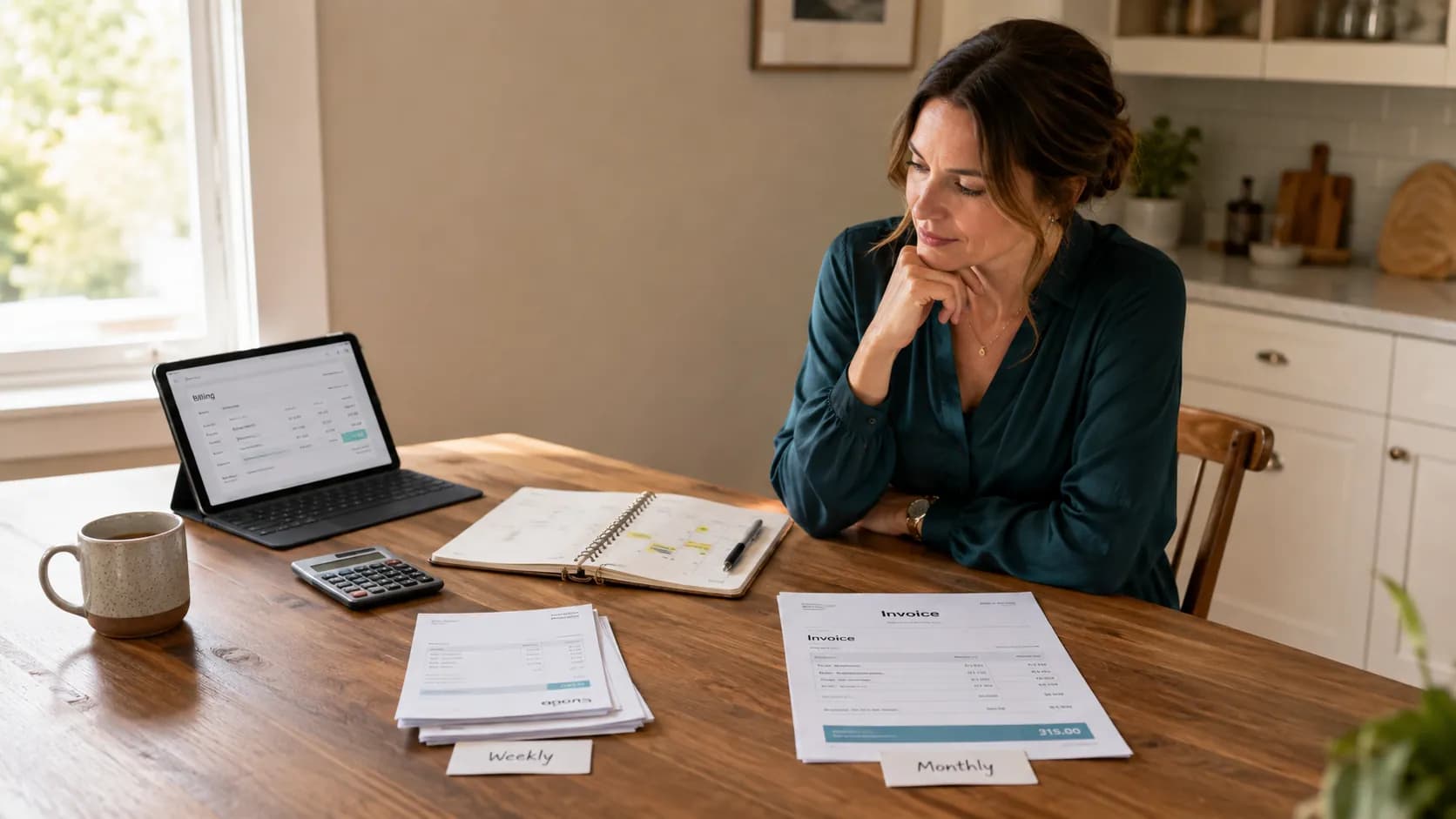
Step 3: Choose weekly, monthly, or package-based invoices
UK private tutors usually invoice in one of three ways.
Weekly invoices
Weekly invoices work well when parents want regular visibility. For example, you might invoice every Friday for lessons completed that week. This is useful for tutors teaching multiple siblings, weekly GCSE lessons, or trial lessons. The downside is that it creates more admin, which is exactly what our free weekly class invoice generator removes: set the day, rate, and number of weeks, and every lesson date fills in automatically.
Monthly invoices
Monthly invoices are cleaner for established tutoring relationships. For example, you might invoice on the last day of each month for all lessons delivered that month. This works well when students have regular weekly lessons. The downside is that a busy tutor may need to remember too much, unless attendance is tracked properly.
Package-based invoices
Some tutors sell lesson blocks, for example five lessons paid in advance. This can improve cash flow, but you still need attendance records, because parents will want to know how many lessons remain. The workflow is clean when each part connects: a package is purchased, attendance is recorded, a lesson is deducted, the remaining balance is shown, and the invoice or payment status updates.
The number most package trackers get wrong
A spreadsheet, and most software, tracks a package as two numbers: how many lessons were bought and how many have been taught. Subtract one from the other and you get a balance. That balance is honest about the past and silent about the future, because it ignores the lessons already sitting in your calendar.
Say a family bought ten, you have taught six, and the next three Tuesdays are already booked in. The balance says four. The number that matters is one. Book a fourth lesson on the strength of that four and you have quietly agreed to teach a lesson nobody has paid for.
So a package is better read as four numbers than one:
- Purchased, what the family paid for
- Used, what you have taught and marked present
- Booked, what is already in the calendar and not yet taught
- Available, what is genuinely free to book
Only the last one answers the question a parent is really asking when they say can we book a few more.
A ten-lesson block, six taught
10
Purchased
6
Used
3
Booked
1
Available
Only 1 lesson left to book. Time to ask about the next block.
Purchased
The block the family paid for
Used
Lessons already taught and marked present
Booked
Future lessons already in the calendar
Available = purchased - used - booked. The middle two are history; the last one is the only number that answers whether this family can book anything else.
Push the booked figure up and watch the last number go negative. That negative is not an accounting curiosity, it is the number of lessons you have promised to teach for free, and it is the single most useful thing a package tracker can tell you. In Teamlilit a package on the student record shows all four, warns when the fourth goes negative, and keeps a dated line for every credit taken or handed back, which is what settles a disagreement about how many lessons are left.
One caution whichever tool you use: decide early what a cancellation does to the balance. A lesson cancelled inside your notice period usually still burns a credit, and one cancelled with fair warning usually does not. Write that into your terms before the first block is sold, not after the first argument. Our guide to handling cancellations and no-shows covers the wording.
Step 4: Create the invoice from attendance records
Once attendance is recorded, the invoice becomes simple. Here is a basic example.
Tutor: Sarah Williams Parent: Mr James Carter Student: Emily Carter Subject: GCSE Maths Invoice date: 28 February 2026 Payment due: 5 March 2026
| Date | Time | Attendance | Billable time | Rate | Amount |
|---|---|---|---|---|---|
| 3 Feb | 17:00 | Attended | 60 min | £40/hr | £40 |
| 10 Feb | 17:00 | Attended | 60 min | £40/hr | £40 |
| 17 Feb | 17:00 | Cancelled late | 60 min | £40/hr | £40 |
| 24 Feb | 17:00 | Attended | 60 min | £40/hr | £40 |
Total due: £160 Payment method: Bank transfer Reference: Emily Maths Feb
This kind of invoice is not only clearer, it also reduces awkward parent conversations, because the parent can see the reason for the total. If you want to produce one quickly, you can create a simple tutoring invoice with a free tool.
UK tax and record-keeping notes for private tutors
If you are tutoring regularly in the UK and being paid for it, you are likely trading.
GOV.UK says you are likely to be trading if you sell services regularly to make a profit, or are paid for a service you provide. It also says you must register for Self Assessment as a sole trader if you earn more than £1,000 from self-employment in a tax year.
For invoicing, this means you should not treat tutoring payments casually once it becomes regular income. You should keep:
- invoices sent to parents or students
- records of payments received
- records of unpaid invoices
- lesson dates and billable hours
- business expenses
- bank statements
- VAT records if you are VAT registered
HMRC says self-employed people need to keep records of all sales and income, all business expenses, and proof such as sales invoices and bank statements. You normally need to keep these records for at least 5 years after the 31 January submission deadline for the relevant tax year.
This is why an attendance-based invoice is useful. It creates a cleaner connection between the lesson delivered and the income recorded. The same lesson records that make your invoices accurate also help you track billable tutoring hours for your accounts.
What about VAT for private tutors in the UK?
VAT is where tutors need to be careful. The simple version is that many small independent tutors will not be VAT registered, because they are below the VAT threshold. GOV.UK says you must register for VAT if your total taxable turnover goes over the registration threshold (£90,000) in the last 12 months, or if you expect it to go over the threshold in the next 30 days.
But tutoring has special VAT rules. HMRC's education VAT guidance says private tuition supplied by an individual teacher working in a personal capacity may be exempt from VAT where the conditions are met, including where the teacher is a sole proprietor or partner and the subject is one ordinarily taught in a school or university.
However, if a tutor takes on other teachers to deliver instruction, the VAT treatment can become more complicated. HMRC says tuition delivered by other teachers may be standard-rated, and the business may need to apportion between exempt and taxable tuition.
So, if you are a UK private tutor, check whether your tutoring is VAT exempt, below your VAT registration threshold, or taxable. This can depend on your structure, your subjects, and whether you personally deliver the tuition or use other tutors. Always check the current rules that apply to you rather than assuming all tutoring is automatically exempt.
How to handle cancellations and no-shows fairly
Cancellations are one of the biggest reasons tutor invoices become messy. A parent may say, "We did not attend, so why are we being charged?" The answer depends on what was agreed before the lesson.
Your cancellation policy should be written, easy to understand, shared before the first paid lesson, reasonable, applied consistently, and visible on invoices when a lesson is charged.
A simple example:
Lessons cancelled with at least 24 hours' notice can be rescheduled without charge. Lessons cancelled with less than 24 hours' notice may be charged at the full lesson rate. If the tutor cancels, the lesson will be rescheduled or refunded.
For UK consumer-facing services, clarity matters. Consumer protection guidance is built around making contract terms fair and clear, so a charge a parent did not expect is harder to enforce than one they agreed to in advance. A good tutoring invoice should not hide cancellation charges. It should show the attendance status and why the lesson was billable. That builds trust. If you do not have a policy yet, a private tutor cancellation policy template is a good starting point. For the charge itself, deciding between 0%, 50% and the full fee and wording the invoice line, see our guide to invoicing late tutoring cancellations.
Should tutors invoice parents or students?
For school-age students, tutors usually invoice the parent or guardian. For adult learners, tutors usually invoice the student directly. The invoice should match the person responsible for payment.
- If the parent books and pays, invoice the parent.
- If the student is an adult and pays themselves, invoice the student.
- If a company, school, or tutoring centre pays, invoice the organisation.
This sounds basic, but it matters for payment chasing. You want the invoice to go to the person who actually agreed to pay.
Manual invoice template vs attendance-based invoicing software
A template is fine when you teach a few lessons per week. A spreadsheet or invoice maker can help you create a simple invoice. But templates start breaking when you need to track weekly attendance, monthly parent invoices, late cancellations, no-shows, lesson packages, sibling lessons, unpaid invoices, partial payments, online lesson attendance, billable minutes, and parent payment history.
That is where tutor invoicing software becomes useful. The difference is simple: a template helps you write an invoice, while attendance-based invoicing software helps you know what should be on the invoice in the first place.
How Teamlilit helps with attendance-based tutor invoices
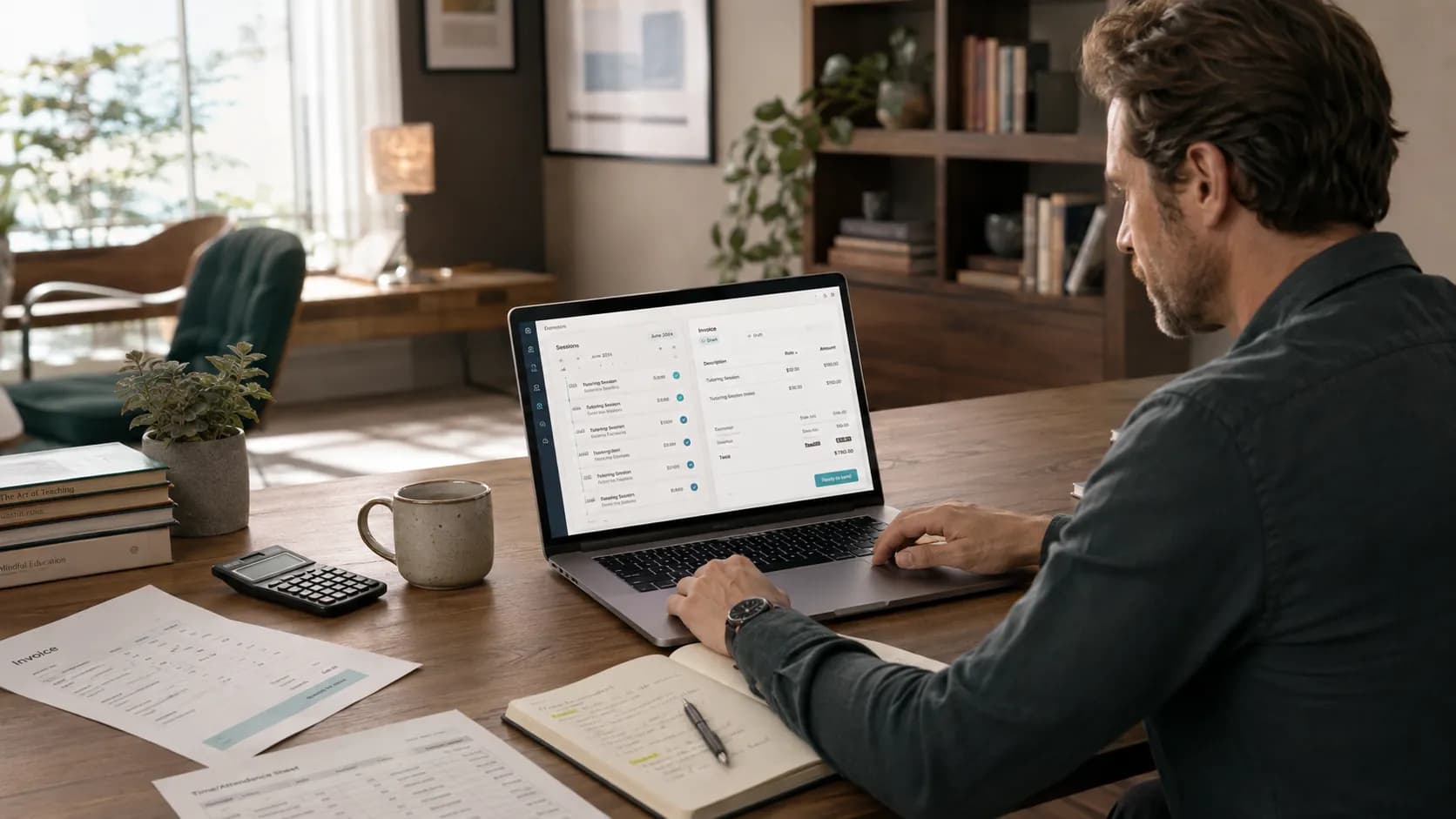
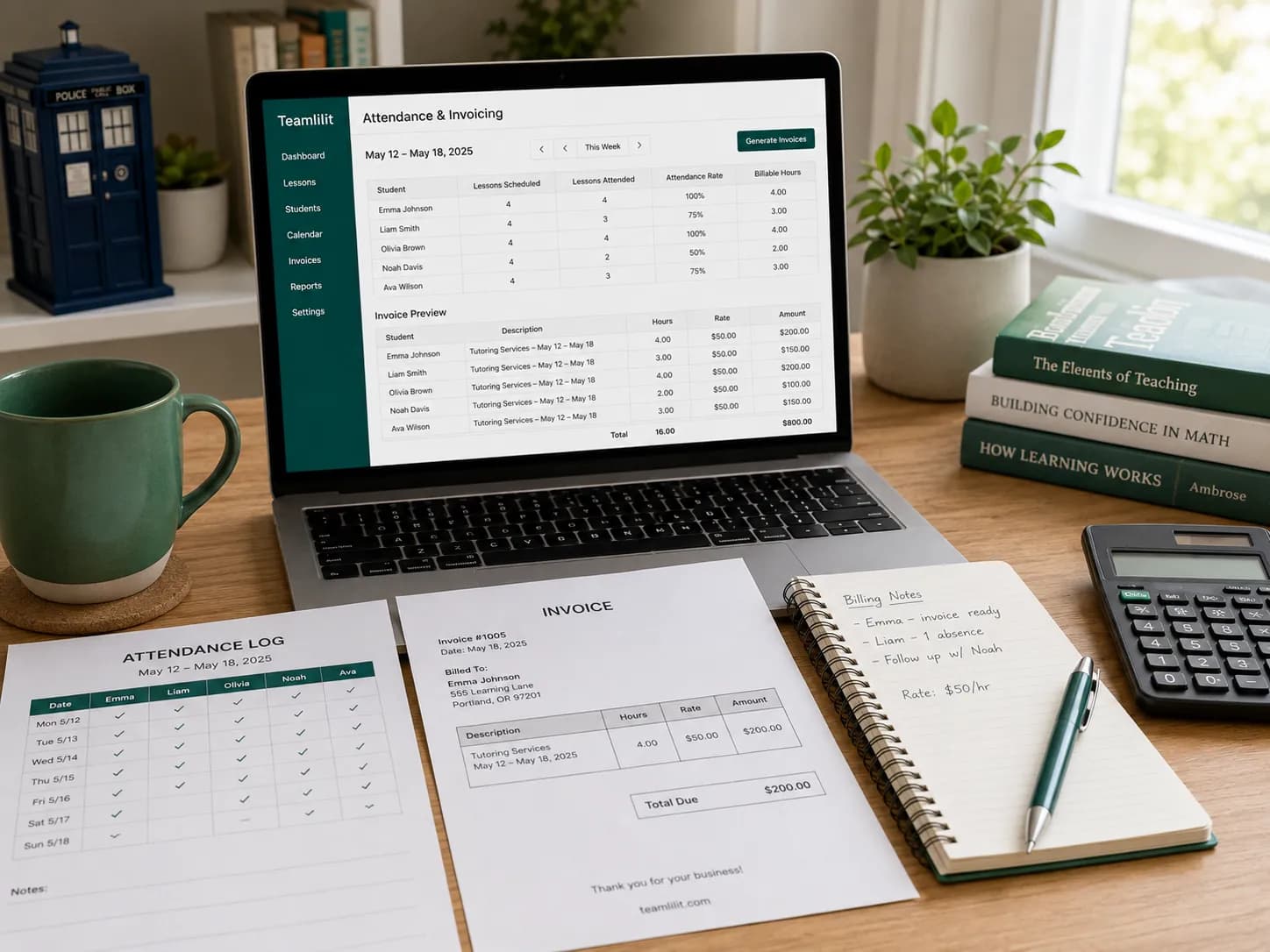
Teamlilit connects the parts of the tutoring workflow that are usually scattered across notebooks, spreadsheets, WhatsApp messages, and bank transfers. Instead of creating invoices manually from memory, tutors can keep lesson attendance, billable time, student records, and payment status connected.
A cleaner workflow looks like this:
- Schedule the lesson.
- Record attendance.
- Confirm billable time.
- Apply the cancellation rule if needed.
- Generate the invoice.
- Track whether the parent has paid.
- Keep the lesson history attached to the student record.
Attendance tells you what happened, billable time tells you what should be charged, and payment status tells you what is still outstanding. If you are copying those attendance rows into a template every month, Teamlilit can turn attendance into invoices with tracked lessons and per-student rates already on the draft. Review any cancellations or adjustments before sending, then record payments against the invoice as they arrive.
Common mistakes tutors make when invoicing
Mistake 1: Waiting too long to invoice
If you wait until the end of the month without good records, you will forget details. Invoice weekly, or keep attendance records immediately after each lesson.
Mistake 2: Not numbering invoices
Invoice numbers help you track payments and records. Use a simple format such as INV-2026-001, INV-2026-002, INV-2026-003.
Mistake 3: Mixing attended and cancelled lessons without explanation
Do not just add a cancellation charge silently. Show the status, for example: "17 Feb, cancelled late, chargeable under 24-hour cancellation policy."
Mistake 4: Not tracking unpaid invoices
An invoice is not finished when it is sent. You still need to know whether it is sent, viewed, paid, overdue, partly paid, or written off.
Mistake 5: Forgetting that records matter
For UK tutors, invoices are part of your business records. HMRC does not require you to send all records with your tax return, but you need to keep them so you can work out profit or loss and show them to HMRC if asked.
Simple tutoring invoice wording you can copy
Here is a simple line you can use in your invoice notes:
This invoice is based on tutoring lessons scheduled and attended during the billing period. Lessons marked as cancelled late or no-show are billed according to the cancellation policy agreed before the lesson.
For payment terms:
Payment is due within 7 days by bank transfer. Please use the student name and invoice number as the payment reference.
For your cancellation policy:
Lessons cancelled with at least 24 hours' notice can be rescheduled without charge. Lessons cancelled with less than 24 hours' notice may be charged at the full lesson rate.
Final checklist for UK tutors
Before sending a tutoring invoice, check that you:
- recorded attendance for each lesson
- calculated billable time clearly
- included cancelled or missed lessons only if your policy allows it
- included the student name or reference
- added your payment details
- included the payment due date
- saved a copy of the invoice
- updated the payment status after the parent paid
If you can answer yes to those questions, your invoicing process is already more professional than many tutors who rely on memory, messages, and manual spreadsheets.
Conclusion
The best way to invoice tutoring students is not to start with the invoice. Start with attendance.
When every lesson has a clear attendance record, invoicing becomes easier, fairer, and less awkward. You know what happened, parents can see what they are paying for, your records are cleaner, and your payment tracking becomes easier.
For UK tutors, this matters because tutoring is still a business. If you are self-employed, you need clear income records. If you grow, you may need better digital records. If you charge for late cancellations, your terms should be clear and fair.
A tutoring invoice should not be a guess at the end of the month. It should be the natural result of your lesson history. Teamlilit helps tutors turn attendance, lesson time, and student records into clear invoices, so you spend less time chasing admin and more time teaching.
FAQ
Do private tutors need to send invoices in the UK?
Private tutors are not always legally required to send a formal invoice to every parent, but it is strongly recommended. If you are self-employed, you need clear records of your income and payments, and invoices are one of the easiest ways to keep those records organised.
What should a tutoring invoice include?
A tutoring invoice should include your name or business name, parent or student name, invoice number, invoice date, payment due date, lesson dates, billable time, hourly rate, total due, and payment details.
Can I charge for missed tutoring lessons?
You can usually charge for missed lessons if the parent or student agreed to a clear cancellation or no-show policy before the lesson. The policy should be reasonable, written clearly, and applied consistently.
Should I invoice weekly or monthly?
Weekly invoices are useful for newer tutoring relationships or parents who want frequent updates. Monthly invoices are better for stable, recurring lessons. If you invoice monthly, attendance tracking becomes more important.
Do UK tutors need to register for VAT?
Not always. VAT depends on your turnover, your tutoring structure, and whether your tuition qualifies for VAT exemption. GOV.UK says VAT registration is required when taxable turnover goes over the threshold, but private tuition has special exemption rules in some cases. Always check the rules that apply to you.
Is a spreadsheet enough for tutor invoices?
A spreadsheet is enough at the beginning. But once you manage multiple students, weekly attendance, cancellations, packages, and unpaid invoices, dedicated tutor invoicing software becomes much easier.
Sources
- Self Assessment tax returns: who must send a tax return - GOV.UK. You must register once self-employed income goes over the £1,000 trading allowance.
- Business records if you're self-employed - GOV.UK. What to keep, and for at least 5 years after the 31 January deadline.
- Register for VAT - GOV.UK. Registration is required once taxable turnover goes over £90,000.
- VAT on education and vocational training (Notice 701/30) - GOV.UK (HMRC). The private tuition VAT exemption and how using other teachers changes it.