Last-minute cancellations are one of the most frustrating parts of running a tutoring business. A student cancels an hour before the lesson, a parent forgets the appointment, a learner does not show up. A weekly session disappears from your timetable, and the hour you planned, prepared for, and reserved is suddenly unpaid.
For private tutors, this is not just annoying. It affects income, scheduling, preparation time, and the stability of the business. That is why every tutor should have a clear cancellation policy.
A private tutor cancellation policy explains what happens when a student cancels a lesson, misses a session, gives short notice, or needs to reschedule. It protects the tutor's time while giving parents and students clear expectations from the beginning. The goal is not to sound strict or unfriendly; it is to avoid confusion. When your cancellation terms are clear, agreed in advance, and easy to understand, missed lessons become much easier to manage professionally.
If you would rather not start from a blank page, our free private tutor cancellation policy template builds the wording for you. This guide explains what to put in it and why each part matters.
Why private tutors need a cancellation policy
Many tutors avoid creating a cancellation policy because they worry it will make them sound harsh. The internal monologue is familiar: "I don't want to scare parents away," "I want to be flexible," "I'll just handle cancellations case by case," "it feels uncomfortable to charge for a lesson that did not happen." That reaction is understandable, especially for tutors who are just starting out.
But without a policy, every cancellation becomes a negotiation. Should the parent pay? Should the lesson be rescheduled? Should the tutor absorb the lost time? What if the same student cancels repeatedly, or does not show up at all? A cancellation policy gives you a professional framework before the problem happens. It helps you:
- Protect your income
- Reduce last-minute cancellations
- Avoid awkward conversations
- Set expectations with parents and students
- Keep your weekly timetable stable
- Plan your availability more confidently
- Treat students consistently
Tutoring is not only the hour spent teaching. It often includes preparation, lesson planning, homework review, travel time for in-person tutors, communication, and follow-up. When a student cancels late, you may not be able to fill that slot with another student, and that time is lost. A fair cancellation policy recognises that your time has value.
Is it fair to charge for cancelled tutoring lessons in the UK?
In many situations, it can be fair for a private tutor to charge a cancellation fee, provided the terms are clear, agreed before lessons begin, and proportionate. The important word is fair. A cancellation policy should not be designed to punish families; it should protect reserved teaching time and encourage proper notice.
For example, a tutor might set out that:
- Lessons cancelled with more than 24 hours' notice can be rescheduled without charge.
- Lessons cancelled with less than 24 hours' notice may be charged at the full lesson rate.
- No-shows may be charged at the full lesson rate.
- Genuine emergencies will be handled with flexibility.
This kind of wording is clear and practical. It tells parents what to expect while still leaving room for reasonable judgement. For UK tutors, it is sensible to avoid vague or extreme wording. Instead of "all payments are non-refundable under all circumstances," it is usually better to explain the notice period, the fee, and the exceptions clearly. The safest approach is simple: be transparent, be consistent, be reasonable, and make sure students and parents see the policy before they book lessons.
24-hour vs 48-hour cancellation policy: which should tutors choose?
One of the biggest decisions tutors face is whether to use a 24-hour or 48-hour cancellation policy. Both can work. The right choice depends on your tutoring style, subject, schedule, student type, and how difficult it is to replace cancelled sessions.
24-hour cancellation policy
A 24-hour cancellation policy is common for private tutors because it feels flexible and easy for parents to understand. For example: "Lessons cancelled with less than 24 hours' notice may be charged at the full lesson rate."
This works well if you teach one-to-one lessons, your schedule changes often, you want a softer policy, you work with families who may need some flexibility, or you are still building trust with new students. A 24-hour policy is usually easier to introduce because it feels fair to most parents. The downside is that 24 hours may still be too short to fill the slot, especially if you teach evenings or weekends.
48-hour cancellation policy
A 48-hour cancellation policy gives tutors more time to reorganise their schedule. For example: "Lessons cancelled with less than 48 hours' notice may be charged at the full lesson rate."
This may be better if your timetable is very full, you teach high-demand subjects, you prepare personalised materials in advance, you run group lessons, you work with exam preparation students, or you manage a tutoring centre or structured programme. A 48-hour policy gives more protection, but it can feel stricter. If you choose it, explain it clearly and politely:
"Because lesson times are reserved in advance and preparation begins before each session, I ask for at least 48 hours' notice for cancellations or rescheduling."
That sounds more reasonable than simply saying "cancel within 48 hours and you pay." The explanation matters.
What should a tutoring cancellation policy include?
A good tutoring cancellation policy should be short, clear, and practical. It does not need to read like a legal contract. It should answer the questions parents and students are most likely to ask.
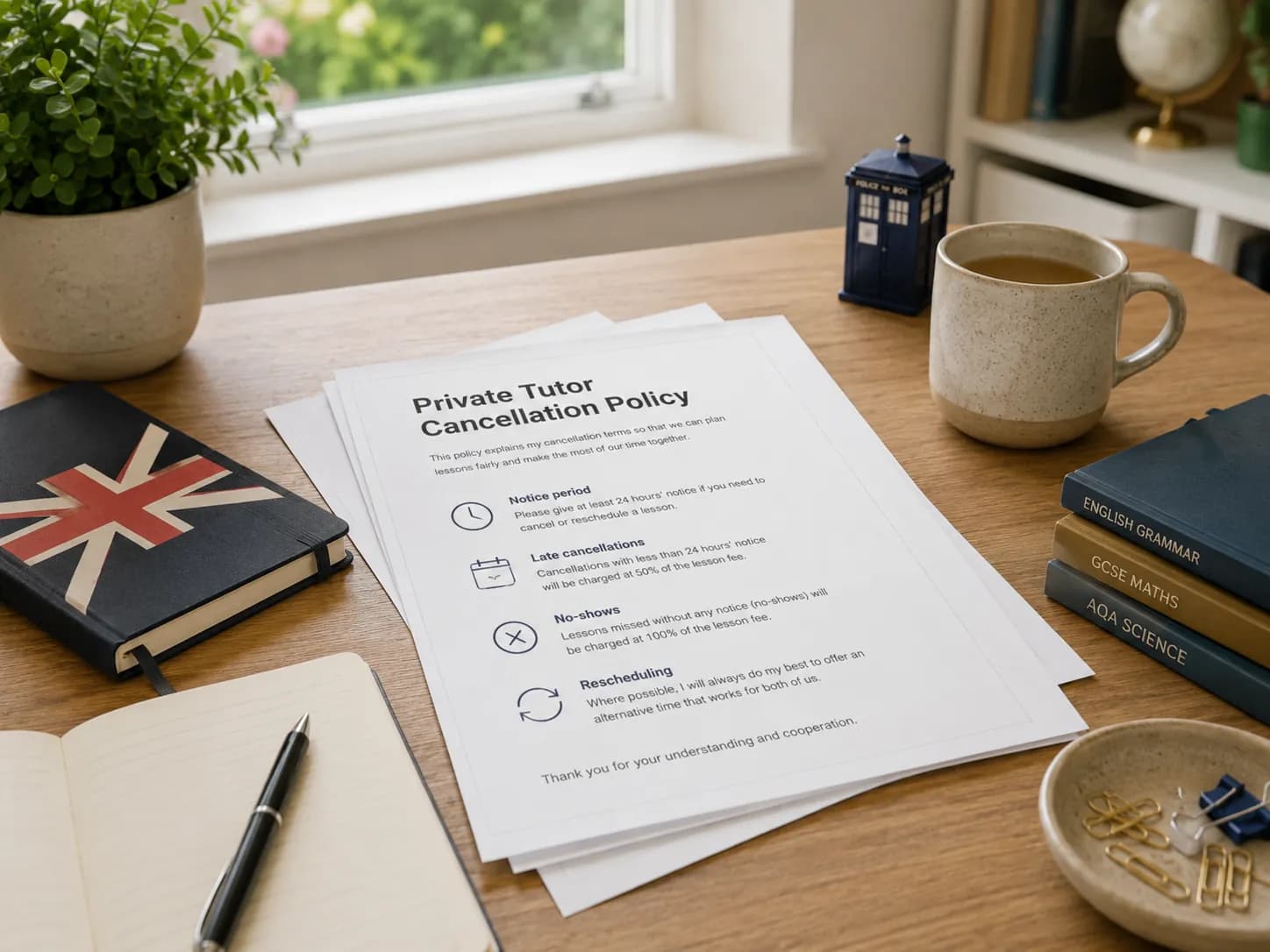
1. Notice period
The notice period explains how much time the student or parent must give before cancelling or rescheduling. Common options are 24 hours' notice, 48 hours' notice, or one week's notice for recurring lessons or monthly packages.
Example wording: "Please give at least 24 hours' notice if you need to cancel or reschedule a lesson." This is the foundation of the policy.
2. Late cancellation fee
The late cancellation fee explains what happens if the student cancels too late. Example wording: "Lessons cancelled with less than 24 hours' notice may be charged at the full lesson rate."
Some tutors charge the full fee, others charge 50%, and some offer one free late cancellation per term. There is no single rule that fits every tutor. The key is to choose a policy that reflects your business and to communicate it clearly before lessons begin.
3. No-show rule
A no-show happens when the student does not attend and does not give notice. Treat it separately, because it is often more disruptive than a normal cancellation. Example wording: "If a student does not attend a scheduled lesson without notice, the lesson may be charged at the full rate."
For online tutoring, you may also want to define how long you wait: "If the student has not joined within 15 minutes of the scheduled start time and no message has been received, the session will be considered a no-show." This avoids confusion. If recurring no-shows are a pattern in your business, our guide on how to reduce student no-shows in online tutoring covers the reminders, prepayment, and habits that prevent them in the first place.
4. Rescheduling rules
Some tutors allow students to reschedule instead of losing the lesson. That can be helpful, but it needs boundaries. Example wording: "Lessons cancelled with more than 24 hours' notice can be rescheduled subject to availability."
The phrase "subject to availability" is important. It means you are not promising unlimited replacement slots. If your timetable is full, you may not always be able to offer another time that week.
5. Illness and emergencies
A good cancellation policy should leave room for real life. Students get sick, parents have emergencies, and unexpected things happen. You can include a compassionate exception without making the policy meaningless. Example wording: "I understand that illness and emergencies can happen. In genuine emergency situations, cancellations will be handled with flexibility." This gives you discretion, and it shows parents that the policy is not designed to punish them.
6. What happens if the tutor cancels
Your policy should not only protect you; it should also explain what happens if you need to cancel. Example wording: "If I need to cancel a lesson, I will offer a rescheduled session or a full refund for that lesson." This builds trust. Parents are far more likely to accept your cancellation terms when they feel the policy is fair on both sides.
7. Payment and invoices
If you invoice students or parents, your cancellation policy should connect clearly to payment. For example: "Late cancellation fees and no-show charges may be included on the next invoice." This avoids a separate uncomfortable payment conversation. If you use a tutor invoice maker or a tutoring management platform, you can keep cancellation fees, lesson records, and payment notes organised in one place.
Example private tutor cancellation policy wording
Here is a simple example you can adapt.
Private tutor cancellation policy
To help keep lessons organised and fair for all students, please give at least 24 hours' notice if you need to cancel or reschedule a lesson.
Lessons cancelled with more than 24 hours' notice can be rescheduled subject to availability.
Lessons cancelled with less than 24 hours' notice may be charged at the full lesson rate.
If a student does not attend a scheduled lesson without notice, the session may be treated as a no-show and charged at the full lesson rate.
I understand that illness and emergencies can happen. Genuine emergency situations will be handled with flexibility.
If I need to cancel a lesson, I will offer a rescheduled session or a full refund for that lesson.
This version is clear, polite, and balanced. It protects the tutor's time while still sounding professional and human.
Example 48-hour cancellation policy
If you want stronger protection, you can use a 48-hour version.
48-hour tutor cancellation policy
Lessons are reserved in advance, and preparation may begin before each session. For this reason, I ask for at least 48 hours' notice if you need to cancel or reschedule a lesson.
Lessons cancelled with more than 48 hours' notice can be rescheduled subject to availability.
Lessons cancelled with less than 48 hours' notice may be charged at the full lesson rate.
No-shows may also be charged at the full lesson rate.
Illness and genuine emergencies will be considered on a case-by-case basis.
If I need to cancel a lesson, I will offer a rescheduled session or refund the lesson fee.
This version works well for tutors with a full timetable, exam preparation students, or highly personalised lesson preparation.
Example parent message for introducing your policy
The way you introduce your cancellation policy matters. You do not need to sound defensive; you can keep it friendly and professional.
"Hi, I just wanted to share my lesson cancellation policy so everything is clear from the start. I ask for at least 24 hours' notice if a lesson needs to be cancelled or rescheduled. Lessons cancelled with less than 24 hours' notice may be charged at the normal lesson rate, as the time has been reserved and may not be possible to offer to another student. Of course, genuine emergencies will be handled with flexibility. Thank you for understanding."
This message works because it explains the reason behind the policy. Parents are more likely to respect a policy when they understand why it exists.
How to add a cancellation policy to your tutoring terms
You can share your cancellation policy in several places:
- In your welcome message to new students
- On your tutoring website
- In your lesson agreement
- In your booking confirmation
- On your invoices
- Inside your student onboarding document
- In your parent communication template
The most important thing is that parents and students see it before a cancellation happens. Do not wait until the first missed lesson to mention the policy; that can feel unfair and create tension. Introduce it when the tutoring relationship begins. For example: "Before we start, I'll send over the lesson details, payment information, and cancellation policy so everything is clear." That sounds professional, and it shows you take your tutoring business seriously.
Should you charge full price for no-shows?
Many tutors charge the full lesson fee for no-shows. That is understandable: the tutor was ready, the time was reserved, and the student did not attend. However, you should explain this clearly in advance: "If a student does not attend a scheduled lesson and no notice has been given, the session may be charged at the full lesson rate."
For online lessons, define when a no-show begins: "If the student has not joined within 15 minutes and I have not received a message, the lesson will be considered a no-show." This avoids confusion around late arrivals.
You can also choose to be flexible the first time it happens: "I understand things can happen, so I may waive the first no-show charge as a goodwill gesture. Repeated no-shows will be charged at the full lesson rate." This can be a good balance between professionalism and kindness.
How to handle illness without losing control of your policy
Illness is one of the hardest parts of cancellation policies. You want to be fair, but you also do not want the policy to become meaningless. A good approach is to include flexibility without creating unlimited exceptions: "Illness and genuine emergencies will be handled with flexibility, but repeated short-notice cancellations may still be charged."
This protects you from repeated patterns while still allowing compassion. You can also encourage parents to give notice as soon as possible: "If your child is unwell, please let me know as early as you can so I can manage the timetable." The tone matters. A cancellation policy should not make families afraid to communicate; it should encourage them to communicate earlier.
How to reduce cancellations before they happen
A cancellation policy helps, but prevention is even better. Tutors can reduce cancellations by improving communication and organisation.
Send lesson reminders. Many missed lessons happen because people forget. A simple reminder reduces no-shows. Send one the day before, and one a few hours before, at the same time each week for recurring lessons. If you teach online, include the lesson link or platform instructions in the reminder.
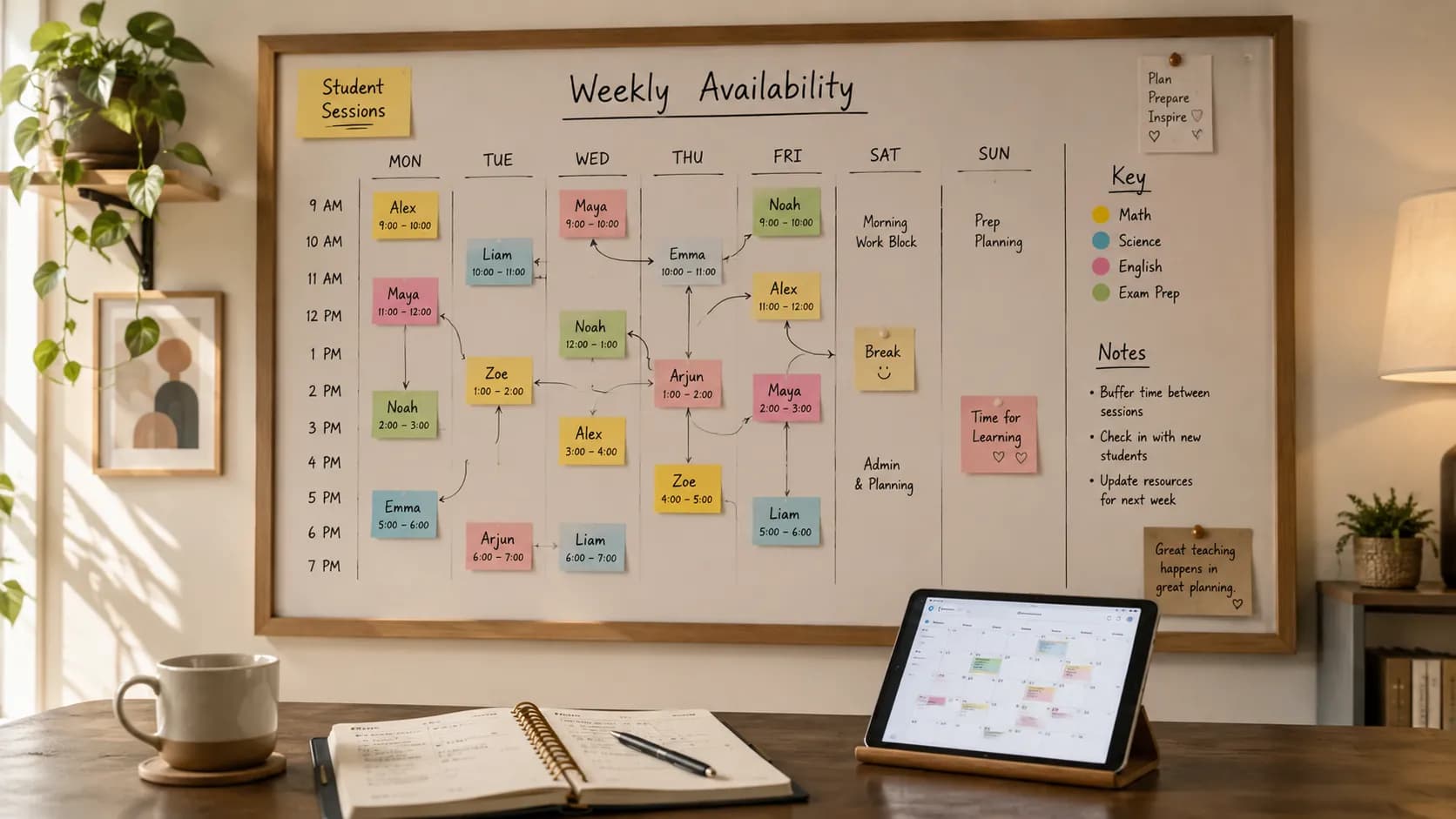
Keep a clear tutoring timetable. If your timetable is messy, cancellations become harder to manage. Track student names, lesson times, recurring sessions, rescheduled lessons, cancelled sessions, attendance, and remaining package hours in one place. This is where tutor scheduling software or a free tutor timetable template helps, and our guide on how to create a tutoring timetable walks through the structure.
Confirm recurring lessons. Do not assume every family remembers the schedule perfectly. At the start of each month or term, confirm recurring lesson times: "Just confirming that our lessons will continue every Tuesday at 5:00pm this month." This reduces misunderstandings.
Make homework and follow-up clear. Sometimes students cancel because they feel unprepared. After each lesson, tell the student what was covered, what to practise, what to prepare for next time, and where to find the lesson materials. A more organised learning experience improves attendance.
Track patterns. One cancellation may be normal; repeated cancellations are a pattern. If a student often cancels late, misses lessons, or reschedules frequently, it may be time for a polite conversation: "I've noticed we've had several short-notice cancellations recently. Would another regular time work better for you?" Sometimes the issue is not motivation, but a lesson time that no longer works.
How cancellation policies connect to invoicing
Cancellation policies are much easier to enforce when your invoices are clear. If a late cancellation fee is added to an invoice, the invoice should show what the charge is for. For example, an invoice line that reads "Late cancellation fee: Maths tutoring session scheduled for 12 September" is far clearer than an unexplained amount.
If you use invoices for your tutoring business, consider including a short cancellation note at the bottom: "Lessons cancelled with less than 24 hours' notice may be charged at the normal lesson rate." This keeps the policy visible and reminds parents of the agreement without a separate conversation every time. A tutor invoice maker makes it easy to add both the line item and the standing note.
Connect your cancellation policy to your invoices
When a student cancels late, misses a session, or arrives late, the first thing you need to know is whether that time is billable. That is exactly where your cancellation policy and your billing should meet, so attendance-based invoicing can pull the right charge straight from what actually happened. Our guide on how to invoice tutoring students based on attendance walks through turning attended, cancelled, and no-show sessions into a clear bill, and a simple tutoring attendance sheet template gives you the record those charges rest on. Once a specific lesson has been cancelled late, our guide to invoicing late tutoring cancellations helps you decide what to charge and how to word the invoice line.
How cancellation policies connect to attendance and time tracking
A cancellation policy is not only about money; it is also about records. Tutors should track attended lessons, cancelled lessons, late cancellations, no-shows, rescheduled lessons, lesson duration, and package hours used.
This helps you understand what is happening in your tutoring business. If one student repeatedly cancels, you can see the pattern clearly. If you sell lesson packages, you can see which sessions were delivered and which were missed. If parents ask for an update, you have a record instead of relying on memory. Per-student time tracking and a proper student management system turn this from a manual chore into something that fills itself in as lessons happen. For tutoring centres, where multiple tutors and students are involved, this becomes even more important.
Using a free private tutor cancellation policy template
Writing your policy from scratch can feel awkward. You may know what you want to say, but not how to say it professionally. That is why using a private tutor cancellation policy template helps. A good template should let you choose:
- A 24-hour or 48-hour notice period
- Whether late cancellations are charged
- How no-shows are handled
- How illness and emergencies are treated
- What happens if the tutor cancels
- Whether cancellation terms appear on invoices
- How to explain the policy to parents
You can then adapt the wording to match your tutoring style. The policy should sound professional, but still human. A template gives you a starting point; always review it and adjust it to fit your business. Our free cancellation policy generator does exactly this, and produces a ready-to-send parent message and email alongside the policy itself.
How Teamlilit helps tutors stay organised
A cancellation policy is easier to manage when your tutoring workflow is organised. Teamlilit helps tutors manage more than just individual lessons; it supports the wider tutoring process, including students, schedules, online classes, resources, recordings, attendance, and follow-up.
For tutors dealing with cancellations, no-shows, rescheduling, invoices, and lesson records, having everything in one place reduces admin work. Instead of tracking policies in one document, attendance in a spreadsheet, invoices in another tool, and lessons in a calendar, you can build a single structured workflow. The goal is simple: spend less time managing scattered admin, and more time teaching.
Final thoughts
A private tutor cancellation policy is not about being strict for the sake of it. It is about respecting your time and setting clear expectations. When students and parents know the rules in advance, cancellations become easier to manage.
A good policy should explain how much notice is required, what happens with late cancellations, how no-shows are handled, whether rescheduling is possible, how illness and emergencies are treated, what happens if the tutor cancels, and how cancellation fees appear on invoices. Keep the wording clear, keep the tone professional, and make sure parents and students see it before lessons begin.
Remember: the best cancellation policy is not the harshest one. It is the one that protects your time, feels fair to families, and helps your tutoring business run smoothly. When you are ready, our free private tutor cancellation policy template will write a fair, downloadable version for you in about a minute.
Frequently asked questions
Can private tutors charge for cancellations in the UK?
Private tutors can often include cancellation terms in their tutoring agreement, but the policy should be clear, fair, agreed in advance, and proportionate. Tutors should avoid surprising parents with cancellation fees after the fact. If you are unsure about your specific situation, consider getting professional advice.
Is 24 hours' notice enough for a tutor cancellation policy?
A 24-hour cancellation policy is common for private tutors because it feels simple and reasonable to many families. It can work well for one-to-one tutoring, flexible schedules, and tutors who want a softer approach. However, tutors with full timetables or heavy preparation may prefer 48 hours' notice.
Is 48 hours' notice too strict for tutoring lessons?
A 48-hour policy is not automatically too strict, but it should be explained clearly. It may be suitable for exam preparation, group tutoring, high-demand subjects, or tutors who prepare personalised materials in advance. The key is to communicate the policy before lessons begin.
Should I charge full price for a no-show?
Many tutors charge the full lesson fee for no-shows because the time was reserved and the tutor was ready to teach. If you choose to do this, explain the no-show rule clearly in your policy. You can also include flexibility for genuine emergencies.
Can I include cancellation terms on my tutor invoice?
Yes, you can include a short cancellation policy note on your tutor invoice. For example: "Lessons cancelled with less than 24 hours' notice may be charged at the normal lesson rate." This helps remind parents of the policy and keeps payment expectations clear.
How do I tell parents about my cancellation policy?
Keep the message polite and simple. Explain that the policy helps keep lesson times fair and organised. Share it before lessons begin, not after the first cancellation. A friendly explanation usually works better than formal or aggressive wording.
Should I make exceptions for illness?
Many tutors choose to handle illness and emergencies with flexibility. A good policy can say that genuine emergencies will be considered case by case, while repeated short-notice cancellations may still be charged.
What should a tutoring cancellation policy include?
A tutoring cancellation policy should include the notice period, late cancellation fee, no-show rule, rescheduling rules, illness or emergency exceptions, what happens if the tutor cancels, and how cancellation fees are handled on invoices.