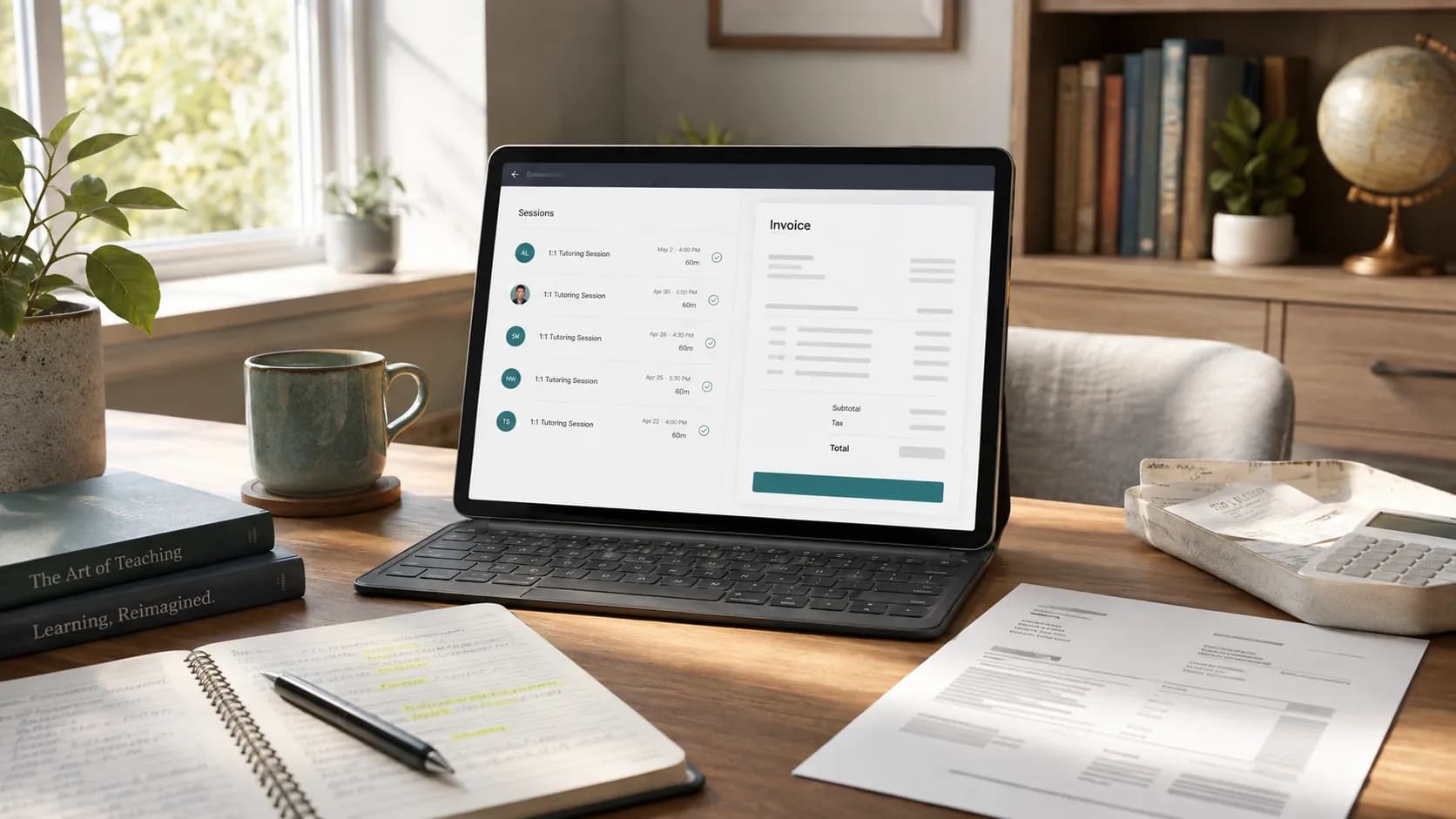
This guide is about the second half of the job. It assumes you already have a record of what you taught and covers what to do with it on billing day.
If you are still deciding what to record on each lesson, and what counts as billable in the first place, start with how tutors can track billable hours, attendance and lesson time. That guide builds the log. This one converts it.
The gap nobody budgets for
Most tutors have solved tracking, in some form. There is a notebook, a spreadsheet, a calendar with reasonably accurate entries, or automatic lesson time recording doing it for them.
What almost nobody has is a conversion routine. So the last Sunday of the month becomes an archaeology project: cross-referencing a calendar against WhatsApp against a half-filled sheet, trying to remember whether the 14th was a no-show or a reschedule, and eventually issuing invoices you are about 90% confident in.
That last 10% is expensive. It is where you under-bill because you could not prove a lesson happened, over-bill and get a complaint, or lose forty minutes per invoice that should have taken two.
The fix is not better tracking. It is having a fixed sequence that runs the same way every month.
Step 1: Freeze the period
Pick a cut-off date and stop counting there. The 28th, the last Friday, the end of the calendar month, it genuinely does not matter which, only that it does not move.
The temptation is to wait "just until Thursday's lesson" so the invoice is complete. Resist it. A fixed cut-off that occasionally pushes one lesson into next month's invoice costs you nothing. A floating one means you are never finished, and it makes every month's invoice cover a slightly different span, which is exactly the thing parents query.
Write the cut-off on the invoice itself: "Lessons from 1 to 31 July". Now the boundary is visible to both sides, and a lesson on the 1st of August has an obvious home.
Step 2: Reconcile, do not rebuild
This is the step that eats the evening, and it is almost always done backwards.
The instinct is to start from a blank invoice and reconstruct the month lesson by lesson. Do the opposite: start from the record you already have, compare it against what was scheduled, and only investigate the rows where the two disagree.
In a normal month, most lessons happened exactly as booked. Those need no thought at all. What needs thought is the handful of exceptions:
- A scheduled lesson with no attendance recorded against it
- Attendance recorded with no scheduled lesson (an instant or rescheduled session)
- A duration that looks wrong for the slot
- A student who appears in a group session they are not enrolled in
If you are reconciling by hand, the free tutoring hours tracker is built for exactly this comparison: it holds the lesson log and does the duration and billable arithmetic, so the only thing left is judgement on the exceptions.
Step 3: Apply the billing rules, in this order
Recorded time is not billable time. Three rules convert one into the other, and applying them in a fixed order stops them interfering with each other.
First, cancellation status. Every session that did not run normally gets resolved against your cancellation policy before anything else happens. Cancelled in time is dropped. Late cancellation and no-show are typically billed in full, because the slot was held and could not be resold. A lesson you cancelled is dropped and its replacement billed instead.
Second, package drawdown. Students on a prepaid block do not generate a charge, they generate a deduction. Take their billable lessons off the block and note the remaining balance. Only when a block runs out mid-month does anything land on this invoice, and then only for the lessons past the balance. Getting this order wrong is the single most common cause of double-billing a package student.
Third, per-student rates. Whatever is left is billed at that student's rate, which is rarely one number across your whole roster. KS3, A-Level prep and adult conversational lessons are three different rates, and a student who moved from GCSE to A-Level in October may have two rates within the same month. If your rates changed mid-period, split the lines at the change date rather than averaging.
Step 4: Group by payer, not by student
Your records are organised by learner. Your invoices should be organised by whoever actually pays.
For a family with two children in different subjects, that is one invoice, itemised per child, not two invoices to the same inbox. It means one payment to chase, one reference to match against your bank statement, and one conversation if something is queried. Parents notice this, and it makes a one-person tutoring business look considerably more organised than it is.
Adult learners paying for themselves are the simple case: payer and learner are the same person. Corporate or school-funded students are the awkward one, because the payer never attended any of the lessons and needs more context on the line items, not less.
For recurring weekly classes billed to several families, our weekly class invoice generator fills in every lesson date from the day, rate and number of weeks, which handles the most repetitive version of this grouping without any per-family retyping.
Step 5: Issue, then chase on a schedule
Send everything on the same date each month. Predictability is what gets tutoring invoices paid: a parent who expects your invoice on the 1st has budgeted for it, and one who receives it whenever you got round to it has not.
Then diarise the chase before you need it. Two follow-ups, on fixed days, sent whether or not you feel awkward about it:
Subject: Invoice INV-0142, due Friday
Hi Sarah,
A quick reminder that invoice INV-0142 for July's lessons (£280) is due this Friday, 8 August.
The invoice is attached again for convenience, and the bank details are at the bottom. Please use INV-0142 as the payment reference so I can match it up.
Any questions about the lessons listed, just ask.
Best, Amar
Note what that message does not do: apologise, explain, or negotiate. It states a fact and a date. Most late tutoring payments are not refusals, they are a parent who genuinely forgot, and a factual reminder resolves them without any relationship cost.
Our guide to invoicing tutoring students covers numbering, payment terms and the second, firmer reminder in more detail.
When you get it wrong: credit notes, not edits
You will occasionally send an invoice that is wrong. A lesson billed that should have been dropped, a rate applied that changed last month, a package deduction missed.
Do not edit the invoice and resend it, and do not delete it. Issue a credit note against the original.
The original number stays in your records, the correction is visible and auditable, and the parent can see exactly what changed rather than receiving a second document that mysteriously says something different from the first. If you are VAT registered this stops being a preference and becomes a requirement, since an issued invoice is a tax document.
This also protects you in the opposite direction. A parent who queries a line and turns out to be wrong gets a clear answer from an unmodified record, rather than your word against theirs about what the first version said.
Where the routine disappears entirely
Everything above is a procedure for reconciling two records that were built separately: what you planned, and what happened. The reason it takes an evening is that they are separate.
When lesson time is recorded on the session itself, the two records are one record, and steps 2 and 3 mostly evaporate. A tutor billing management system drafts the invoice from sessions it already tracked, one line per lesson, with each student's rate applied, already excluding anything billed last month. You review a draft rather than assembling one. Attendance on every session is what makes that draft trustworthy, and Teamlilit's invoicing handles the consolidation, tax and credit notes described above.
That does not make the routine pointless. You still need a cut-off, still need to group by payer, and still need to chase. It removes the archaeology, not the judgement.
Getting to that point is a setup job rather than a monthly one, and it is worth doing deliberately: our guide to connecting time tracking to billing covers which pieces to join in what order, the rounding and payer rules to fix once, and what genuinely integrates with what.
Frequently asked questions
How often should tutors invoice?
Monthly in arrears suits most regular tutoring: one invoice per payer covering the month's lessons, issued on the same date every month. Packages and brand-new students are the exception and are usually billed upfront, partly for cash flow and partly because prepayment reduces no-shows.
What do I do about a lesson taught after my cut-off date?
Leave it for next month. A fixed cut-off that occasionally shifts a lesson into the following invoice is far less work than a floating one that forces you to reopen a period you have already billed. State the period on the invoice so the boundary is visible.
How do I fix an invoice I have already sent?
Issue a credit note against the original rather than editing or deleting it. The original invoice number stays in your records, the correction is auditable, and the parent can see exactly what changed and why. If you are VAT registered, this is required rather than optional.
Should siblings get separate invoices?
Group by payer rather than by learner. One consolidated invoice per paying adult, itemised per child, means one payment to chase instead of three and one reference to reconcile against your bank statement.
How long should this actually take?
Around twenty minutes a month once your record is trustworthy enough that you are reconciling exceptions rather than rebuilding the month. If it is still taking you an evening, the problem is almost always upstream in how the hours get recorded, not in the invoicing itself.
The short version
Freeze the period. Reconcile the exceptions rather than rebuilding the month. Apply cancellation status, then package drawdown, then rates, in that order. Group by payer. Issue on a fixed date and chase on fixed days. Correct with credit notes.
Do it the same way every month and billing day stops being a day.