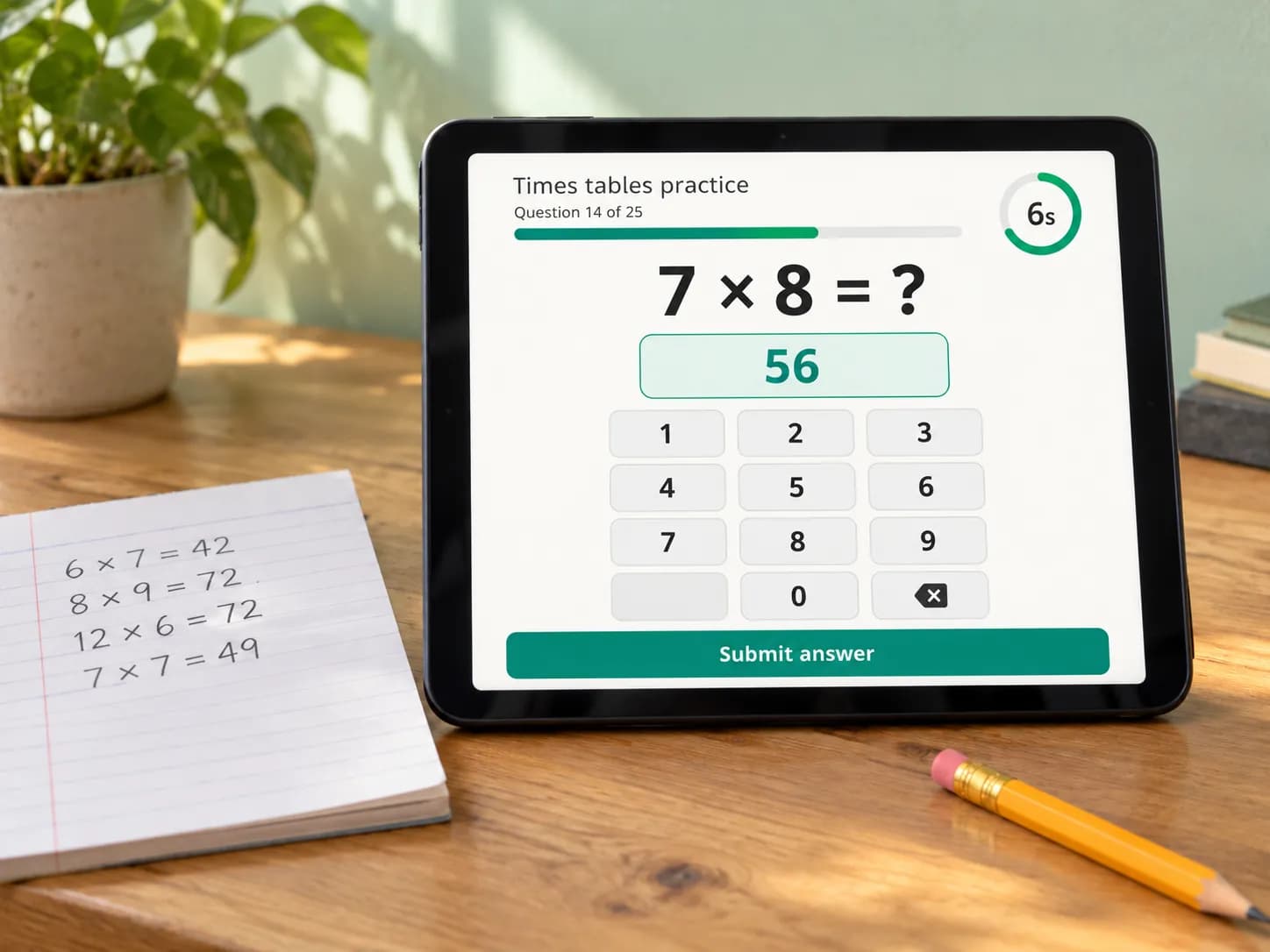
Every June, Year 4 pupils in England sit down in front of a screen and answer 25 times tables questions, each against a 6-second clock. The multiplication tables check is short, it has no pass mark, and it still makes a lot of children (and parents) nervous.
Quick answer: The multiplication tables check (MTC) is a statutory on-screen check for Year 4 pupils in England. It has 25 questions from the 2 to 12 times tables, 6 seconds per question and a 3-second pause in between, and takes under 5 minutes. There is no pass mark: the school gets a score out of 25 and shares it with you.
This guide explains exactly how the check works, which tables come up and how often, what the score means, and how to practise in a way that builds recall rather than anxiety. There is a practice check further down that follows the official format.
What the multiplication tables check is for
The purpose of the check, in the words of the Department for Education's assessment framework for the check, is "to determine whether year 4 pupils can fluently recall their multiplication tables". It is not designed as a diagnostic test, but it helps schools spot pupils who need extra support.
It has been statutory since the 2021 to 2022 school year. All eligible Year 4 pupils at maintained schools, special schools and academies (including free schools) in England take it. It sits at the end of a curriculum path that starts in Key Stage 1:
| Year | What the national curriculum expects |
|---|---|
| Year 2 | Recall and use multiplication and division facts for the 2, 5 and 10 times tables |
| Year 3 | Recall and use multiplication and division facts for the 3, 4 and 8 times tables |
| Year 4 | Recall multiplication and division facts for multiplication tables up to 12 × 12 |
These are the statutory statements in the national curriculum for mathematics. The check measures the Year 4 one.
How the times tables check works
The check is taken online, on screen, in June. Here is what your child will see, from the Department for Education's information for parents and the assessment framework:
- 3 practice questions first, then the real check.
- 25 questions, each worth one mark, all in the same simple format: one number × another number =.
- 6 seconds per question, starting as soon as the question appears. The time limit is deliberate: it gives enough time to recall a fact, while "limiting pupils' ability to work out answers".
- A 3-second pause after each answer before the next question.
- Answers typed on a keyboard, with a mouse and the on-screen number pad, or on a touchscreen with the on-screen pad. A pupil can press Enter to move on or let the time run out.
- Under 5 minutes in total for most pupils.
Each pupil gets one of several equivalent sets of questions at random. If a pupil has to restart, they are given a different set, which shares no more than 30 percent of its questions with the first. Questions are not ordered by difficulty, and no set contains both a fact and its reverse, so 3 × 8 and 8 × 3 never appear together.
Schools can use a "try it out" area from April so that pupils get used to the screen before the check itself.
Which tables come up, and how often
Questions come from the 121 facts that make up the 2 to 12 times tables. The 1 times table is not in the check, although it can appear in the practice questions. The framework sets a minimum and a maximum number of questions from each table in every set:
| Times table | Questions in each set |
|---|---|
| 2 | 0 to 2 |
| 3, 4, 5 and 11 | 1 to 3 |
| 6, 7, 8, 9 and 12 | 2 to 4 |
| 10 | 0 to 2 |
The 6, 7, 8, 9 and 12 times tables get the most questions "because these have been determined to be the most difficult". The Key Stage 1 tables (2, 5 and 10) are kept to between 3 and 7 questions in total, so most of every set comes from the tables taught in Key Stage 2.
That table is the most useful thing to know when you plan practice. A child who is fast on the 2s, 5s and 10s but hesitant on the 7s and 8s has the easy third of the check covered and most of it still to do.
The score, and what happens to it
- The score is out of 25. The check is marked automatically and the school receives every pupil's score when the check window closes.
- There is no pass mark and no expected standard.
- Your child's teacher shares the score with you.
- School-level results are not published in performance tables. Schools see their own results, and the Department for Education publishes national and local authority figures.
For context, here is how pupils did in June 2025, from the Department for Education's latest national results:
| Measure, June 2025 | Result |
|---|---|
| Average score | 21.0 out of 25 (20.6 in 2024) |
| Pupils with full marks | 37 percent (34 percent in 2024), the most common score |
| Disadvantaged pupils, average | 19.3 out of 25, 2.4 points below other pupils |
So a score in the low 20s is close to the national average, and plenty of children get every question right.
Try a practice check
The practice check below builds each set the way the official sets are built: 25 questions, the per-table limits above, no 1 times table and never a fact with its reverse. It gives you 6 seconds per question and a 3-second pause, says nothing until the end, then shows the score and the facts to practise. It is not the official check, and a new set is generated every time.
Practice check: 25 questions, 6 seconds each
25 questions from the 2 to 12 times tables, 6 seconds each, a 3 second pause in between, and no feedback until the end, as in the real check. Type the answer and press Enter, or use the number pad.
Built from the Department for Education's published rules for the check. Each set is random.
How to practise without stress
The Department for Education says plainly that parents do not need to do anything additional to prepare a child for the check; your child's teacher may ask you to practise times tables as part of normal learning. That is good news, because the best preparation is the ordinary kind: short, regular practice that turns working out into remembering.
- Little and often. A few minutes most days is easier to keep up than one long session a week, and the check asks for quick recall, which comes from meeting the same facts again and again.
- Spend the time where the questions are. Use the table above. Once the 2s, 5s and 10s are solid, give most practice time to the 6, 7, 8, 9 and 12 times tables.
- Use the reverses. Every fact learned gives you its reverse for free (if 7 × 8 = 56, then 8 × 7 = 56). The 121 facts of the 2 to 12 times tables come down to 66 different ones to remember.
- Practise recall, not speed. If a child is counting up in sevens, more timed drills will only add stress. Go back to that one table untimed until the answers arrive without counting, then add the clock.
- Mix screen and paper. Practising on screen gets a child used to typing an answer quickly; paper practice is easier to mark, keep and repeat. Our free times tables worksheets include a check practice mode built to the same rules as the practice check above.
- Keep it low stakes. There is no pass mark. Talk about the check as a chance to show what they know, not a test they can fail.
If your child has a specific learning difficulty or a disability, ask the school about access arrangements. Several exist, and the teacher decides whether they are right for your child.
A four-week practice plan
If the check is a few weeks away, this plan keeps sessions short and puts the effort where the check puts its questions.
| Week | Focus, five minutes a day |
|---|---|
| 1 | The 2, 5 and 10 times tables mixed, then the 3s and 4s untimed |
| 2 | The 6s and 9s untimed, plus a mixed set of facts already known |
| 3 | The 7s, 8s and 12s untimed, plus a mixed set of facts already known |
| 4 | Two practice checks a week; between them, only the facts that were missed |
For tutors: fitting the check into lessons
Tutors working with Year 4 pupils can make the check a small, steady part of each lesson rather than a block of revision in May.
- Start each lesson with one practice check and note the score and the missed facts. Five minutes, and you have a record of progress over the term.
- Teach the missed facts, not the whole table. The results screen of the practice check lists them.
- Send short practice home. A few minutes of written facts on the hardest tables, set as homework with a due date, keeps the habit going between lessons.
Common questions about the multiplication tables check
What is the multiplication tables check?
It is a short on-screen check taken by Year 4 pupils in England in June. It has 25 multiplication questions from the 2 to 12 times tables, with 6 seconds to answer each one. Its purpose is to find out whether pupils can recall their times tables fluently.
Is there a pass mark for the times tables check?
No. There is no pass mark and no expected standard. The school receives each pupil's score out of 25 and the teacher shares your child's score with you. School-level results are not published in performance tables.
Which times tables are in the check?
The 2 to 12 times tables, without the 1 times table. Each set includes more questions from the 6, 7, 8, 9 and 12 tables, and only a few from the 2, 5 and 10 tables.
Do I need to prepare my child for the check?
The Department for Education says parents do not need to do anything additional. Your child's teacher may ask you to practise times tables at home as part of normal learning, and schools can use a try-it-out area from April so pupils know the format.
What was the average score in the latest check?
In June 2025 the national average was 21.0 out of 25, up from 20.6 in 2024, and 37 percent of pupils scored full marks, the most common score.
Sources
- Multiplication tables check: information for parents - Department for Education, GOV.UK, last updated 15 September 2025. Who takes the check and when, the 25 questions, 3 practice questions, 6 seconds per question, under 5 minutes, no pass mark, the teacher sharing the score, access arrangements, the try-it-out area and the advice to parents.
- Multiplication tables check assessment framework, from academic year 2021/2022 - Department for Education, national curriculum assessments, GOV.UK. Purpose, statutory status, format, the 6-second limit and 3-second pause, input methods, random equivalent forms and restarts, the 2 to 12 tables and the per-table limits (Tables 1 and 2), reporting and the absence of an expected standard.
- Multiplication tables check attainment, academic year 2024/25 - Department for Education, published 20 November 2025. The national average, the share with full marks and the disadvantage gap for the June 2025 check.
- National curriculum in England: mathematics programmes of study - Department for Education, last updated 28 September 2021. The statutory Year 2, Year 3 and Year 4 statements on multiplication facts.
The practice check and the four-week plan are original material prepared for this guide; the Department for Education does not endorse them.