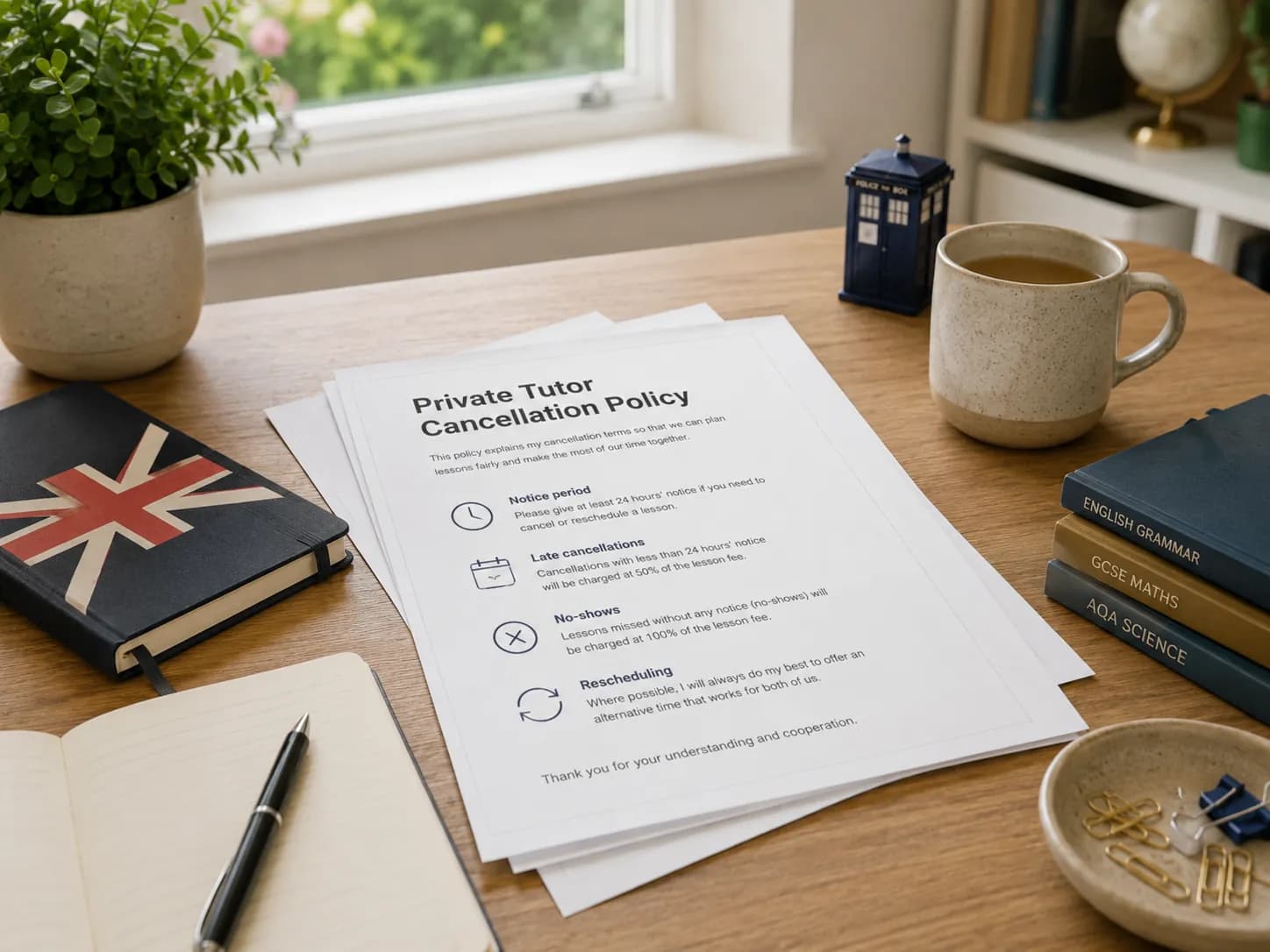
A student cancels at 9am for a 4pm lesson. Do you charge the full fee, half the fee, or nothing? What if you had already prepared the lesson? What if the student simply does not arrive? And if you do charge, what should appear on the invoice?
These decisions become awkward when they are made at the end of the month, long after the cancellation happened. The fairest approach is to decide while the facts are fresh, record the outcome, and show any charge clearly on the next invoice.
This guide is about applying a policy, not writing one. If you still need to decide what your terms should say, start with our guide to writing a private tutor cancellation policy in the UK. Here we look at how to apply an existing policy to late cancellations, no-shows, late arrivals and rescheduled lessons, and how to word the invoice.
What should a tutor charge for a late cancellation?
There is no single percentage that every UK tutor should charge. A sensible starting point is:
| What happened | Typical invoice treatment |
|---|---|
| Cancelled outside the agreed notice window | No charge, or reschedule subject to availability |
| Cancelled late for the first time | Waive as goodwill, or charge 50% |
| Cancelled at very short notice and the slot could not be filled | Charge 50% or the full agreed fee |
| Did not attend and gave no notice | Charge the full agreed fee |
| Student arrived late | Charge for the booked lesson and finish at the scheduled time |
| Lesson moved at short notice | Apply the rescheduling rule in your policy, and do not accidentally charge twice |
| The tutor cancelled | Do not charge. Reschedule, credit or refund the lesson |
The final decision should reflect the policy agreed with the student or parent, the notice given, your actual loss, whether the slot could be filled, and any genuine emergency.
Should I charge for this cancelled lesson?
Four questions get you to a consistent answer. The tool below applies them in the order that matters: the notice window first, then whether a policy was ever agreed, then how much of the hour was genuinely lost.
Decision guide
The same rules, written out, for the readers who would rather scan a table than answer questions.
| Your situation | Recommended action |
|---|---|
| The cancellation was outside the notice window | Do not charge. Offer another time if your policy allows it. |
| There was no clear, agreed cancellation policy | Do not add a surprise fee. Explain the impact, decide whether a goodwill payment is appropriate, and agree a policy for future lessons. |
| First late cancellation, some notice given, and you had prepared | Consider charging 50%, or waive it once and explain what happens next time. |
| Very short notice, you had prepared or were waiting, policy agreed | Charge what the policy sets. A full lesson fee is reasonable where the slot could not realistically be filled. |
| A no-show under an agreed policy | Charge the full agreed no-show fee, unless you make an exception for a genuine emergency. |
| It is becoming a pattern | Apply the agreed rule consistently, and discuss whether the regular lesson time still works. |
For example: a lesson cancelled within 12 hours, where you had already prepared and the policy had been agreed, and this is the student's first late cancellation. A half fee protects some of the lost time while leaving room for goodwill, and the message writes itself. "Because today's lesson was cancelled within 12 hours and I had already prepared the session, I have added the agreed 50% late-cancellation charge to the next invoice."
What UK tutors should know before charging
A cancellation policy is important, but putting a charge in your terms does not automatically make it fair.
The Competition and Markets Authority says terms used with consumers must be fair and transparent. Its consumer guidance on cancellation charges says a business is generally entitled to an amount that covers losses directly caused by the cancellation, such as costs already incurred or lost profit. It also says the business should take reasonable steps to reduce its loss, and that a cancellation charge should be a genuine estimate of that direct loss (1).
For a tutor, the relevant loss usually means a reserved slot that could not be offered to another student, plus preparation already completed for that session. If you fill the cancelled slot with another paying student, charging the original family the full lesson fee becomes much harder to justify, because the loss has been reduced.
The CMA also says significant terms should be brought to the customer's attention early and written in language they can understand (2). Hiding a cancellation fee in a long document, or introducing it only after a student cancels, is far more likely to end in a dispute. If you have not written your terms yet, our free private tutor cancellation policy template builds the wording for you.
In the UK tutoring market, actual practice varies:
- PMT Education lets clients cancel free up to 48 hours ahead, and inside that window the tutor chooses between the full fee, 50%, or no charge at all (3).
- Tutorful allows a 50% or 100% charge for cancellations inside 24 hours, and defaults to charging 50% unless the tutor says otherwise (4).
- Cambridge Private Tutors publishes a full-fee rule inside 24 hours, unless the lesson is rescheduled (5).
The lesson is not that one percentage is universally correct. It is that the charge should be clear, proportionate, and applied to the situation you described in advance.
How to handle each cancellation scenario
The student cancels with enough notice
If the family cancels outside your agreed notice window, mark the lesson as cancelled in time and add no charge.
If your policy allows rescheduling, offer an alternative subject to availability. Avoid promising that every cancelled lesson can be moved, especially during busy GCSE, A-level or entrance-exam periods.
Invoice treatment: no line is normally needed. If you want the invoice to show a complete lesson history, include a zero-value line such as 8 September 2026, GCSE Maths, cancelled with notice: £0.00.
The student cancels late for the first time
A first late cancellation is where consistency and goodwill have to meet.
If your policy says the full fee is due, you may apply it. You could also waive the charge once, or reduce it to 50%, particularly if the student is normally reliable or the cancellation came from an unexpected illness.
If you make an exception, describe it as an exception. Otherwise the family will reasonably expect the same treatment next time.
Hi Sarah, thanks for letting me know. As the lesson was cancelled inside the 24-hour notice period, it would normally be charged under our cancellation policy. I will waive the fee this time as it is the first occurrence. For any future late cancellation, the agreed charge will appear on the next invoice.
The student cancels repeatedly at short notice
Repeated late cancellations are no longer an occasional inconvenience. They affect reliable income and stop you offering the time to another student.
Apply the agreed policy consistently and record each cancellation when it happens. If the same student keeps cancelling, ask whether the regular slot is still suitable. A different day, a temporary pause, or ending the recurring booking may be better than sending the same uncomfortable invoice every month. Our guide to reducing student no-shows covers the reminders and booking habits that prevent most of these.
Hi Sarah, I have noticed that the Tuesday lesson has been cancelled at short notice several times. I have applied the agreed late-cancellation charge to this month's invoice. Could we also check whether Tuesday at 6pm is still the right regular time? I am happy to look at alternatives if another slot would be easier to keep.
The student does not attend
A no-show normally creates the clearest case for the agreed full charge. You reserved the time, prepared the lesson and waited, with no opportunity to refill the slot.
Your policy should define when a late student becomes a no-show. For an online lesson, 10 or 15 minutes is a practical waiting period. During that time, message the student or parent and keep a record of the attempted contact.
Do not describe the invoice line as a completed lesson if no teaching took place. Describe exactly what happened: 14 September 2026, no-show charge, English Language lesson, per agreed cancellation policy: £35.00.
The student arrives late
Late arrival is different from a cancellation. If the student joins 20 minutes late for a one-hour booking, you can usually teach the remaining 40 minutes and finish at the original end time. The full slot was still reserved, and you were available throughout it.
Record the actual arrival time, particularly if lateness is frequent, but invoice the booking as the normal lesson rather than inventing a separate penalty: 17 September 2026, Chemistry tutoring, booked session 5pm to 6pm: £40.00.
The family asks to reschedule at the last minute
A last-minute request to move a lesson has the same immediate effect as a cancellation. The original slot may be impossible to fill.
You have three practical options:
- Move the lesson without charge when you have a convenient replacement time.
- Apply a reduced fee to the original slot, then charge for the replacement lesson.
- Treat the original lesson as a late cancellation under the policy, and make the new booking separately.
Whichever you use, do not leave the parent wondering whether both lessons are being charged. Confirm it when you accept the change.
I can move Thursday's lesson to Saturday. Because the request came inside the 24-hour cancellation window, the original slot would normally be chargeable. I am happy to waive that fee this time because I can offer you an available Saturday slot, so you will only be charged once.
A student misses a group lesson
The lesson still takes place for the rest of the group, but the absent student's reserved place still has value. Apply the policy to that student's normal group fee, not to the price of the whole class.
If students pay by term or by monthly package, say in advance whether a missed group lesson receives a credit, a recording, the materials, or no replacement. Group lessons are difficult to reschedule for one person, so clarity matters far more than negotiating after every absence.
The tutor cancels
Do not charge the student for a lesson you cancelled. Offer a replacement lesson, leave the amount as credit, or refund any prepayment.
Reciprocity makes the whole policy easier to accept. Parents are far more likely to see a cancellation charge as fair when your terms also explain what they get if you cannot teach.
How to show a cancellation charge on a tutoring invoice
Never hide a cancellation fee inside the total, and never label it as tuition if the lesson did not take place. Use a separate, descriptive line containing:
- The scheduled lesson date
- The subject or student reference
- What happened, such as late cancellation or no-show
- The percentage or fixed amount charged
- A short reference to the agreed cancellation policy
Clear invoice examples
| Situation | Suggested invoice wording | Amount |
|---|---|---|
| 50% late-cancellation fee | Late cancellation, GCSE Maths, 12 September 2026, 50% of £40 lesson fee | £20.00 |
| Full late-cancellation fee | Late cancellation, A-level Biology, 15 September 2026, per agreed 24-hour policy | £45.00 |
| No-show | No-show charge, English tutoring, 18 September 2026, per agreed policy | £35.00 |
| Fee waived | Late cancellation, Chemistry, 20 September 2026, one-time goodwill waiver | £0.00 |
| Rescheduled without charge | Original booking 22 September 2026, moved to 24 September, no cancellation fee | £0.00 |
Avoid vague lines such as "extra charge", "admin", or "missed lesson". A parent should be able to connect every amount on the invoice to a specific booking and an agreed rule.
Your invoice should also carry the usual required details. GOV.UK lists what invoices must include, such as a unique invoice number, your details, the customer's details, a clear description, the relevant dates and the amount due, with extra naming requirements for sole traders and limited companies (6).
If you need to produce a one-off invoice, our free tutor invoice maker lets you add a late-cancellation line and download the invoice as a PDF or Word file. For the wider process, see our guide to invoicing tutoring students by attendance.
Record the decision when the cancellation happens
The invoice should be the final output of the decision, not the place where you try to remember it.
For every booked lesson, record one status: attended, cancelled with enough notice, late cancellation, no-show, rescheduled, or cancelled by tutor. Then record whether it is billable, and at what rate: 0%, 50% or 100%. Our examples of cancellation and replacement lesson records show each of those statuses written out, including how a rescheduled booking stays linked to the lesson that replaces it.
That one habit prevents the familiar month-end questions:
- Was that Tuesday lesson cancelled or moved?
- Did I promise to waive the fee?
- Was the student absent, or did I cancel?
- Have I already taught the replacement lesson?
- Am I about to charge for both the old and the new booking?
Keeping this evidence also supports accurate business records. UK sole traders must keep records of business income and expenses for Self Assessment, and GOV.UK says you need the documents that support those figures if HMRC checks your return (7). A tutoring attendance sheet is enough to start with.
If cancellations regularly affect your billing, read our guide to tracking billable hours and the free tutoring hours tracker that goes with it.
Turn attendance records into clear invoices with Teamlilit
When the lesson record and the invoice live in different places, small exceptions are easy to lose. A cancellation sits in WhatsApp, attendance sits in a notebook, and the final amount gets reconstructed from memory weeks later.
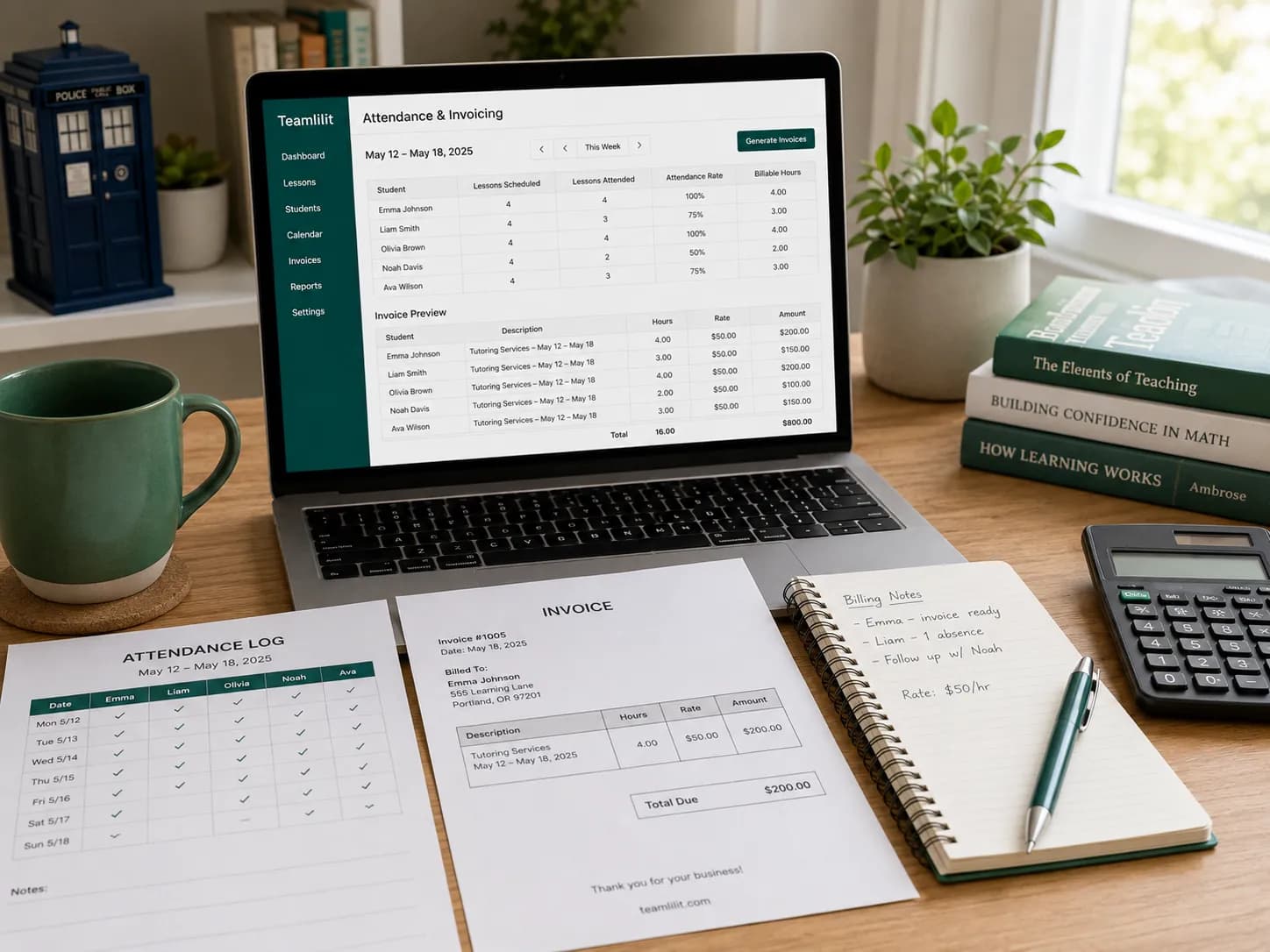
Teamlilit keeps the scheduled lesson, the attendance record and the invoice connected. Each session records who was present, late or absent, with the join and leave times behind it, so when it is time to invoice you are working from what actually happened rather than rebuilding the month from messages and calendar entries.
From there you can build the invoice from the attended sessions, add a late-cancellation or no-show line where your policy applies, and keep the reason attached to the lesson it came from. You still make the decision, and you review the invoice before it is sent.
If you are copying attendance into an invoice template and checking old messages for exceptions, Teamlilit's billing software for tutors builds the draft from tracked lessons and keeps payment status alongside it. You review the draft and add any cancellation charge or waiver under your agreed policy before sending.
FAQ
How much should a tutor charge for a late cancellation?
There is no single percentage every UK tutor should use. A common pattern is no charge outside the agreed notice window, 50% for a first late cancellation where some notice was given, and the full lesson fee where the notice was very short, you had prepared or were waiting, and the slot could not be filled. Whatever you choose, the charge should match the policy the family agreed before the lesson.
Can a tutor charge for a cancelled lesson in the UK?
Usually yes, when a clear cancellation policy was agreed in advance, the charge is proportionate, and it reflects a real loss such as a reserved slot that could not be refilled or preparation already completed. CMA guidance says consumer terms must be fair and transparent, that a cancellation charge should be a genuine estimate of direct loss, and that a business should take reasonable steps to reduce that loss. This is general information rather than legal advice.
What should a tutor charge for a no-show?
A no-show is normally the clearest case for the full agreed fee, because the time was reserved, the lesson was prepared and there was no opportunity to offer the slot to anyone else. Define in your policy when a late student becomes a no-show, for example after 10 or 15 minutes for an online lesson, and message the student while you wait so the attempt is recorded.
Should I charge extra when a student arrives late?
No. Late arrival is not a cancellation. Teach the remaining time, finish at the scheduled end time, and invoice the booking as a normal lesson, because the full slot was reserved and you were available throughout it. Record the actual arrival time if lateness becomes a pattern, but do not invent a separate penalty line.
How do I show a cancellation charge on a tutoring invoice?
Use a separate, descriptive line rather than folding the amount into the total. Include the scheduled lesson date, the subject or student, what happened, the percentage or fixed amount, and a short reference to the agreed policy. For example: "Late cancellation, GCSE Maths, 12 September 2026, 50% of £40 lesson fee".
Can I charge a cancellation fee if I never agreed a policy?
Adding a fee the family never agreed to is the fastest route to a dispute, and an unexpected charge is much harder to defend than one explained in advance. Handle this occurrence by explaining the impact, decide whether a goodwill payment is appropriate, and agree a written policy that applies from the next lesson onwards.
What happens if the tutor cancels the lesson?
Do not charge for a lesson you cancelled. Offer a replacement lesson, leave the amount as credit on the account, or refund any prepayment. Reciprocity is what makes the rest of the policy acceptable to families, so say plainly in your terms what happens when you are the one who cannot teach.
Should I charge for a missed group lesson?
The class still runs, but the absent student's reserved place still has value, so apply your policy to that student's normal group fee rather than to the price of the whole class. Say in advance whether a missed group session receives a credit, a recording, the materials, or no replacement, because group lessons are very difficult to reschedule for one person.
Sources
- 1Cancelling goods or services: guide for consumers · Competition and Markets AuthorityCancellation charges should cover losses that directly result from the cancellation, and the business should take reasonable steps to reduce that loss.
- 2Unfair contracts: what do businesses need to know? · Competition and Markets Authority (CMA37)Consumer terms must be fair and transparent, and significant terms should be brought to the customer’s attention.
- 3What happens if my student cancels our lesson? · PMT EducationFree cancellation up to 48 hours ahead; inside that window the tutor chooses full fee, 50%, or no charge.
- 4For tutors: what is your cancellation policy? · TutorfulCancellations inside 24 hours can be charged at 50% or 100%, at the tutor’s discretion.
- 5Cancellation policy · Cambridge Private TutorsFull lesson rate inside 24 hours unless the lesson is rescheduled.
- 6Invoices: what they must include · GOV.UK
- 7Business records if you are self-employed: what records to keep · GOV.UK