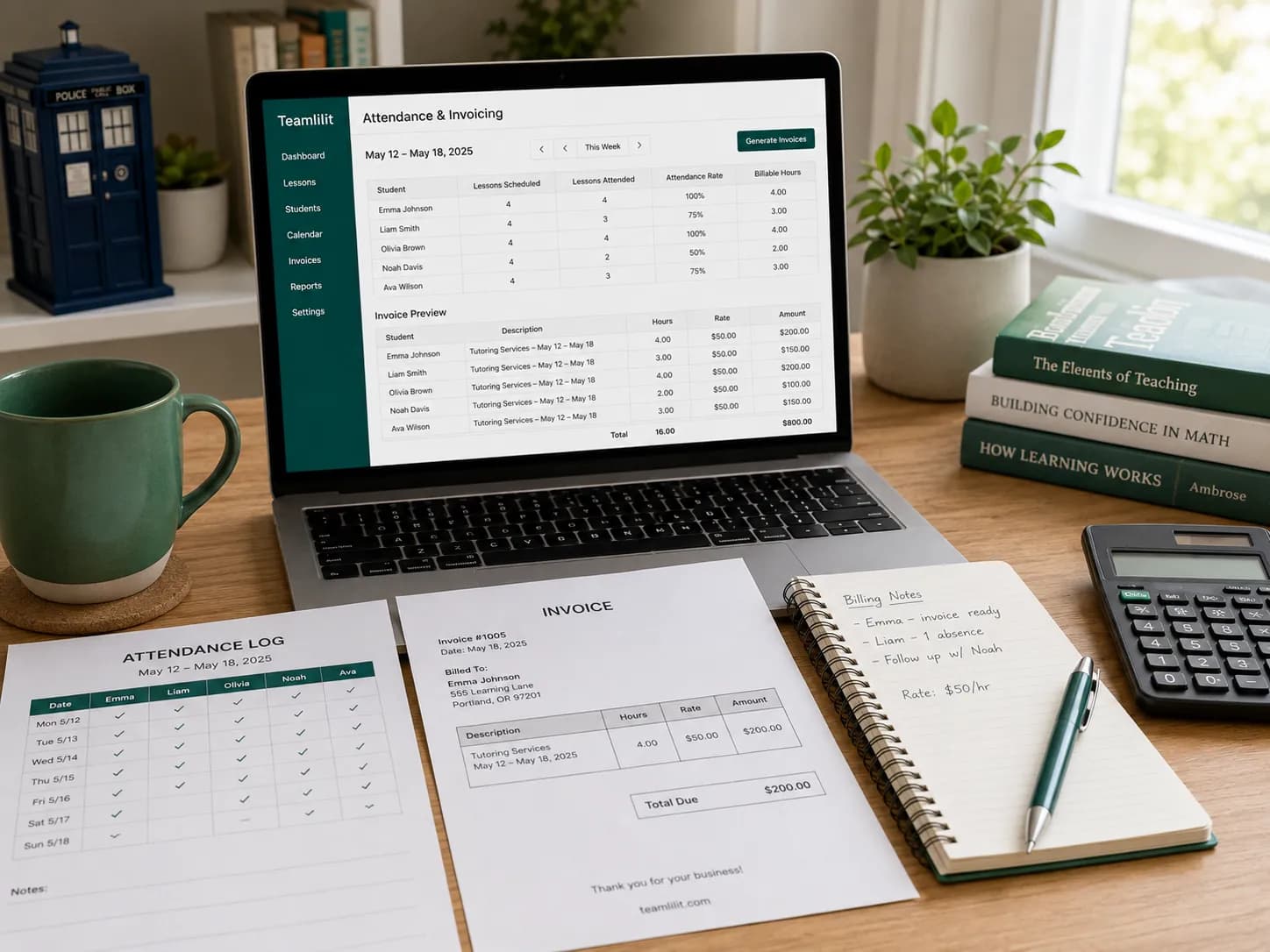
A student arrives 20 minutes late. Another misses a group class. A parent moves Tuesday's lesson to Thursday.
At the end of the month, a tick beside each name cannot explain all three situations.
A useful tutoring attendance record shows the booked lesson, what happened, how many minutes the student attended, and any follow-up or billing decision. Keep the original booking visible when a lesson moves, and record cancellation charges separately from time spent learning.
Below are completed examples for private lessons and groups, including the awkward cases that a simple attendance mark cannot explain on its own.
Example 1: a weekly 1:1 tutoring attendance record
Leo has a 60-minute GCSE maths lesson every Tuesday at 17:00. During September, one lesson moves to Thursday.
Keep his name, subject, tutor and reporting period at the top of the record. Then give each booking a dated entry:
| Date | Booking outcome | Arrival and departure | Attended minutes | Record note |
|---|---|---|---|---|
| 1 September 2026 | Attended | 17:00 to 18:00 | 60 | Full lesson completed |
| 8 September 2026 | Attended, late | 17:20 to 18:00 | 40 | Arrived 20 minutes late; normal finish |
| 15 September 2026 | No-show | Did not attend | 0 | No notice received; parent contacted at 17:10 |
| 22 September 2026 | Rescheduled | Lesson did not take place | 0 | Moved by agreement to 24 September |
| 24 September 2026 | Replacement attended | 17:00 to 18:00 | 60 | Replaces the 22 September booking |
| 29 September 2026 | Attended | 17:00 to 18:00 | 60 | Full lesson completed |
This record contains six entries, but only five lesson opportunities after the agreed move. The original 22 September booking and its replacement are linked, so they do not become two separate lessons due.
Leo attended four lessons and received 220 minutes of tutoring. The no-show remains visible even if the tutor later waives the fee.
The register below holds Leo's September exactly as it appears above. Change an outcome, move the minutes, or add a booking of your own, and watch which totals move and which do not.
For ordinary sessions, the P/A/L marks on an attendance sheet give you the overview. Use a dated note or companion lesson log for the arrival times, cancellation details and replacement links shown here.
What extra information is worth keeping?
Add detail when it explains an exception:
- The scheduled slot: date, start and finish, with the time zone if you teach across countries.
- The student and session: enough to distinguish siblings, different subjects and group bookings.
- What happened: attended, no-show, cancelled or rescheduled, plus late arrival or early departure where relevant.
- Actual attendance: arrival, departure and any substantial interruption.
- Notice and follow-up: when a cancellation message arrived, who cancelled and what was agreed.
- Billing decision: charge, waiver, credit or package deduction, recorded separately.
- Linked booking: the date or reference of a replacement lesson.
You do not need to repeat a parent's contact details in every attendance row. Keep those in the student's main record.
Example 2: a group tutoring attendance record
A GCSE revision group meets on 3 September from 17:00 to 18:15. The session lasts 75 minutes, but each student has a different attendance record.
| Student | Attendance | Arrival and departure | Attended minutes | Follow-up |
|---|---|---|---|---|
| Aisha | Present | 17:00 to 18:15 | 75 | None |
| Ben | Late | 17:20 to 18:15 | 55 | Share the opening practice questions |
| Cara | Present, left early | 17:00 to 17:45 | 45 | Revisit the final worked example |
| Dan | Absent, no-show | Did not attend | 0 | Contact parent about missed session |
Three of four students attended at least part of the class. Ben still counts as attending, although he arrived late. Cara's departure belongs beside her attendance mark so nobody assumes she completed the full session.
Also keep these two totals separate:
- Tutor teaching time: 75 minutes.
- Total student attendance time: 75 + 55 + 45 = 175 minutes.
The second total adds time across individual students. It does not mean the tutor taught for 175 minutes.
For groups with changing membership, mark students as expected only from the date they join the group. A student who enrols halfway through the month should not inherit absences for earlier classes.
Attendance versus billable attendance: record two different facts
Attendance answers: Was the student there, and for how long?
Billing answers: What charge, credit or package deduction applies?
Those answers can differ. In Leo's late lesson, the record might say:
The 60-minute billing entry does not change the attendance total to 60. Leo received 40 minutes of teaching.
Any charge needs to follow clear, fair terms agreed in advance and the consumer rights that apply. For UK consumer contracts, the Competition and Markets Authority explains that a cancellation charge is not fair merely because it appears in a signed contract. Charges should generally reflect direct losses, and businesses should take reasonable steps to reduce those losses.
That means "our policy says so" is not a complete answer to every billing question. The examples here show how to document a decision once it has been assessed.
A no-show fee is not a taught hour
If the student never attends, record zero attended minutes. If an appropriate no-show fee applies, keep it in a separate charge field.
For example:
Attendance: Absent. Outcome: No-show. Attended time: 0 minutes. No-show charge: £30 under the applicable policy, after review. Follow-up: Parent contacted at 17:10.
Avoid adding 60 minutes to the student's learning record just because the fee equals a normal hour.
The same applies to prepaid lessons. A package deduction and a completed lesson are different entries. If a missed booking uses a package credit under fair, applicable terms, keep the attendance at zero and label the deduction explicitly.
Once the records are complete, our guide to invoicing tutoring students based on attendance covers the next step.
Examples for late arrivals and early departures
The four situations below all produce a different attended-minutes figure from the same 60-minute booking. Switch between them, then change the times to match a lesson of your own.
The tutor starts late
If the student is ready at 17:00 but teaching begins at 17:10, do not mark the student late.
Record who caused the delay, the time teaching actually began and whether the lesson was extended, shortened or credited. A student's waiting time should not silently become taught time.
Examples for cancellations and no-shows
Record when the cancellation was received, not just when you read it. Also record whether the student, parent or tutor cancelled.
The following examples use a fictional 24-hour notice window. That is an example policy choice, not a statutory notice period or a recommendation for every tutor.
| Situation | What the record should show | Attended time | Example billing decision |
|---|---|---|---|
| Cancelled with enough notice | 16 September, 17:00 lesson; parent cancelled on 14 September at 10:00; 55 hours' notice | 0 minutes | No charge |
| Late cancellation | Same booked slot; parent cancelled on 16 September at 14:30; 2 hours 30 minutes' notice | 0 minutes | £15 cancellation charge after review |
| No-show | No cancellation received; student did not attend; tutor recorded contact attempt | 0 minutes | £30 no-show charge after review |
| Tutor cancellation | Tutor cancelled; lesson did not take place; replacement or refund arrangement recorded | 0 minutes | No lesson charge; record any refund or credit owed |
The £15 and £30 figures illustrate completed records. They are not standard UK cancellation fees.
Deciding what a missed lesson should say in the register is the part tutors get wrong most often, because four different events all produce zero attended minutes. Describe what happened and the advisor below names the outcome to record.
If another paying student takes a released slot, reassess the loss before applying a charge. For the charging decision and wording, see how to handle late cancellations when invoicing tutoring students.
If the family contacts you later with an explanation, update the record while retaining when the original no-show was recorded and what changed. An unanswered message is not proof that a parent deliberately ignored the lesson.
How to record rescheduled and make-up lessons
Rescheduled: move the booking and retain the link
Return to Leo's September record:
| Booking | Outcome | Link | Charge in this example |
|---|---|---|---|
| 22 September, 17:00 | Rescheduled by agreement | Replaced by 24 September | £0 |
| 24 September, 17:00 | Attended for 60 minutes | Replaces 22 September | £30 |
The old entry explains why Tuesday disappeared from the teaching record. The new one shows when the lesson actually happened.
In software, this may be a booking with a change history. In a spreadsheet, it can be two linked rows. Either way, the agreed move should not accidentally create an absence plus an extra lesson charge.
Make-up: record what was actually delivered
A make-up lesson happens after a missed or shortened session. It may be a full replacement or a shorter catch-up.
For example, Dan misses the 75-minute group lesson above. The tutor waives the missed-session fee and later offers a free 30-minute catch-up:
| Date | Record | Attended minutes | Charge |
|---|---|---|---|
| 3 September | Group lesson missed; no-show fee waived | 0 | £0 |
| 10 September | Individual make-up for 3 September, 16:00 to 16:30 | 30 | £0 |
Dan has now received 30 minutes of catch-up teaching. Do not rewrite the original group lesson as attended or turn the catch-up into 75 minutes.
If a make-up uses a credit, record which credit it uses. If it is an additional paid lesson, record the agreed charge. Do not assume that every missed class automatically creates an entitlement to a replacement.
When the make-up falls in the next month, show it as pending in the current summary. Add its attended minutes only after it takes place.
Example: a month-end tutoring attendance summary
Use the completed lesson records to produce a summary a parent can understand.
For Leo's September example:
| Measure | September total |
|---|---|
| Original weekly bookings | 5 |
| Bookings moved by agreement | 1, replaced within September |
| Lesson opportunities after the move | 5 |
| Lessons attended, including the replacement | 4 |
| Late arrivals | 1 of the 4 attended lessons |
| No-shows | 1 |
| Actual tutoring received | 220 minutes, or 3 hours 40 minutes |
| Outstanding replacement lessons | 0 |
Notice that late arrivals are included within attended lessons. Adding four attended lessons and one late arrival would count the same lesson twice.
How to calculate tutoring attendance percentage
For this example, use:
Attendance percentage = lessons attended ÷ lessons due × 100
Leo attended four of five lessons due:
4 ÷ 5 × 100 = 80% attendance
Here, "lessons due" means completed attendance opportunities within the reporting period: attended sessions, no-shows and late cancellations. It excludes future bookings, tutor cancellations, timely cancellations released under the policy, and old bookings superseded by an agreed replacement. Count a replacement once when it becomes due.
This is a suggested reporting convention for these examples. State your own convention clearly, particularly if a school, agency or funder requires a different measure. If no lessons were due, report "not applicable", rather than 0% attendance.
Attendance percentage also does not show how much time a late student missed. In Leo's case:
220 attended minutes ÷ 300 scheduled minutes = 73.3% of scheduled lesson time received
Both figures are useful. One tells the parent how many lessons Leo joined; the other shows the actual time he received.
The free Attendance Sheet provides its own totals for P/A/L entries. A summary with the exclusions above needs a checked companion log or adapted calculations; do not assume a custom cancellation label will be included correctly in the default totals.
Keep the billing summary beside it
Assume Leo's four attended bookings are charged at £30 each, including the late arrival under the fair full-slot terms used in the example. A separately reviewed £30 no-show charge applies to 15 September.
| Billing item | Amount |
|---|---|
| Four attended lesson bookings at £30 | £120 |
| No-show charge for 15 September | £30 |
| Original 22 September booking, replaced by 24 September | £0 |
| Total charges before payments or credits | £150 |
The attendance summary still says 220 minutes taught. It does not become five taught hours because the total charge equals five normal lesson fees.
Leo attended four of his five September lessons, including the replacement on 24 September. He arrived 20 minutes late on 8 September and missed 15 September. He received 3 hours 40 minutes of tutoring. All agreed replacement lessons are complete. The separate billing summary shows the lesson charges and the no-show charge.
Add the academic update from your lesson notes. Attendance can explain missed teaching time, but it does not show whether the student understood the topic. Our guide to communicating with parents as a private tutor gives examples of those conversations.
Keep attendance notes factual and private
Write "parent cancelled at 09:15; fee waived" rather than an unnecessary account of a family's personal circumstances. The ICO's data minimisation guidance says personal data should be relevant and limited to what its purpose requires.
Keep access to a group register restricted. For an individual parent update, share their child's summary rather than the full class sheet. Protect digital records and maintain a recoverable backup.
Set a retention period you can justify for the record's purpose and any applicable obligations. There is no single UK GDPR retention period for every attendance record; review information and delete or anonymise it when it is no longer needed.
Put these examples into your attendance sheet
Start with the attendance overview, then add detail for exceptions.
Our free tutoring Attendance Sheet gives you students, session dates, P/A/L marks and an optional notes column. Choose Excel for an editable tracker or PDF for a printable register. Keep the detailed booking changes and billing decisions in a companion log when you need them.
Test yourself on the awkward cases
Want attendance recorded automatically?
When you teach in Teamlilit's online classroom, join and leave times are captured for each student, with attendance connected to their session history.
Review and confirm attendance in the session wrap-up, then add the notes that explain any exceptions. The Help Centre's attendance and progress guide shows where that history lives.
You still decide what a cancellation, credit or billing exception means. The recorded lesson gives you the facts to work from.
Frequently asked questions
Should a late student count as present?
Count them as having attended, with a late mark and their actual minutes. In an attendance summary, late arrivals are a subset of attended lessons, not an additional category to add on top.
Should a cancelled lesson be marked absent?
Keep the cancellation outcome explicit. A timely cancellation, a late cancellation, a no-show and a tutor cancellation can all involve zero attendance, but they explain different events. Use a dated note or separate log if your sheet only accepts P/A/L.
Can an absent student still have a billable booking?
A fair, applicable cancellation or no-show charge may apply, depending on the terms and circumstances. Keep attended minutes at zero and show the charge separately. Payment does not turn absence into attendance.
Does a make-up lesson remove the original absence?
Keep the original event visible and link the make-up to it. Record the replacement's actual date and duration. If you report a completion measure that treats replacements differently, explain that measure alongside the original attendance history.
What should parents receive at the end of the month?
A short summary of lessons due, lessons attended, lateness or missed sessions, actual teaching time and any outstanding replacements. Keep the billing breakdown distinct and include an academic update from the lesson notes.
Sources
- Cancelling goods or services: guide for consumers - Competition and Markets Authority. Explains that a cancellation charge is not fair merely because it appears in a signed contract, supporting the separation of a billing decision from an attendance mark.
- Unfair contract terms guidance (CMA37) - Competition and Markets Authority. Paragraphs 6.63 to 6.64 address savings, finding another customer and disproportionate charges, supporting the advice to reassess a loss before charging for a released slot.
- Data minimisation - Information Commissioner's Office. Personal data should be relevant and limited to its purpose, supporting factual attendance notes.
- A guide to data security - Information Commissioner's Office. Supports restricting access to a group register and keeping a recoverable backup.
- Storage limitation - Information Commissioner's Office. There is no single retention period for every record; review and delete or anonymise when no longer needed.