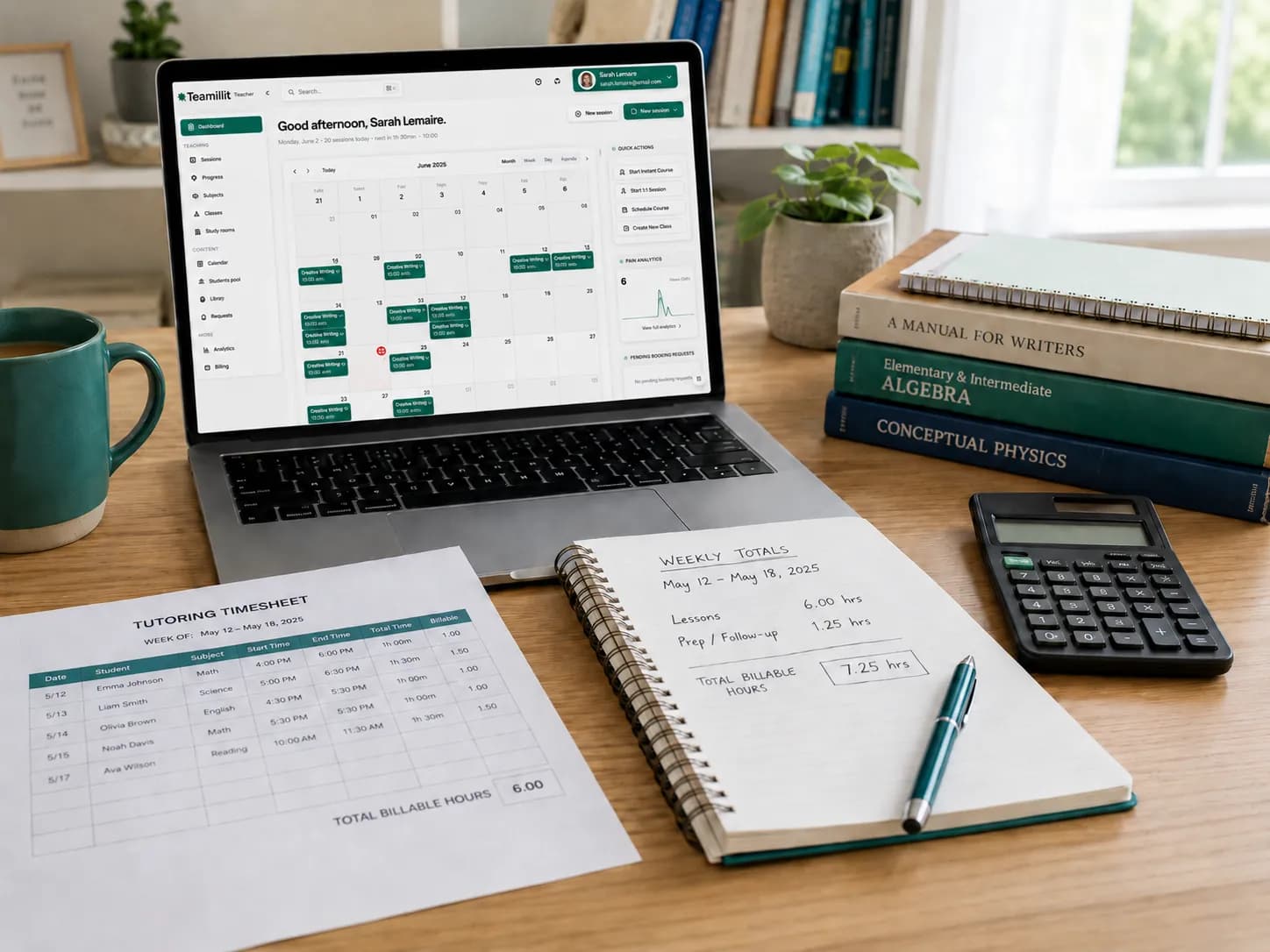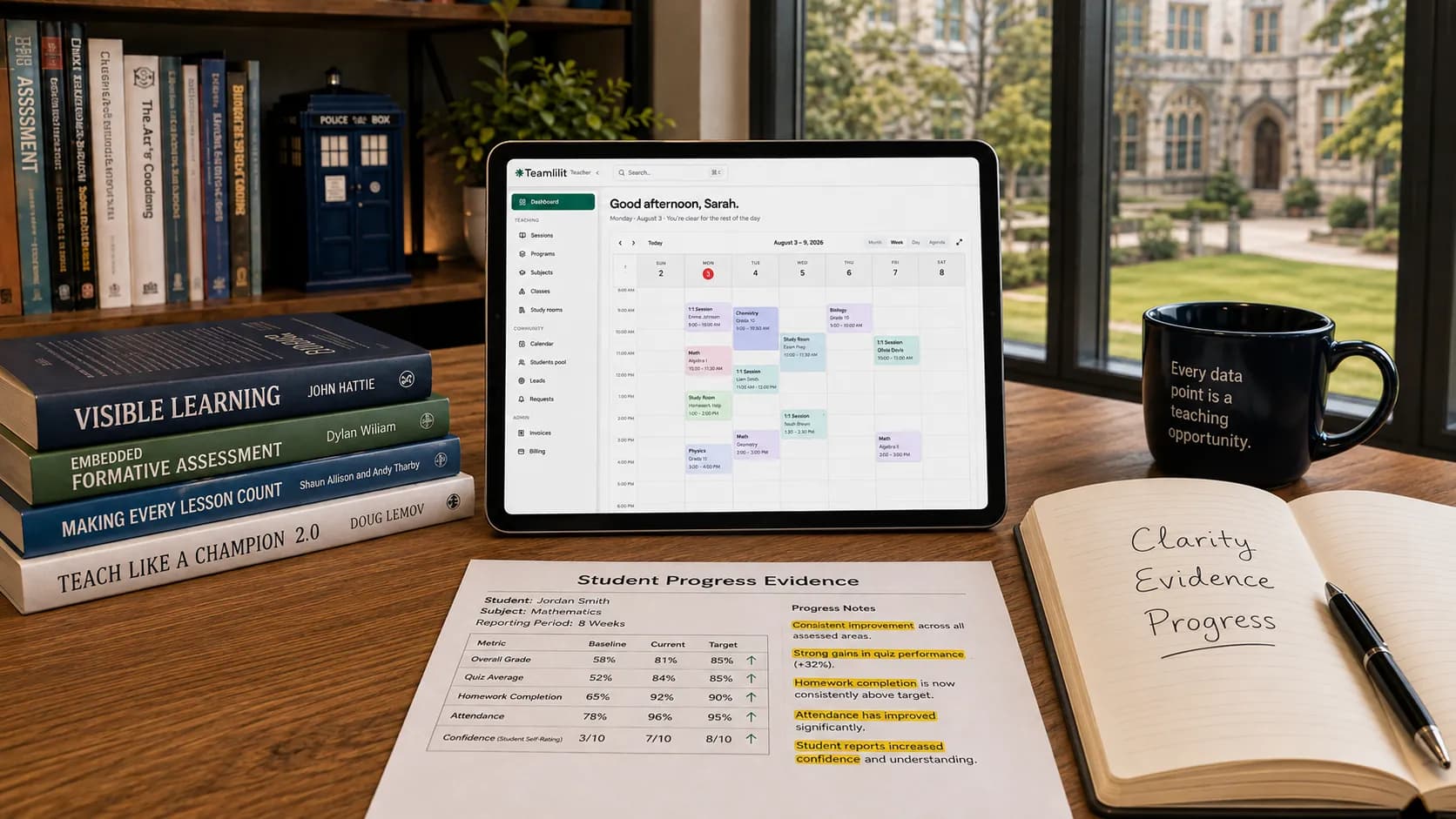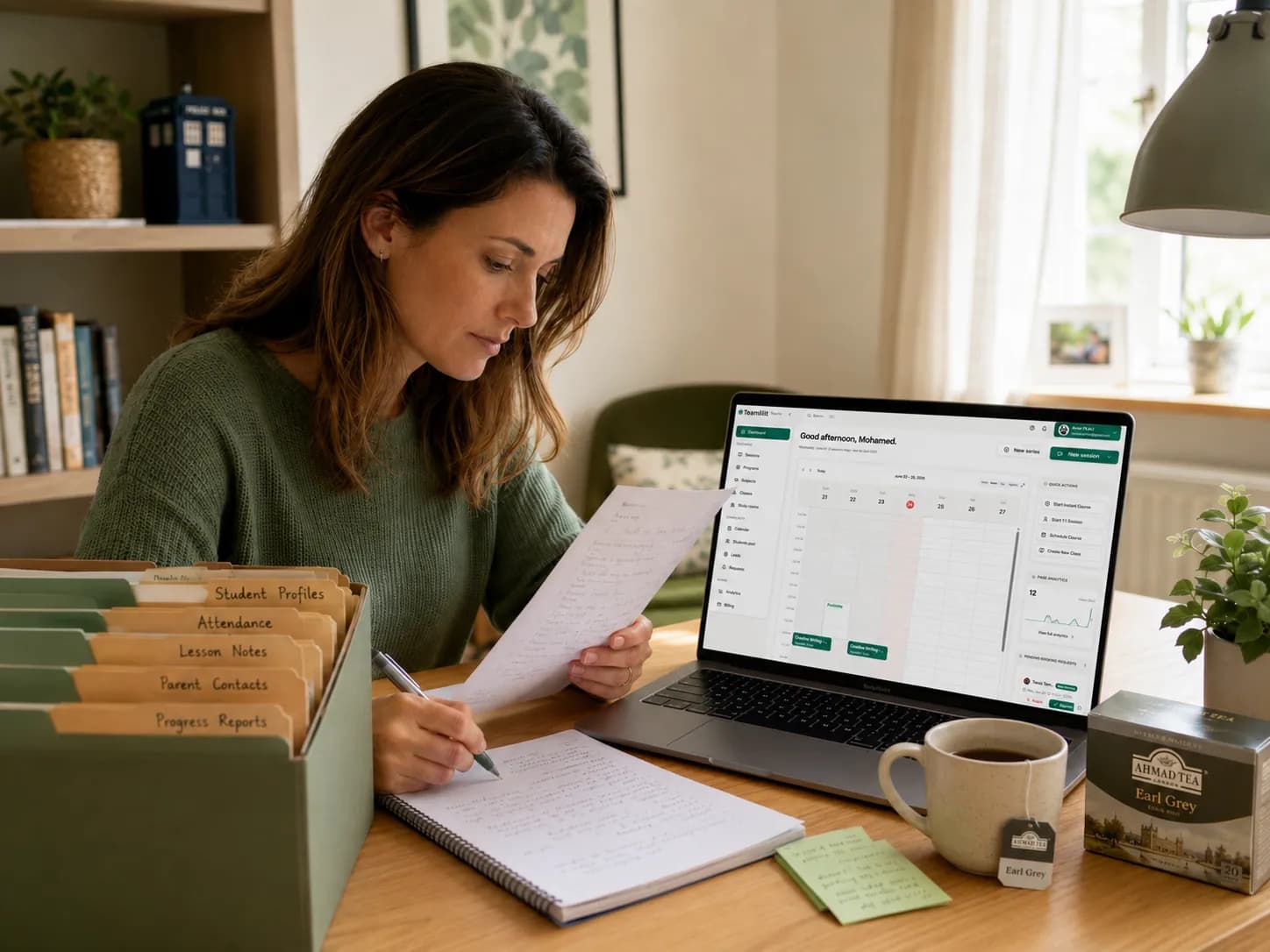
Private tutors remember more than people realise. You remember which student panics before exams, which parent prefers short email updates, which learner needs extra time with algebra, which student missed homework twice but improved after changing the revision plan, which lesson was cancelled late, and which invoice is still unpaid.
At the beginning, this all feels manageable. A few notes in a notebook, a student list in a spreadsheet, lesson times in Google Calendar, parent messages in WhatsApp, invoices in a folder.
Then the tutoring business grows. Suddenly you are not just teaching. You are managing student records, parent communication, lesson notes, attendance, homework, safeguarding concerns, payments, and invoices. That raises an important question: what student records should private tutors actually keep?
The answer is not "keep everything". Good record-keeping is about keeping the right information, for the right reason, in the right place, for the right amount of time.
This guide explains what private tutors should record, what they should avoid collecting, how to organise student information, and what UK tutors should consider around data protection, safeguarding, DBS, and tax records.
Why private tutors need student records
Student records are not just admin. They help you teach better, communicate clearly, protect your business, and reduce mistakes. A good record helps you answer questions like: what did we cover last lesson, what homework was set, what is this student struggling with, what exam board are they following, has the parent been updated, did the student attend, was the missed lesson billable, has the invoice been paid, and are there any important safeguarding or wellbeing notes?
Without records, everything depends on memory. And memory is not a reliable business system. Good records help tutors look professional because they make tutoring feel planned, consistent, and accountable. They are also the foundation of organising your tutoring students as your roster grows.
The golden rule: only keep what you need
Private tutors should not collect information just because they can. A useful record should have a clear purpose. Before writing something down, ask: why do I need this information? If you cannot answer that question, you probably should not keep it.
For example, it makes sense to record that a student struggles with fractions if you teach them maths. It may not make sense to record unrelated family details, casual gossip, emotional opinions, or personal information that has no clear tutoring purpose. The best tutoring records are useful, factual, proportionate, and easy to explain.
The main types of records private tutors should keep
Most private tutors need five broad categories of records: student profile records, lesson and progress records, attendance and scheduling records, parent or guardian communication records, and payment, invoice, and business records. Some tutors may also need safeguarding records, depending on the situation. Let us go through each one.
1. Student profile records
Every student should have one clear profile. This is the central place where you keep the information you need to teach and manage that student properly. A profile may include the student name, year group or level, subject, exam board if relevant, school year or course, target exam date, regular lesson day and time, lesson format, agreed rate, parent or guardian contact details, learning goals, strengths, weak areas, lesson preferences, and any agreed cancellation or billing notes.
This profile should not become a dumping ground. It should answer one question: what does the tutor need to know to teach this student well and manage the relationship professionally? A free student profile template for tutors lays out exactly these fields so the profile stays consistent. If your roster mixes curricula or school systems, the profile is also where that context belongs; see how tutors adapt their teaching for diverse student backgrounds using curriculum tags and one intake record.
2. Parent or guardian contact records
If you tutor children or teenagers, parent and guardian details are usually essential. You may need to keep the parent or guardian name, phone number, email address, preferred contact method, billing contact, an emergency contact where appropriate, consent or agreement records where relevant, and important parent communication.
This is especially useful when there are two different roles involved. One parent may arrange lessons while another pays invoices, or a guardian may be the emergency contact while the student communicates directly about homework. A common tutor mistake is leaving parent communication scattered across WhatsApp, email, SMS, and memory. That works until there is a disagreement about a cancellation, payment, homework task, or lesson plan. Important communication should be easy to find.
3. Learning goals and academic records
Tutors should record enough academic information to teach effectively: starting level, target level, exam board, exam date, topics already covered, weak topics, strengths, recurring mistakes, confidence level, homework habits, revision priorities, assessment results if useful, and the agreed learning plan.
This is where record-keeping becomes directly connected to better teaching. Instead of writing "bad at algebra", write "needs more practice rearranging equations with negative terms; confident when steps are written clearly, but rushes when working mentally". That is more useful, more professional, and more respectful. Good student records should help you plan the next lesson. They should not label the student.
4. Lesson notes
Lesson notes are one of the most valuable records a private tutor can keep. They do not need to be long. In fact, short consistent notes are usually better than long notes you never maintain. After each lesson, record the date, topic covered, attendance status, what went well, what the student struggled with, homework set, next lesson focus, and any parent follow-up needed.
A simple lesson note might look like this: "Worked on simultaneous equations by substitution. Understood the method after examples but made sign errors when expanding brackets. Set 10 practice questions. Next lesson: review mistakes, then move to word problems." That is enough. The goal is not to write a school report after every session. The goal is to make sure next week's lesson starts from the right place. Our free tutoring lesson notes template gives you that structure and turns each note into a parent update too.
5. Attendance and cancellation records
Attendance records protect both the tutor and the client. For each scheduled lesson, record the status clearly: attended, cancelled in time, cancelled late, no-show, rescheduled, free trial, unpaid trial, package lesson, or billable lesson.
This matters because attendance often affects payment. If a parent asks why a lesson was charged, you should be able to answer calmly with the record: lesson date, agreed time, cancellation status, the cancellation policy that applied, and whether the lesson was billable. This avoids awkward back-and-forth through WhatsApp. A clean attendance record also helps you spot patterns, such as repeated cancellations or students losing consistency before exams. You can start with a simple tutoring attendance sheet template before you automate it.
6. Homework records
Homework records are useful because they show continuity between lessons. You may want to record the homework set, due date, whether it was completed, quality of completion, mistakes to review, whether a parent reminder is needed, and the next task. This does not need to be complicated. For many tutors, one short line is enough: "Homework: complete worksheet Q1 to Q12 on factorising. Review Q5, Q8, Q11 next lesson." Homework records help parents see that lessons are part of a learning plan, not isolated sessions.
7. Progress records
Progress records are different from lesson notes. A lesson note says what happened today. A progress record shows what is changing over time: topics mastered, topics still weak, mock test scores, confidence changes, exam technique improvements, recurring errors, parent update summaries, and the next milestone.
You do not need a full report every week. But once a month it is useful to write a short progress summary: "Over the last four lessons, Maya has improved in expanding brackets and solving one-step equations. She still needs support with rearranging formulae and checking signs. Next month we will focus on exam-style algebra questions." This kind of summary is very powerful when parents ask, "How is it going?" A reusable progress report template for tutors gives that summary a consistent shape you can fill in for every student.
8. Payment and invoice records
Private tutoring is also a business, so payment records matter. Keep clear records of the lesson rate, package price, invoices sent, invoice dates, payment dates, unpaid lessons, cancelled but billable lessons, discounts, refunds, payment method, and expenses where relevant.
If you are self-employed, you also need business records for tax, kept separately from student learning notes. The important thing is to connect the workflow: attendance leads to a billable lesson, which leads to an invoice, which leads to a payment. When this connection is manual, mistakes happen: a tutor may forget to invoice a lesson, charge the wrong amount, or lose track of prepaid sessions. The more students you teach, the more this matters, which is covered further in how tutors can track billable hours and made simpler with a free invoice maker for tutors. To track lesson time and attendance together against each session, rather than reconstructing it later, per-student time tracking records it automatically as you teach.
9. Safeguarding records
If you work with children or young people, safeguarding should be treated seriously. Safeguarding records are different from ordinary lesson notes. If a student says something concerning, if you notice signs of harm, or if there is a boundary issue, you should write a factual record and follow appropriate safeguarding guidance.
A safeguarding note should usually be factual, dated, written as soon as possible, based on what was seen, heard, or disclosed, kept securely, and shared only with appropriate people or authorities when necessary. Avoid emotional language, assumptions, jokes, or personal opinions.
For example, instead of writing "Parent seems awful and the student is probably being neglected", write "Student arrived 25 minutes late and said, 'No one remembered to bring me.' Student appeared upset and did not have required materials. I recorded the incident and followed safeguarding procedure." That difference matters. Safeguarding notes should not be mixed casually with normal lesson notes or payment records. The NSPCC publishes safeguarding guidance specifically for tutors, and the Department for Education's out-of-school settings guidance includes private tuition.
10. Communication records
Tutors do not need to save every message forever, but important communication should be recorded or easy to find. Keep records of communication about lesson times, cancellations, rescheduling, payment agreements, invoice disputes, student progress, homework concerns, safeguarding concerns, consent or permissions, changes in contact details, and complaints or disagreements.
You do not need to copy every "thanks" message into a system. But if a message affects the tutoring relationship, the lesson plan, billing, safety, or expectations, it is worth keeping.
At a glance: what to keep, and how carefully
| Record type | Keep? | Why | Keep carefully |
|---|---|---|---|
| Student name | Yes | Identify the learner | Keep accurate |
| Parent contact | Yes | Communication and billing | Do not overshare |
| Lesson notes | Yes | Plan future lessons | Keep factual |
| Attendance | Yes | Billing and cancellations | Link to your policy |
| Homework | Yes | Continuity between lessons | Keep concise |
| Medical details | Only if needed | Safety and support | Avoid over-collecting |
| Safeguarding concern | Yes, if relevant | Child protection | Store separately and securely |
| Payment records | Yes | Business and tax | Keep separate from teaching notes |
| Random WhatsApp screenshots | Usually no | Often unnecessary | Avoid indefinite storage |
Records private tutors should avoid keeping
Good record-keeping is not about collecting everything. Keeping too much information can create more risk. Private tutors should avoid unnecessary records such as unrelated family details, casual gossip, emotional judgments about parents or students, unnecessary medical details, screenshots kept without reason, old school reports no longer needed, sensitive information not needed for tutoring, payment card information you do not need, excessive recordings of lessons, private conversations unrelated to tuition, and old records kept indefinitely.
A simple rule: if it does not help you teach, manage payment, communicate professionally, protect safety, or meet a legal or business requirement, think twice before keeping it.
Should tutors keep medical or special educational needs information?
Sometimes, yes, but only when it is relevant and necessary. If a student has dyslexia and this affects reading speed, homework format, or lesson planning, it may be useful to record reasonable teaching notes. If a student has a medical need that affects safety during in-person tuition, it may be appropriate to know what to do in an emergency.
But be careful. Do not collect detailed medical information just because it is available, do not store diagnostic documents unless there is a clear need, and do not write sensitive labels casually. A better approach is to record practical teaching needs. For example, "benefits from larger text and extra processing time" is usually more useful than storing unnecessary private documentation. For the practical side of acting on those notes, our guide on supporting students with dyslexia and maths difficulties covers the layout and pacing adjustments worth recording lesson by lesson.
Should tutors record lessons?
Some tutors record online lessons for revision or safeguarding reasons, but recordings create extra responsibility. Before recording a lesson, think carefully: do you really need the recording, has the student or parent been told clearly, what is the recording for, who can access it, how long will it be kept, how will it be deleted, and is there a safer alternative such as written lesson notes?
For many private tutors, short lesson notes are enough. Recording every lesson by default can create more storage, privacy, and safeguarding risk than value.
How long should private tutors keep student records?
There is no single universal answer for every type of record. The sensible approach is to separate records by purpose.
Active student records. Keep these while tuition is ongoing: student profile, parent contact details, lesson notes, learning goals, attendance, homework, and progress notes. They help you teach and manage the relationship.
Former student learning records. When tuition ends, review the record. You may not need to keep all lesson notes forever. You might keep a short final summary for a limited period in case the parent returns, asks for a reference, or there is a reasonable business reason. Old detailed notes should not be kept indefinitely without a reason.
Financial records. Invoices, payments, income, and expenses may need to be kept for tax purposes. HMRC requires self-employed people to keep business records for at least five years after the 31 January Self Assessment submission deadline. Store these as business records, not mixed randomly with lesson notes.
Safeguarding records. These should be handled carefully and may need to be kept separately from ordinary student notes. If you are unsure, follow official safeguarding guidance or seek professional advice.
A private tutor could use a simple rule: keep the active student profile while tuition continues, keep lesson notes while useful and for a reasonable period after tuition ends, delete or archive parent contact details when no longer needed, keep financial records according to tax rules, keep safeguarding records securely per guidance, and delete old unnecessary notes during a regular review. The key is to have a rule. Do not just keep everything forever because deleting feels like effort.
UK data protection points private tutors should understand
If you are a private tutor in the UK and you keep student names, parent contact details, lesson notes, progress records, attendance, invoices, or messages, you are handling personal information. UK data protection is governed by the UK GDPR and the Data Protection Act 2018, so this applies to you. You do not need to become a lawyer to run a tutoring business, but you should understand the basics.
The ICO's principle of data minimisation says you should only keep the minimum personal data you need, and storage limitation says data should not be kept longer than necessary. The ICO also indicates that tutors and sole traders who keep educational progress records may need to pay the data protection fee, while use limited to accounts and payments can be exempt. It is worth checking your own status rather than assuming.
1. Know why you keep each type of data
Do not collect information without a reason. The student name identifies the student, the parent email is for communicating about lessons, lesson notes plan future lessons, attendance records track completed and missed sessions, and invoices manage payment and tax records. If there is no clear reason, do not keep it.
2. Keep information accurate
If a parent changes email address, update it. If a student changes exam board, update it. If a payment has been made, mark it correctly. Inaccurate records create confusion and disputes.
3. Keep information secure
Student records should not be left everywhere. Avoid loose paper notes in public places, unlocked shared devices, spreadsheets with no password protection, sending sensitive information to the wrong person, storing everything in random folders, and sharing student details unnecessarily. Use secure tools, strong passwords, and sensible access controls.
4. Do not keep records longer than needed
Review your records regularly. At least once a year, check which students are active, which records are outdated, which details are no longer needed, which financial records must be retained, and which files should be deleted or archived.
5. Be ready for access requests
Students and parents may ask what information you hold. If your records are messy, this becomes stressful. If they are organised, factual, and relevant, it is much easier to respond properly. This is another reason not to write emotional or unnecessary comments in student notes. Write records as if the student or parent may one day read them.
A note on DBS checks
Many parents value a DBS check, and it can be part of looking professional. Self-employed tutors cannot apply for a standard or enhanced DBS check directly, but where the role is eligible they can now apply for an Enhanced DBS check through an Umbrella Body. Whether a particular role is eligible depends on the work, so check the current GOV.UK and DBS guidance.
A simple student record template for private tutors
You can use this structure for each student. It mirrors the free student profile template for tutors, which fills it in and exports it for you.
Student details
Student name, year group or level, subject, exam board, target exam date, regular lesson time, lesson format, rate.
Parent or guardian details
Name, email, phone, preferred contact method, billing contact, emergency contact.
Learning profile
Main goal, current level, strengths, weak areas, confidence level, learning preferences, support needs relevant to tuition.
Lesson record
Date, attendance, topic covered, what went well, what needs practice, homework set, next lesson focus, parent update needed.
Admin record
Invoice status, payment status, package balance, cancellation notes, important communication.
Spreadsheet, notebook, or student management software?
You can keep records in different ways. The best choice depends on how many students you teach and how complex your admin has become.
A notebook is simple, fast, and personal, but it is hard to search, hard to back up, and easy to lose. It also does not connect lesson notes to attendance, billing, invoices, or parent communication.
A spreadsheet is a good starting point. It can track students, lessons, payments, and simple notes. But spreadsheets become harder when notes get too long, parent communication is elsewhere, attendance affects billing, invoices are created separately, homework needs tracking, you teach many students, or you need to find records quickly. The spreadsheet may still contain the information, but the workflow is manual. We compare this in detail in tutor CRM vs spreadsheet.
Student management software becomes useful when you want one student profile per learner, lesson notes connected to lessons, attendance connected to billing, invoices connected to billable hours, parent updates connected to progress, fewer scattered records, and less admin after teaching. This is the point where student records stop being just files and become part of the tutoring workflow. See student management software for tutors for what that looks like, or compare the wider tutor tech stack if you are still choosing which apps to keep.
The connected tutoring workflow
A good tutoring business has a simple flow:
student profile → lesson notes → attendance → billable hours → invoice → parent update
That is why student records matter. A student record is not just a document. It is the centre of the tutoring relationship. The student profile tells you who the learner is, the lesson notes tell you what happened, the attendance record tells you whether the lesson took place, the billing record tells you whether it should be paid, the invoice turns that into business admin, and the parent update builds trust. When these records are disconnected, tutors lose time. When they are connected, the business feels calmer. The same connected week is also where your tutoring timetable begins.
Final checklist: what student records should private tutors keep?
Private tutors should keep records that help them teach, communicate, bill correctly, protect students, and run a professional business:
- Student profiles
- Parent or guardian contact details
- Learning goals
- Lesson notes
- Homework records
- Attendance and cancellation records
- Progress summaries
- Important parent communication
- Payment and invoice records
- Safeguarding notes, where relevant
And avoid keeping unnecessary personal details, emotional opinions, unrelated family information, old notes with no purpose, excessive recordings, sensitive documents you do not need, and scattered screenshots kept forever.
The goal is not to keep more information. The goal is to keep better information. A growing tutoring business cannot depend on memory, WhatsApp, and a messy spreadsheet forever. Good student records make you a better tutor, a clearer communicator, and a more professional business owner.
Frequently asked questions
What records should a private tutor keep?
Private tutors should keep records that help them teach, communicate, bill correctly, protect students, and run a professional business: student profiles, parent or guardian contact details, learning goals, lesson notes, homework and attendance records, progress summaries, important parent communication, payment and invoice records, and safeguarding notes where relevant. The aim is better information, not more information.
Should private tutors keep lesson notes?
Yes. Lesson notes are one of the most valuable records a tutor can keep. They do not need to be long. A short, consistent note after each lesson covering the topic, what went well, what needs practice, the homework set, and the next focus is enough to start the next lesson from the right place.
How long should tutors keep student records?
There is no single period for every record. Keep active student records while tuition continues, keep lesson notes for a reasonable period after tuition ends, and delete parent contact details when no longer needed. Financial records should be kept for tax purposes: HMRC requires self-employed people to keep business records for at least five years after the 31 January Self Assessment deadline. Safeguarding records should be kept securely according to safeguarding guidance.
Do private tutors need to keep attendance records?
Attendance records are not legally required, but they protect both tutor and client. Recording each lesson as attended, cancelled in time, late cancellation, no-show, or rescheduled lets you apply your cancellation policy consistently and answer billing questions with a clear record instead of searching messages.
What parent details should tutors keep?
Keep the parent or guardian name, phone, email, preferred contact method, billing contact, and an emergency contact where appropriate, plus important communication about lessons, cancellations, payments, and progress. Keep only what you need to communicate and bill, and avoid storing unnecessary personal details.
Should tutors keep safeguarding records?
If you work with children or young people and something concerning happens, you should write a factual, dated record as soon as possible based on what was seen, heard, or disclosed, store it securely, and share it only with appropriate people or authorities when necessary. Safeguarding notes should be kept separately from ordinary lesson and payment records. The NSPCC publishes safeguarding guidance for tutors.
Do UK private tutors need to think about GDPR?
Yes. UK data protection is governed by the UK GDPR and the Data Protection Act 2018, so a tutor keeping student names, parent details, lesson notes, attendance, or invoices is handling personal data. In practice that means knowing why you keep each piece of data, keeping it accurate and secure, not keeping it longer than necessary, and being able to respond if a parent or student asks what you hold. The ICO also says tutors who keep educational progress records may need to pay the data protection fee, while accounts-and-payments-only use can be exempt.
Can tutors keep student records in a spreadsheet?
Yes, especially when a tutoring business is small. A spreadsheet can track students, lessons, payments, and simple notes. It becomes harder as you grow, because notes get too long, parent communication lives elsewhere, attendance affects billing, and invoices are created separately. At that point the information still exists but the workflow is manual, which is when many tutors move to student management software.
What should tutors avoid writing in student notes?
Avoid emotional opinions, assumptions, jokes, unrelated family details, casual gossip, and unnecessary sensitive information. Write records as if the student or parent may one day read them, because they can ask what you hold. Keep notes factual, proportionate, and easy to explain, and record practical teaching needs rather than labels.
What is the best way to organise student records?
Give every student one profile that holds their details, parent contact, goals, lesson notes, attendance, and admin, and keep financial and safeguarding records separately. A notebook suits very few students and a spreadsheet suits a small business, but once records need to connect, student management software keeps the student profile, lesson notes, attendance, billable hours, and invoices linked around each learner.
Sources
- How long to keep your records - GOV.UK. Self-employed people must keep business records for at least five years after the 31 January Self Assessment deadline.
- Guide to the UK GDPR - Information Commissioner's Office. UK data protection duties under the UK GDPR and the Data Protection Act 2018.
- DBS checks for self-employed people - GOV.UK. Self-employed people cannot apply for a standard or enhanced DBS check directly; eligibility and Umbrella Body route.