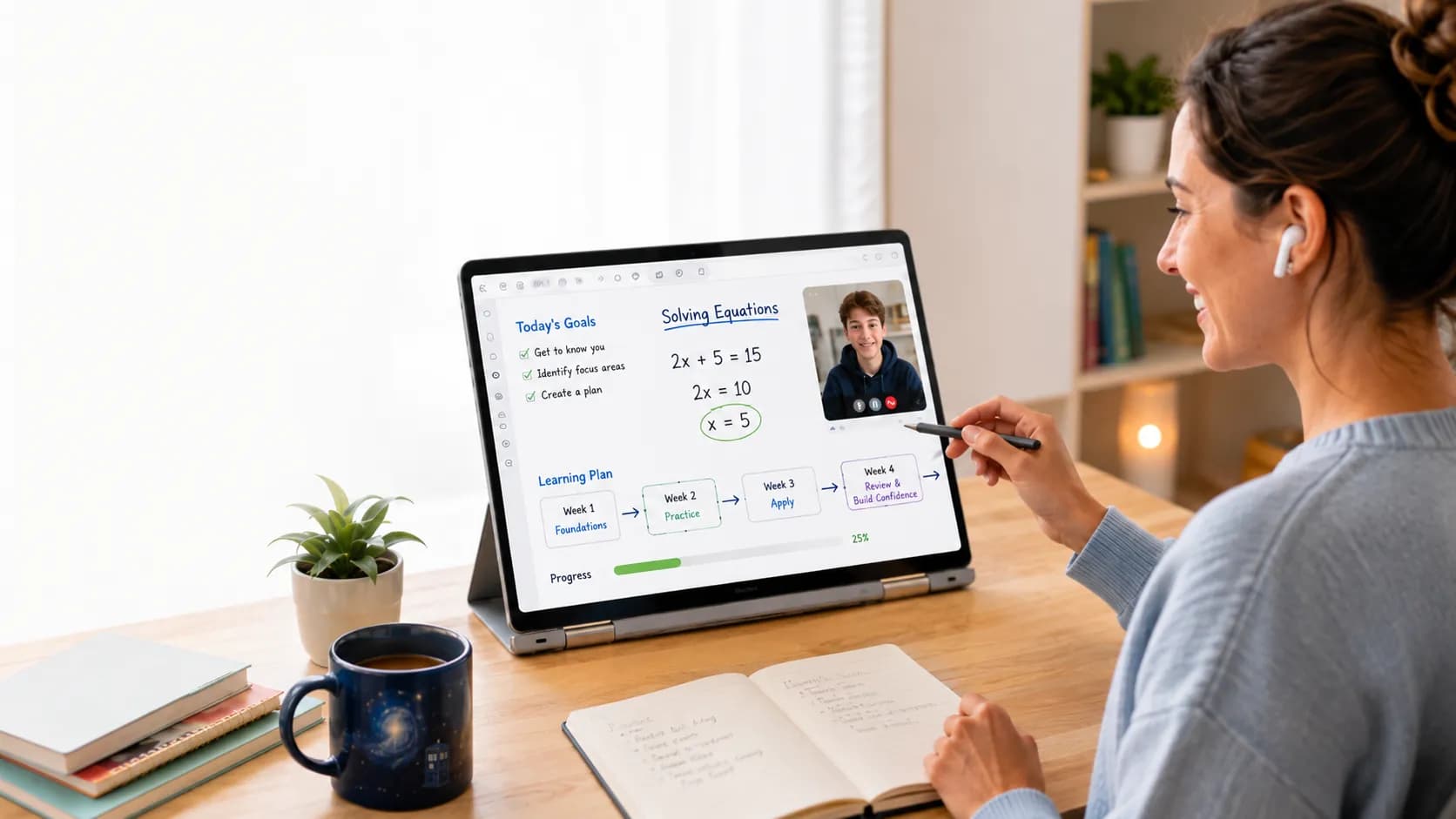
To start a tutoring business while working full-time, you need five things: one narrow offer you can sell fast, four to six protected evening hours, three paying students from the network you already have, admin that mostly runs itself, and a simple rule for deciding when to grow. Nothing on that list requires handing in your notice.
Spend ten minutes on tutoring forums like r/TutorsHelpingTutors and you will see the same questions on repeat: what should I charge, where do the first clients come from, and how do I fit any of this around a 9 to 5? This guide answers all three in order, as a launch plan you can run entirely after work.
Why a lean, after-hours launch works
Starting on the side is not the consolation-prize version of starting a tutoring business. It is the lower-risk version. Your salary covers the bills while you find out, with real bookings rather than optimism, whether families in your subject will pay your rate. If the answer is yes, you scale with proof. If it is slower than you hoped, you have lost some evenings, not your income.
The constraint is also a feature. Because you only have a few hours a week to sell, they are scarce, and scarce slots are easier to price with confidence than a wide-open calendar. The mindset shift that makes everything else work: treat your evening slots as premium inventory, not leftovers.
Step 1: Define a narrow offer you can sell fast
The biggest time sink for a new tutor is not teaching, it is preparing to teach too many things. Pick one syllabus you already know deeply, such as GCSE Maths or A-Level Biology, and turn it into a concrete promise: "I help Year 11 students go up a grade between mock and final exams" sells faster than "I tutor maths and science, all levels."
One syllabus means one set of materials, one exam board's past papers, and prep that compounds instead of scattering. It also makes the next step, finding students, dramatically easier, because a specific offer is easy for other people to repeat on your behalf.
On price: do not guess low out of nervousness. Our guide on how to price online tutoring sessions benchmarks 2026 rates by region, subject, and level, and the tutor earnings calculator shows what your four to six weekly hours translate to per month at a given rate. Run the numbers before your first enquiry, so the rate comes out steady when a parent asks.
Step 2: Ring-fence 4 to 6 prime tutoring hours
Look at your week and choose the evenings that survive contact with real life. Two blocks of two to three hours, say Tuesday and Thursday from 5pm to 8pm, beat scattered single hours: less context-switching for you, and recurring weekly slots that families can build a routine around. Our guide on how to create a tutoring timetable covers this in seven steps, including the buffers that stop lessons colliding with your commute.
Then stop being the scheduler. Set those blocks as your availability in Teamlilit and share your online booking page, and students pick an open slot themselves; the lesson lands on your timetable without a single back-and-forth message. For someone answering messages on lunch breaks, that is the difference between growing and stalling.
Connect Google Calendar and every tutoring lesson appears there automatically, alongside your day-job commitments, so a late meeting never silently collides with a booked lesson. One calendar to check, not two.
Step 3: Find your first 3 paying students quickly
Your first students will not come from a website. They will come from people who already know you: former students and their parents, colleagues with school-age children, neighbourhood and PTA groups, the languages or maths department you used to work in. Write one short message that states your offer from Step 1, who it is for, and that you have "two evening slots opening this month", and send it to that warm circle. Specific and scarce beats polished and vague.
Two tactics do the heavy lifting at this stage:
- Ask for the forward, not the sale. "Do you know one parent whose child has GCSE Maths next year?" is an easy favour; "would you like tutoring?" is a pitch.
- Offer a paid 30-minute diagnostic instead of a free trial. You assess the student, name the gaps, and outline a plan. Parents get real value, you get paid for your evening, and the students who book it are serious.
When the warm network is exhausted, our guide on how to get more tutoring students covers the next channels in order of effort.
Step 4: Systemise admin before you get busy
Admin is the silent killer of side-hustle tutoring. Teaching four evening hours is easy; doing it after invoicing, rescheduling, note-writing, and chasing payments has already eaten your evening is not. The fix is to set up tutoring business management software while you have three students, not to wait until ten students make the mess obvious. What that looks like in practice:
- Bookings confirm themselves. Your booking page fills the slots you ring-fenced in Step 2, and your recurring lesson timetable repeats weekly lessons automatically, so the timetable maintains itself term after term.
- Attendance becomes the invoice. Every session is recorded per student as it happens, and at the end of the month you invoice tutoring students in a couple of clicks: dates, hours, and rate pre-filled from what actually ran, emailed as a PDF before bedtime.
- Sell lesson packs that track themselves. Offer a prepaid pack of 5 or 10 lessons; each time you mark the student present, a credit comes off the pack automatically, and pack-covered lessons show as already paid on the bill. Upfront money, zero chasing.
- Let AI draft the after-lesson write-up. With AI lesson summaries, available on Pro and Academy plans, Teamlilit drafts a wrap-up from what you explained during the lesson, plus a set of practice exercises (five by default). You review and edit the draft, hit publish, and your students receive the recap and homework by email automatically. The same summary makes a ready-made progress update for parents; our guide on how to communicate with parents as a private tutor shows the rhythm that keeps families renewing.
The goal is simple: your evening hours go to teaching, and the paperwork happens as a by-product of the lesson instead of a second shift after it. Once the side hustle starts behaving like a business, the questions change from "where is that lesson note?" to "what is an hour worth and how many can I sell?"; our guide to running a tutoring business end to end covers that money and capacity side, including what changes the day you add a second tutor.
Step 5: Grow only when the numbers tell you
Set one threshold before emotions get involved: the monthly tutoring income that would cover your essential bills. When your tutoring has cleared that bar for three consecutive months, with invoices actually paid rather than promised, you have earned the right to a bigger decision about the day job. Until then, the day job funds the experiment. Your invoice list already shows paid, partly paid, and overdue per family, so the "did we really hit it?" check takes a minute, and our guide on how tutors can track billable hours covers keeping the hours themselves honest.
Growth inside your fixed hours comes from composition, not more evenings. Tag your students by cohort, such as "GCSE 2027" or "A-Level Chemistry", and watch which tags fill fastest: that is where demand is telling you to expand. The highest-leverage move is usually a small group revision class in one of your existing slots, booked through the same page: three students at a group rate out-earns one at your solo rate, in the same hour.
The after-hours tutoring toolkit
You do not need to buy anything to run the first month. These free tools cover the launch, and each one is a piece of the system Step 4 eventually consolidates:
- Free tutor timetable template to plan your ring-fenced blocks
- Lesson-notes template so every session leaves a record from day one
- Tutor earnings calculator to sanity-check your rate and monthly target
- Free invoice maker for professional PDF invoices before you automate billing
- Cancellation policy generator to set the rules while you still have zero awkward cases
When juggling the separate pieces becomes the bottleneck, that is the signal you have outgrown them, and the scheduling, notes, billing, and student records move into one system.
Common roadblocks and quick fixes
- No-shows eat your scarcest asset. An empty booked slot costs a side-hustle tutor proportionally more than anyone else. Prepaid lesson packs mostly solve it, and a clear written policy handles the rest; our guide on how to reduce student no-shows has the full playbook.
- Prep time spirals. If you spend 45 minutes preparing for every paid hour, your real rate just halved. Stay inside your one syllabus, reuse materials across students, and let the AI-drafted exercises from your wrap-ups become next lesson's homework instead of building worksheets from scratch.
- Employer conflict. If your contract or profession restricts you, tutor a different age group, subject, or exam board than your day job touches, and keep the two worlds cleanly apart. When in doubt, ask; a two-line email to HR beats a grey area.
Your first 30 days
Frequently asked questions
Can I legally tutor while employed full-time?
In most cases, yes. Check your employment contract first: some include exclusivity or conflict-of-interest clauses, and teachers are often restricted from privately tutoring students of their own school. Keep tutoring clearly separate from your day job, and declare the extra income. In the UK, that means registering for Self Assessment once your tutoring income passes the £1,000 trading allowance.
Do I need tutoring insurance from day one?
It is rarely a legal requirement, but professional indemnity and public liability cover are advisable and inexpensive, with low-cost monthly policies widely available. If you teach children, follow the safeguarding norms parents expect: a verifiable identity, session records, and in the UK an up-to-date DBS check, which helps you win clients even where it is not mandatory.
How quickly can I raise my hourly rate?
As soon as you have proof: improved marks, testimonials, or a full calendar. A practical rule is to review your rate after your first ten paying students. Apply the new rate to new enquiries first, keep existing families at their current rate until the end of term, and let demand tell you when the next increase is due.
Start small, start tonight
You do not need to quit anything to start a tutoring business. You need one specific offer, two protected evenings, three paying students, and admin that runs itself while you are at work. The first three are yours to do this week.
Ready to reclaim your evenings? Start a free 14-day trial, set your availability, and share your booking link with your first family tonight. No credit card required.
Sources
- Set up as a sole trader - GOV.UK. When and how to register as self-employed in the UK, supporting the Self Assessment note.
- Tax-free allowances on property and trading income - GOV.UK. The £1,000 trading allowance threshold referenced in the legal FAQ.