It is Sunday evening. Six lessons with a student sit behind you, a parent has asked how things are going, and the cursor is blinking in an empty box. You know the student has improved. Turning that into a sentence that sounds like evidence rather than reassurance is the part that takes forty minutes.
This is a writing clinic rather than a template. Below are ten progress reports written out in full for the situations tutors actually face, plus the rewrites that turn a vague comment into one a parent can do something with.
Need wording for one specific situation? Jump straight to strong progress, a student who is struggling, inconsistent homework, confidence up but the grade flat, exam preparation, a younger student, GCSE and A Level, language tutoring, missed lessons or the end of term report.
The six parts of a report parents actually use
Every good progress report, whatever the subject or the age of the student, answers the same six questions. Most weak reports answer two of them.
| Part | The question you are answering | Weak | Stronger |
|---|---|---|---|
| What we worked on | Which specific skill or topic? | "We did maths." | "Solving linear equations, and translating word problems into equations." |
| Progress observed | What can they do now? | "She improved." | "She isolates the variable without being prompted." |
| Evidence | What did you actually see? | "She understands it." | "She solved 7 of 8 practice equations unaided." |
| Area to improve | What is still unreliable? | "Needs more practice." | "Negative signs still cause errors when expanding brackets." |
| Next step | What will tutoring do about it? | "Keep working on algebra." | "Multi-step equations, then exam-style word problems." |
| Message for the family | One useful thing at home? | "She needs to study more." | "Two short equation sets between lessons, ten minutes at a time." |
Read down the right-hand column and you have a complete report. Read down the left and you have the version most parents receive, which is part of why so many of them fall back on the school grade as the only progress instrument they trust.
Describe what the student did, not what the student is
This is the single rule that lifts a report above the comment-bank average. A label cannot be checked, argued with or acted on. An observation can be all three.
Instead of "Daniel is careless", write:
Daniel used the correct method on all six questions but lost three marks to sign and arithmetic slips.
Instead of "Maya is unmotivated", write:
Maya completed one of the last four homework tasks, so we have had fewer chances to consolidate the material between lessons.
Instead of "Leo lacks confidence", write:
Leo now attempts unfamiliar questions before asking for help and explains his reasoning more often, although this has not yet shown up in his timed-paper scores.
Each rewrite does the same three things: it replaces a character judgement with something you watched happen, it makes the problem small enough to fix, and it hands you the next lesson plan for free.
The other half of the rule is conditions. "Solved 7 of 8" means very different things depending on whether the student was working alone, being prompted, working against the clock or looking at their notes. Say which. A report that states the conditions is doing assessment; a report that leaves them out is doing marketing.
Turn vague comments into ones a parent can act on
Six comments most tutors have written at some point, and the version that survives contact with a parent who wants specifics.
Ten tutor progress report examples
Not sure which one to start from? Answer five questions about the report you are about to write.
These are model reports, written to be adapted rather than copied. Each one takes about ten minutes to write when your lesson notes exist, and is close to impossible to write when they do not.
Strong progress
The temptation here is praise, and praise is the least informative thing you can send. A parent already suspects things are going well. What they cannot see is what specifically changed.
This month we focused on solving linear equations, including equations with brackets. Sarah is now completing most one and two-step equations independently rather than waiting for me to start the method. In this week's practice she solved 7 of 8 questions correctly, and the only error came from a negative sign when expanding brackets. Next we move into equations from word problems, so she can apply the method when the equation is not already written for her. A very solid month.
It says what changed, gives one concrete piece of evidence, admits the remaining weakness, then explains what happens next. The admission is what makes the praise land.
A student who is struggling
The temptation here is the opposite: softening the message until nothing is left in it. "We are continuing to work hard and I am sure things will improve" tells a parent nothing and buys you one month before the same conversation returns with less goodwill.
We have been working on adding and subtracting fractions with unlike denominators. Noah can identify the correct operation and completes the calculation accurately when the common denominator is given, but he is not yet choosing that denominator reliably on his own. In our latest independent set he got 3 of 8 correct, and most of the errors happened before the calculation itself. For the next few lessons I am slowing the sequence down and focusing on equivalent fractions before we return to mixed questions.
Nothing there describes Noah as a weak student. It describes one step in a process that is not yet automatic, which is both more accurate and more fixable.
Inconsistent homework
This is where progress reports most often turn into disciplinary letters, and the moment they do, the rest of the report stops being read.
Lina completed two of the five practice tasks set during this period. In lessons she can usually reproduce the method after a short review, but we are now spending part of each session rebuilding skills that would normally be consolidated between lessons. For the next two weeks I am reducing homework to two ten-minute exercises rather than one longer worksheet. The goal for now is consistency rather than volume.
The last two sentences are the ones that matter. You have reported a problem and, in the same breath, changed something in response to it. That reads as a tutor in command of the situation rather than a tutor complaining.
Confidence has improved but the grade has not
Worth keeping in your rotation, because it is the tension parents notice first and mention last.
Ethan is much more willing to attempt unfamiliar questions than he was at the start of term. He now begins most questions without waiting for a prompt and explains his method aloud even when he is unsure. His latest mixed-topic paper was 43 percent, so the change in approach has not yet produced the change in grade we want. The marks are currently going on multi-step algebra and ratio questions, which is where the next month will focus.
Never send the word "confidence" on its own. Name the behaviour that made you believe it: attempting without prompting, asking a question instead of going quiet, correcting an error unaided, carrying on after a wrong answer. Those are observations. Confidence is an inference you drew from them.
A grade that lags behind real improvement is normal rather than a warning sign, and it deserves its own explanation to the family. Our guide to the grade gap covers why the report card moves last and how to have that conversation before a parent starts it.
Exam preparation
For exam students the report should become diagnostic. Parents want one question answered, and it is not "how is he getting on".
This month we completed three timed GCSE Maths sections and reviewed the errors by topic. Maya's raw scores were 54 percent, 61 percent and 64 percent, with the clearest improvement in algebra and graphs. Probability is still inconsistent, particularly questions that combine several pieces of information, and timing remains tight in the final ten minutes. The next three sessions will prioritise probability, higher-tariff mixed questions and timed finishing practice.
A younger student
With younger students the evidence gets simpler and more concrete, not vaguer.
This month Leo has been practising reading unfamiliar words without guessing from the first letter. In our latest reading activity he decoded 18 of 20 target words correctly and self-corrected two mistakes after rereading. Longer words with several syllables are still hard, so next month we will practise breaking them into parts before blending them. At home, five minutes of reading aloud a few times a week is plenty to reinforce this.
Note the size of the ask at the end. One small, specific, genuinely achievable action beats a home-learning programme the family will abandon in week two and then feel guilty about.
GCSE and A Level tutoring
At this level the useful report is about mark-scheme behaviour, not about a working grade.
Aisha's analytical paragraphs are becoming much more focused. She now selects relevant quotations independently and usually identifies the writer's technique accurately. In her latest timed response the marks were lost because the analysis stopped at identifying the technique rather than developing its effect and linking it back to the question. Our next target is three fully developed analytical paragraphs within the time limit.
And for A Level, where the gap is almost always evaluation rather than knowledge:
Tom's subject knowledge is secure. His essays are currently stronger on explanation than on evaluation: in the last two timed essays he used appropriate evidence throughout but presented competing arguments separately rather than weighing them against each other. Over the next three sessions we will work on evaluative paragraph structure and on finishing judgement paragraphs under timed conditions.
"Tom is currently working at a B" tells a parent where he is. Neither paragraph above mentions a grade, and both tell the parent considerably more.
Language tutoring
Language progress is badly served by "beginner, intermediate, advanced", because none of those words describe anything the learner can do. Report communicative ability instead.
Sofia is becoming more comfortable speaking Spanish without preparing every sentence first. She can now describe recent events for around two minutes and ask simple follow-up questions during conversation. Past-tense verb endings are still inconsistent, especially when she switches between regular and irregular verbs. Next month we keep the conversation practice and add short retelling exercises, so she uses the past tense more accurately while speaking spontaneously.
Or for a receptive skill:
Karim can now understand the main point of short B1-level listening passages on familiar subjects and usually picks out key details on a second listen. Fast connected speech is still difficult, particularly when the speaker uses unfamiliar vocabulary. Our next focus is listening for meaning without trying to translate every word.
A student who misses lessons
Attendance facts and moral judgements are not the same thing, and the report should contain only one of them.
Oliver attended four of the six lessons planned this period. When lessons have been regular he has shown better accuracy with simultaneous equations, but the gaps have made momentum hard to maintain and there is not yet enough comparable practice to judge progress confidently. We will review the missed material at the start of the next session and then return to the original plan. More consistent attendance would make it easier to build on each lesson rather than revisiting earlier work.
"Missed three sessions" is evidence. "Does not take tutoring seriously" is speculation about a family you see for one hour a week. Report the first, and report what effect it had on the learning.
The end of term report
The longest report you will write, because it has to show an arc rather than a snapshot.
During the spring term we focused on algebra, ratio, percentages and multi-step problem solving. At the start of term Ella often needed a prompt to choose a method and was particularly unsure when a question combined more than one topic. She now starts most algebra and percentage questions independently, and her accuracy on our mixed practice sets has gone from roughly half correct to around three quarters correct under the same conditions.
The strongest improvement has been in algebraic manipulation and percentage change. Ratio questions with unfamiliar wording still take her too long, and she sometimes abandons a correct method after an arithmetic slip. We will open next term with ratio and mixed problem solving before increasing the amount of timed exam practice.
Ella has also become much more willing to check an answer and explain where an error came from, rather than asking straight away for the solution. Keeping up short practice tasks over the break will protect that. Overall she finishes the term considerably more independent than she began it, with a clear set of priorities for the next stage.
Read it against the six parts and every one is there: worked on, progress, evidence, remaining gap, next step, and one thing for the family. That is the whole method, applied at term length.
Stuck on one sentence?
Sometimes you know exactly what happened and only need a way into the sentence. Pick the situation and adapt a line.
How much evidence is enough
One observation per claim. That is the whole rule, and it is less work than it sounds, because a good report only makes two or three claims.
What counts as an observation is anything you could describe to a stranger without using an adjective: a count ("7 of 8"), a change in conditions ("unprompted, three sessions running"), a specific error ("loses the sign on the second term"), a self-correction, a time ("finished the paper with four minutes spare, first time this term"). What does not count is a summary of your impression, however sincere.
This is also why progress reporting works better as a repeated measurement than as an occasional verdict. The National Center on Intensive Intervention describes progress monitoring as collecting evidence repeatedly against a student's goal and using the resulting pattern to decide whether the current approach continues or changes (1). The pattern is the point. A single data point is a mood; four across a term is a trend you can report and act on.
The same logic runs through the Education Endowment Foundation's work on feedback, which is at its most useful when it identifies the specific misconception and redirects the learner's next effort, rather than when it delivers a verdict on how the learner is doing overall (2). A progress report is feedback with an audience of two, so it should behave the same way: specific, forward-looking, and about the work rather than about the person.
What not to write
- Fixed labels. "Lazy", "careless", "unmotivated", "not a maths person". They cannot be disproved, they are remembered long after the report is filed, and they describe a personality rather than a skill.
- Unsupported praise. "Excellent progress" with nothing underneath it reads as filler at best and as sales copy at worst.
- A score with no context. "Scored 68 percent" means nothing until you say what was tested, how long they had, and whether they were working alone.
- A practice percentage converted into a final grade. Grade boundaries are set after papers are marked and shift year to year with the difficulty of the paper (3), so the conversion you are making is a guess wearing a number.
- A home-learning programme. One thing, small and specific. Anything longer transfers your job to a parent who has not been trained to do it and will feel bad about not doing it.
- Personal information you do not need. Keep the report about learning. Under UK data protection rules, personal data should be adequate, relevant and limited to what is necessary for the purpose it is used for (4), and a report explaining academic progress rarely needs unrelated family, medical or household detail in it. If you are unsure what belongs in a student file at all, our guide to what student records private tutors should keep covers the boundaries.
From lesson notes to the report
Here is the uncomfortable truth about report day. If writing the report is hard, the problem is almost never your writing. It is that you are trying to reconstruct eight weeks of teaching from memory, a calendar and a chat thread, at nine o'clock on a Sunday.
A report should be assembled, not composed.
The note you write after a lesson does a different job from the report you send a parent. The note captures one session for you: topic, what was covered, what they understood, where they got stuck, homework, next focus. The report reads several of those back and describes the pattern. If you are starting from scratch, our free tutoring lesson notes template gives you the fields, and the guide on keeping lesson notes for tutoring students covers the habit that makes them worth keeping.
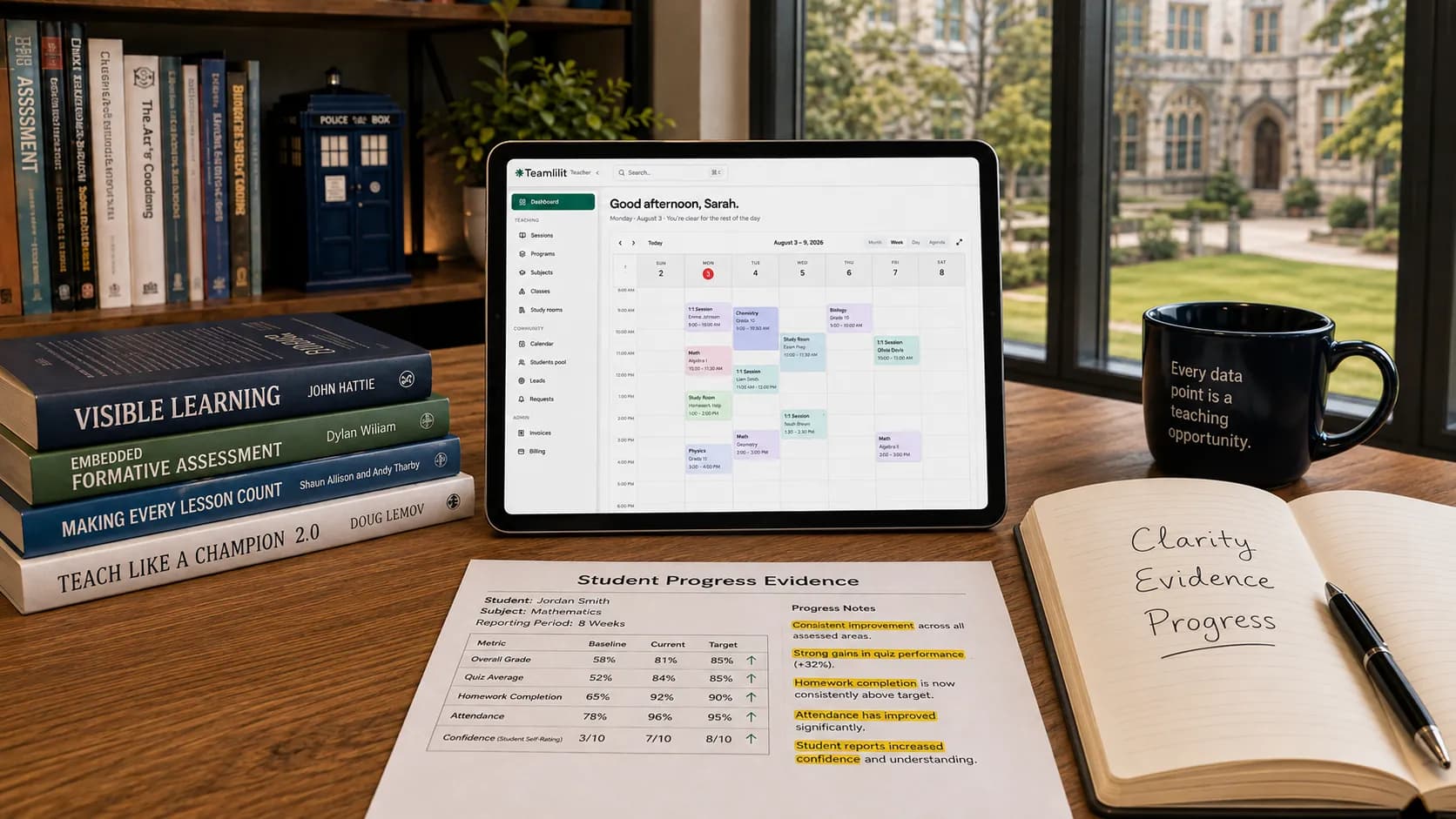
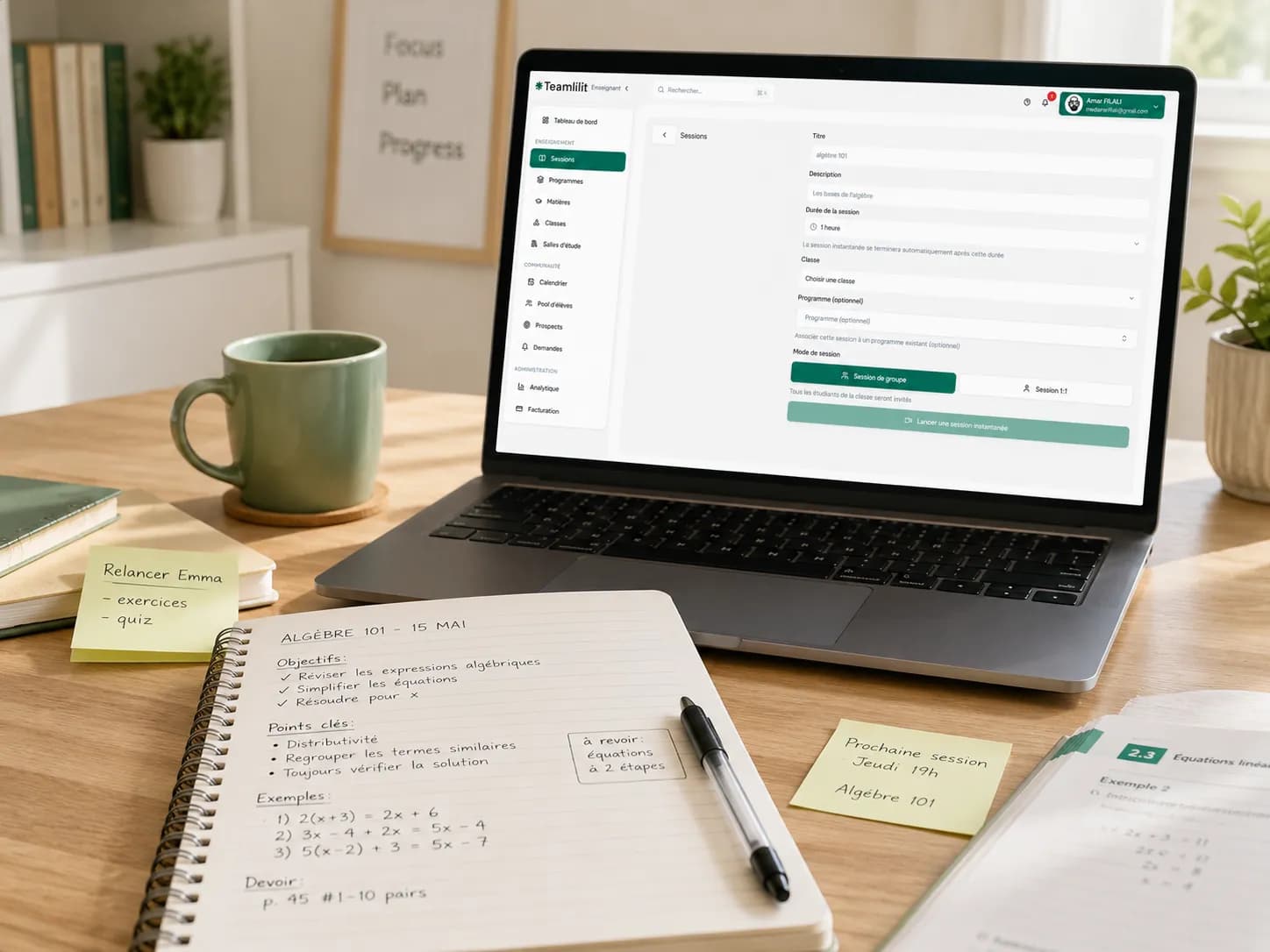
If report day still means matching notes to a separate register and searching old homework messages, keep lesson evidence, attendance and student history together. In Teamlilit, dated session notes sit with the student's lessons and attendance. Record the work attempted and the next practice task there, then use that history to write your report from specific examples.
Before you send it
Frequently asked questions
What should a tutor write in a progress report for parents?
Six things, in this order: the specific skill or topic you worked on, what the student can now do, one observation that proves it, what is still unreliable, what the next lessons will cover, and one small thing the family can do. The third item is the one most reports skip, and it is the one that makes the other five believable. Write what the student did rather than what the student is like, because an observation can be checked and a label cannot.
How do you write a progress report for a struggling student?
Say what is difficult, then narrow it to the exact step that is failing. "Noah is struggling with fractions" gives a parent nothing to hold on to. "Noah can complete the calculation when the common denominator is given, but is not yet choosing that denominator himself" names a specific, fixable barrier and implies the next lesson. Follow it with what you are changing in response, so the report reads as a plan rather than a verdict.
How do you report progress when the grade has not improved?
Report the things that move before a grade does: independence, accuracy, self-correction, strategy choice, how the student explains their reasoning, and performance on comparable tasks. Say plainly that the grade has not changed yet, then name the marks still being lost and what the next sessions will do about them. A grade averages weeks of work, much of it produced before tutoring began, so it is usually the last measure to move.
How long should a tutoring progress report be?
Long enough to carry evidence, short enough to be read. For a monthly update, two or three sentences per section and around 200 words in total is usually right. An end of term report earns more length, perhaps 300 to 400 words, because it has to show the arc of a whole term rather than the last few lessons. Length is not the quality signal: a 200-word report with one concrete observation beats a 600-word one made of adjectives.
Should tutors write a progress report after every lesson?
No. A lesson note and a progress report do different jobs. A note records one session and is written for you; a report summarises a pattern across several sessions and is written for the family. Writing a full report weekly produces reports with nothing new in them, because a pattern needs several observations before it exists. Keep a short note after every lesson, then build the report from those notes at whatever interval suits the arrangement.
What makes an end of term report different from a monthly update?
An end of term report has to show the arc. A monthly update answers what changed since last month. A term report answers where this student started, where they are now, and what the next term should do about it. That means an explicit comparison with the starting point, the topics covered across the whole term rather than the last few weeks, and a stated priority for the next block of lessons. It is also the report families read before deciding whether to continue, so the comparison matters more than the detail.
Should a tutor progress report mention homework and attendance?
Yes, but as evidence rather than as a complaint. Give the numbers, such as completed two of five practice tasks or attended five of eight sessions, then say what effect that had on the learning: topics interrupted, methods slower to become automatic, not enough comparable practice to judge progress. Follow it with what you are changing in response. Reported that way it is information a family can act on. Reported as a judgement about effort, it turns a progress report into a disciplinary letter and the rest of it stops being read.
How do you write a GCSE or A Level progress report?
Report against the mark scheme rather than against a predicted grade. Name the raw score, the paper it came from, the question types where marks were lost and whether timing was a factor, then say what the remaining sessions will target. Avoid turning a single practice percentage into a final grade: grade boundaries are set once papers are marked and vary year to year with the difficulty of the paper, so "64 percent, up from 54 percent on a comparable timed paper, with most marks lost in probability" is both more honest and more useful than "she is a grade 7 now".
The report is the easy part
Every example on this page is short. None of them took long to write. What they have in common is that the person writing them already knew what happened in lesson three, because they wrote it down in lesson three.
So the way to make progress reports painless is not a better template. It is a sentence after each lesson naming what the student did and under what conditions. Do that, and report day becomes reading rather than remembering.
When you are ready to write one, the free tutor progress report template turns your notes into a parent-ready document, and the parent update generator handles the shorter monthly email between formal reports. For the wider rhythm of what to send and when, see our guide to communicating with parents as a private tutor.
Sources
- Progress Monitoring - National Center on Intensive Intervention. Progress monitoring collects evidence repeatedly against a student's goal, and the resulting pattern is what tells you whether to continue or change the approach.
- Feedback - Education Endowment Foundation Teaching and Learning Toolkit. Feedback is information about performance relative to a learning goal, and it works by redirecting the learner's next effort rather than by delivering a verdict.
- How GCSE and A level grading works: teachers' and headteachers' guide - Ofqual, GOV.UK. Grade boundaries are set once marking is complete and vary year on year to reflect fairly any changes in how difficult the paper is.
- Principle (c): Data minimisation - Information Commissioner's Office. Personal data must be adequate, relevant and limited to what is necessary for the purpose it is processed for.
- The CEFR Levels - Council of Europe. The six levels A1 to C2 are defined through illustrative "can do" descriptors rather than through labels.
Want the evidence written before report day arrives? Start a free 14-day trial. No credit card required.